






Greta vs Lovable: Which AI App Builder Wins in 2026?
TL;DR
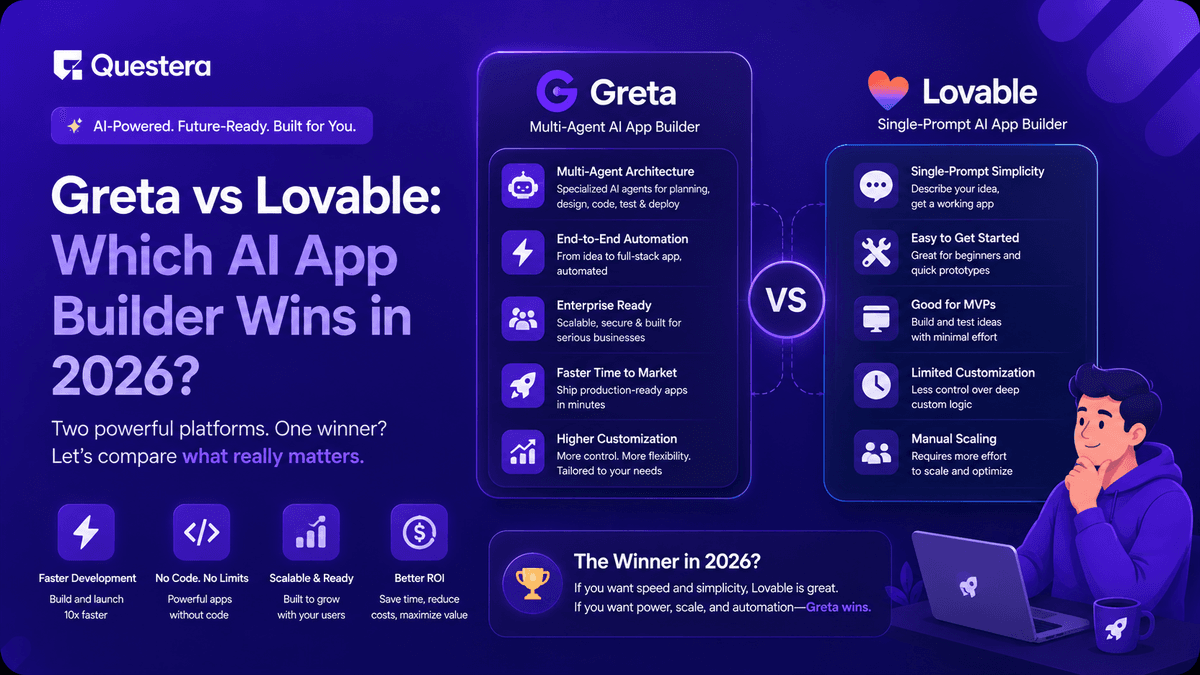
Greta vs Lovable comes down to two different bets. Lovable optimizes for design-led React/Supabase apps with multi-mode editing (Agent, Visual Edits, Plan) and credit-based pricing starting at $25/month. Greta optimizes for end-to-end SaaS builds with built-in growth tooling — domain, SEO, analytics — bundled in the platform. Lovable wins for designers and product managers iterating on prototypes; Greta wins for solo founders shipping a full SaaS plus its marketing stack.
Introduction
The AI app builder market has two breakout players for non-developers in 2026: Greta and Lovable. Both let you describe an app in plain English and ship a working full-stack product. Both bundle frontend, backend, auth, and deployment. But pick the wrong one for your use case and you'll either burn credits debugging or miss tooling you needed from day one.
This guide breaks down Greta vs Lovable in detail — architecture, pricing, code quality, design output, and the kinds of builders each one fits. If you're trying to pick between them for your next build, by the end of this post you'll know exactly which one wins for you.
What is the core difference between Greta and Lovable?
The core difference between Greta and Lovable is what each platform optimizes for. Lovable optimizes for fast prototyping and iteration on React-based web apps, with a multi-mode editing experience (Agent Mode, Visual Edits, Plan Mode) that lets you switch between conversational prompts and direct visual tweaks. Greta optimizes for the full founder workflow — building the app and the marketing stack around it in one place.
In practice, this changes how each platform feels. With Lovable, you describe the app, the AI generates a React + Tailwind + Supabase build, and you iterate through a mix of prompts and visual edits. With Greta, you describe the app and the platform also handles your custom domain, search ranking basics, analytics, and growth tooling out of the box. Neither is strictly better — they fit different builders.
According to a 2026 Lovable usage breakdown, the platform serves around 8M vibe coders globally, while Greta has gained traction with solo founders who want bundled marketing infrastructure rather than a separate stack of tools. The volume difference reflects different positioning, not a quality gap.
How does Lovable's multi-mode editing actually work?
Lovable's standout feature is its three editing modes. Each mode fits a different type of task, and you move between them fluidly during a build.
The three modes
Agent Mode provides autonomous AI development with independent codebase exploration, proactive debugging, real-time web search, and automated problem-solving. Visual Edits lets you click on elements and tweak them directly — no credits consumed for basic text and styling changes. Plan Mode lets you map out features before you ask the agent to build them. The combination produces a more controlled experience than pure prompt-driven platforms.
Build this with a prompt on Greta.sh — describe the app, Greta writes and deploys it.Stack and architecture
Lovable's apps are built on a fixed stack: React for the interface, Tailwind CSS for styling, and Supabase for backend services like authentication, database, and storage. This is great for predictability — every Lovable app looks structurally similar under the hood — but it's a constraint if you want a different stack.
How does Greta's unified flow compare?
Greta runs as a unified vibe coding platform where one agent handles design, logic, database, and deployment together. Its own positioning emphasizes that Greta builds everything — design, logic, database, and full deployment at once. The result is tighter coupling between what you see and what's underneath, with growth tooling bundled into the same interface.
Where Lovable separates the build from marketing concerns, Greta bundles them. Custom domains, basic SEO setup, analytics, and content management live inside the same workspace. For solo founders trying to ship a SaaS plus its landing page plus its growth stack in one weekend, this is a meaningful time-saver. For PMs and designers building prototypes, it's tooling they don't need.
Greta vs Lovable: feature-by-feature comparison
Here's how the two platforms compare across the dimensions that matter most to non-developers and small teams in 2026.
| Feature | Greta | Lovable |
|---|---|---|
| Architecture | Unified single-agent flow | Multi-mode (Agent, Visual Edits, Plan) |
| Tech Stack | Flexible (Supabase, MongoDB, AWS) | Fixed (React + Tailwind + Supabase) |
| Best For | Solo founders, full SaaS + growth | Designers, PMs, React-based prototypes |
| UI Quality | High — design and logic built together | High — strong React + Tailwind output |
| Growth Tooling | Built-in (domain, SEO, analytics) | Separate — focus on app generation |
| Visual Editing | Conversational + template-based | Dedicated Visual Edits mode |
| Pricing Model | Subscription with included build capacity | Credit-based, $25/month Pro |
| Code Export / GitHub | Yes | Yes — GitHub sync built in |
| AI Models | Multi-model (Claude, OpenAI, Deepseek) | Gemini Flash default, switchable |
| Free Tier | Yes | Yes — 5 daily credits, 30/month max |
The pattern: Lovable wins on dedicated editing modes and React workflow polish. Greta wins on bundled growth tooling and stack flexibility.
Which one ships better-looking apps?
Both platforms produce high-quality UI on the first prompt — better than most competitors. The difference is in workflow.
Lovable's Visual Edits mode lets you tweak design elements directly without consuming credits for simple changes, which makes design iteration cheap. The fixed React + Tailwind stack also means the visual output is consistent and predictable across projects. For designers and product managers used to working visually, this is a big advantage.
Greta's design comes from the same unified agent that handles logic, which produces cohesive first-pass output but less granular visual control mid-build. For founders who care more about shipping a polished v1 quickly than tweaking pixels, Greta's approach is faster. For builders who want precise design control through every iteration, Lovable's Visual Edits has the edge.
For landing pages specifically — which most founders need alongside the app — both platforms work well. Our deeper guide on AI Prompts for Building Landing Pages covers the layered prompting techniques that get the best output from either tool.
Greta vs Lovable: pricing and credit consumption
Pricing structures differ meaningfully and affect what you can realistically ship on each platform.
Lovable uses a credit-based model. Lovable.dev costs $25/month for 100 credits, and $50/month if you want security features like SSO and a data opt-out option. The free plan gives you 5 daily credits that max out at 30 per month. Each prompt consumes credits based on complexity — a simple UI change costs roughly 0.50 credits, a component removal about 0.90, and a complex feature like authentication around 1.20 credits.
Greta offers a free tier and subscription plans with bundled capacity, with an AppSumo lifetime deal occasionally available for solo founders.
Credit predictability is one of Lovable's reported weaknesses. Many users report that debugging consumes a large number of credits — if the AI repeatedly attempts to fix the same error, the credit cost can increase significantly. Pricing can become unpredictable for complex projects.
Greta's growth tooling is bundled — domain setup, basic SEO, and analytics are included rather than being separate concerns. For founders shipping a single SaaS MVP on a tight budget, Greta's pricing tends to be more predictable. For designers and PMs prototyping multiple ideas where credit costs scale with experimentation, Lovable's model is workable but requires careful prompt discipline.
Want to try one of these? Start on Greta.sh — no setup, no boilerplate — just a prompt.Who is each platform actually built for?
The clearest way to pick between Greta and Lovable is to match the platform to your role and what you're shipping.
- Pick Lovable if you're a designer, PM, or technical founder who wants direct visual control during iteration and is comfortable with the React + Tailwind + Supabase stack.
- Pick Lovable if you're prototyping multiple ideas and want a strong free tier to test concepts before committing.
- Pick Greta if you're a solo founder shipping a SaaS plus its landing page plus its growth stack and want everything in one workspace.
- Pick Greta if you want predictable pricing without credit anxiety, especially during heavy iteration cycles.
- Pick Lovable if you'll export to GitHub regularly and want fine-grained edit modes (Agent, Visual, Plan) for different parts of the build.
- Pick Greta if you want stack flexibility — multiple AI model options and backend choices (Supabase, MongoDB, AWS).
Both platforms are credible and shipping real apps. The choice is about fit, not which is "better" in absolute terms.
How do Greta and Lovable compare to other AI app builders?
The 2026 AI app builder landscape has narrowed to a few credible players: Greta, Lovable, Emergent, Bolt, Replit Agent, and Cursor. Each optimizes for a different builder.
- Greta vs Emergent — Greta is unified single-agent with growth tooling; Emergent is multi-agent for complex full-stack builds. We cover this in detail in our breakdown of Greta vs Emergent.
- Lovable vs Bolt — Both are credit-based and React-focused, but Bolt is more web-first and faster for quick prototypes; Lovable has stronger multi-mode editing.
- Lovable vs Cursor — Cursor is for builders who want to read and edit code directly; Lovable abstracts code away.
- Greta vs Replit Agent — Greta is non-developer-friendly; Replit Agent assumes more technical comfort and gives more code-level control.
If you're new to the category and want a broader playbook, our guide on how to Build a SaaS App in 2026 without writing code covers the full workflow across any of these platforms.
Which platform is better for specific app types?
Different app types fit different platforms. Here's where each tends to win.
- SaaS MVPs with a marketing site → Greta. Bundled growth tooling saves time.
- React-based dashboards and admin panels → Lovable. Native to its stack.
- Apps with heavy design iteration → Lovable. Visual Edits mode keeps costs down.
- Solo founder side projects → Greta. Predictable pricing, all-in-one.
- Client work for agencies → Lovable. Familiar React + Supabase, easy GitHub export.
- AI-powered apps with custom backend logic → Either, but Greta's stack flexibility wins for non-Supabase backends.
For specific use cases, our walkthroughs on how to Build a Fitness Tracking App using prompts and our list of profitable AI app ideas cover examples that work well on either platform.
Common Mistakes to Avoid
- Picking the platform before defining the app — Both Greta and Lovable are capable. The right pick depends on whether you're shipping a full SaaS + marketing stack or iterating on a React prototype.
- Underestimating Lovable credit consumption — Debugging cycles can burn through credits unpredictably. Budget a credit buffer beyond your plan cost, or use Visual Edits mode for design tweaks to save credits.
- Expecting one-prompt perfection on either platform — Both work best with iterative prompting. Real builds take 10–50 prompts. Use a structured approach like our Ultimate Prompt Library for AI App Builders to keep iteration costs down.
- Not testing the free tier first — Both platforms have free tiers. Run a small test build on each before committing to a subscription.
- Ignoring the stack constraint — Lovable's React + Tailwind + Supabase stack is great for most apps but limiting if you need a different backend. Check the stack matches your needs before subscribing.
- Comparing on sticker price alone — A $25/month Lovable plan can cost more in practice than a $30/month Greta plan once credit top-ups, hosting add-ons, and AI usage are factored in.
Frequently Asked Questions
Ready to ship? Open Greta.sh — your idea → a working app, in one chat.1. Is Greta or Lovable better for non-developers?
Both are non-developer-friendly. Greta is easier if you want bundled growth tooling and predictable pricing. Lovable is easier if you want dedicated visual editing modes and are comfortable with the React stack. The free tier on each is the best way to find out which feels right for you.
2. Can both Greta and Lovable build full-stack apps?
Yes — both platforms handle frontend, backend, database, auth, and deployment. Lovable's apps run on React + Tailwind + Supabase by default. Greta supports a broader stack including Supabase, MongoDB, and AWS-based backends.
3. Which one has better pricing for solo founders?
For predictable monthly costs without credit anxiety, Greta tends to be cheaper in practice because growth tooling is bundled. For low-cost prototyping across multiple ideas, Lovable's $25/month Pro tier is competitive — but watch for credit burn during debugging.
4. Which platform produces better-looking apps?
Both produce strong UI on first pass. Lovable's Visual Edits mode gives more granular design control during iteration. Greta's unified agent produces more cohesive first-pass output. Designers tend to prefer Lovable; founders prioritizing shipping speed tend to prefer Greta.
5. Can I export the code from Greta and Lovable?
Yes — both platforms support GitHub export of real, working codebases. This means you're not locked into either platform and can scale your app with developers later if needed.
6. Which is better for building a SaaS plus its landing page?
Greta has the edge here because its growth tooling — custom domains, basic SEO, analytics — is bundled into the same workspace. Lovable can build a great landing page too, but you'll typically wire up domain and analytics separately.
7. Are AI app builders like these going to replace developers?
Not entirely. They automate boilerplate and shrink the on-ramp for non-developers, but senior engineering, complex systems, and production reliability still need human expertise. We cover this in detail in our piece on whether Vibe Coding is the End of Software Engineering Jobs.
Conclusion
- Greta vs Lovable isn't about which platform is better — it's about which fits your build. Lovable wins for designers and PMs iterating on React-based prototypes. Greta wins for solo founders shipping a full SaaS plus its marketing infrastructure.
- Pricing models matter more than sticker price. Lovable's credit-based pricing can burn unpredictably during debugging, while Greta's bundled tooling reduces add-on costs.
- Both platforms produce high-quality first-pass UI and support real code export. Neither locks you in long-term.
- For most solo non-developer founders shipping their first SaaS in 2026, Greta is the faster path because growth tooling is built in. For designers, PMs, or teams comfortable in the React + Supabase world, Lovable is the better fit.
Pick the platform that matches your build, not the headlines. Either way, the bar to ship is now lower than it has ever been — the only thing stopping your next launch is which one you choose tonight.





© 2026 Questera
Follow in Google