






Is Vibe Coding the End of Software Engineering Jobs? (Honest Take)
TL;DR
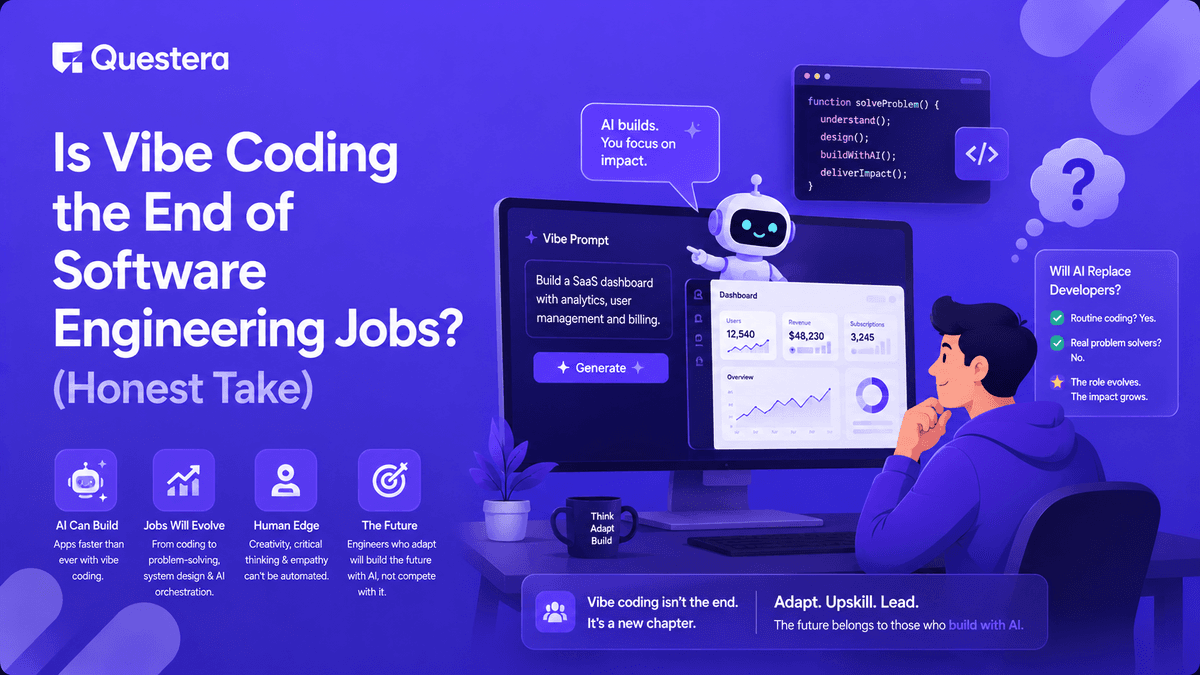
Vibe coding is not the end of software engineering jobs — but it is reshaping the profession. Junior coding tasks, CRUD apps, and boilerplate work are being automated fast. Senior engineering, system design, security, infrastructure, and complex distributed systems still require human expertise. The honest takeaway: software engineering jobs are shifting, not disappearing. Engineers who learn to work with AI as a force multiplier will earn more; those who don't will face wage pressure.
Introduction
The headlines are getting noisy. "AI will replace developers." "Vibe coding ends software engineering." "Solo founders are shipping SaaS without engineers." Some of this is true. Most of it is overstated. And the answer to whether vibe coding ends software engineering jobs is far more nuanced than X threads suggest.
This post gives the honest take. Not a doomer prediction, not a hype piece — just a clear look at what vibe coding actually changes, which roles are genuinely at risk, which roles are getting more valuable, and what engineers (and aspiring engineers) should do about it right now.
What is vibe coding and why is it a threat to some engineering jobs?
Vibe coding is the practice of building software by describing what you want in natural language, while an AI agent writes, tests, and deploys the actual code. The term was coined by AI researcher Andrej Karpathy in early 2025 and has since become shorthand for the entire AI-assisted development category.
Vibe coding threatens specific kinds of engineering work because it dramatically compresses the time and skill required to produce certain types of code. Boilerplate CRUD apps, standard landing pages, basic dashboards, and simple integrations — tasks that used to take a junior developer a week — can now be produced in hours by a non-developer with a clear prompt. According to a 2025 GitHub developer survey, over 70% of developers now use AI coding tools daily, and 30%+ of new code in active repos is AI-generated.
That's the disruption side. But it's only half the story. The full picture requires looking at which engineering tasks are actually being automated and which aren't.
Which engineering jobs are actually at risk from vibe coding?
The engineering jobs at highest risk are ones where the work is repetitive, well-defined, and shallow. The jobs at lowest risk are ones requiring system-level thinking, deep context, security judgment, or infrastructure expertise.
High-risk roles and tasks
These are seeing real pressure right now:
- Junior frontend engineers building static UI — AI tools produce comparable output in minutes
- Bootcamp-style full-stack devs shipping CRUD apps — vibe coding platforms now do this end-to-end
- Agency developers building marketing sites and landing pages — AI prompts replace much of this work
- Contract devs producing standard dashboards and admin panels — same story
- WordPress and Webflow customizers — increasingly replaced by AI app builders
Low-risk roles and tasks
These remain firmly human-required:
- Senior engineers doing system design and architecture
- Infrastructure and DevOps engineers managing complex deployments
- Security engineers handling threat modeling, audits, and incident response
- Distributed systems and database engineers
- ML and AI infrastructure engineers (ironically, the people building the tools)
- Engineers who own production reliability at scale
What vibe coding actually replaces — and what it doesn't
The honest framing: vibe coding replaces tasks, not roles. The tasks it replaces are concentrated in junior, repetitive, and visible work — which is why the panic feels real, even when the bigger picture is more nuanced.
Most senior engineers describe AI coding tools as a force multiplier — they ship more, faster, with the same headcount. Most companies aren't laying off their engineers; they're raising the bar on what one engineer is expected to produce.
What is the realistic impact on software engineering jobs?
The realistic impact is a bifurcation of the engineering job market. Senior engineers and those who learn to work with AI are getting more valuable. Junior engineers and those whose work overlaps heavily with AI capabilities are seeing wage pressure and slower hiring.
The senior end is doing fine
Companies still desperately need engineers who can design systems, own production, debug at scale, and handle the messy 20% that AI can't. Compensation for these roles is up, not down. The market isn't flooded with these people, and AI hasn't replaced them.
The junior end is harder than it was
Entry-level engineering hiring slowed significantly in 2024–2025 and remains tight in 2026. Companies that used to hire 10 juniors a year now hire 3 — and expect each of them to ship what a mid-level used to. The on-ramp is steeper. Bootcamps that worked in 2020 don't work as well now.
The non-developer end is exploding
The biggest market shift isn't engineers losing jobs — it's non-developers shipping software. Solo founders, marketers, and operators are now launching products that used to require an engineering team. Many of the AI app ideas for non-developers we cover are being shipped by people with zero coding background, and a growing number of AI-built apps making $1M+ ARR were built without traditional engineering teams.
This expansion of "who can build" is the bigger story. It doesn't eliminate engineering jobs — it changes who competes for the lowest tier of them.
How will engineering jobs evolve over the next 3–5 years?
Engineering jobs will keep existing — but the day-to-day will look different. The shift mirrors what happened to other professions when their core tooling changed.
- Engineers will spend more time on design and review, less on writing code — like architects spending more time on plans than on drawing walls.
- Code review skills will become more valuable than writing skills — because AI produces a lot of code that needs human judgment to ship safely.
- System design, distributed systems, and infrastructure expertise will pay more — these areas are where AI fails most often, and where mistakes are most expensive.
- "Full-stack" will mean something broader — a single engineer plus AI tools will own what used to take a team of 5.
- Engineering teams will get smaller and ship more — companies will hire fewer engineers but expect each one to produce more output.
- New specialties will emerge — "AI coding orchestrator," "prompt engineer for production systems," and similar roles are already showing up in job listings.
What should engineers do about this right now?
The honest advice depends on where you are in your career. The blanket "learn AI tools" answer is too vague to be useful.
If you're a senior engineer
Get fluent with vibe coding tools, but don't pivot away from your core expertise. The market still pays a premium for system design, production ownership, and deep technical judgment. Use AI to ship 3x more in the same time, and frame your value to leadership in those terms.
If you're a mid-level engineer
Lean into the parts of the job that AI can't do — code review, architecture, mentorship, and owning complex systems. The wage pressure is real in the middle of the market, but the path forward is going deeper, not broader.
If you're a junior engineer
The path is harder, but not closed. Focus on getting deeply skilled at one thing — distributed systems, security, ML infrastructure, or a specific industry domain. Generic full-stack skills are commoditized; specialized expertise is not.
Want to try one of these? Start on Greta.sh — no setup, no boilerplate — just a prompt.If you're a non-developer wanting to build software
The opportunity is genuine. You can now ship real SaaS products without writing code, and our guides on six-figure SaaS ideas and how to Build a Fitness Tracking App using prompts walk through the exact workflow. The catch: distribution and pricing are now the hard parts, not the build.
Common Mistakes to Avoid
- Believing the "engineering is dead" narrative — Senior engineering demand is still strong, and replacing experienced engineers with AI is far harder than X threads suggest.
- Believing the "nothing has changed" narrative — Entry-level hiring genuinely is harder, and dismissing this hurts juniors trying to break in.
- Refusing to use AI tools — Engineers who don't adopt AI coding tools will fall behind peers who do. The output gap is real and growing.
- Over-relying on AI without code review — Vibe-coded apps shipped without engineering review accumulate security holes, performance bugs, and technical debt fast.
- Pivoting too hard away from coding — "Going into product management" because of AI panic is rarely the right move. Doubling down on engineering depth usually pays better.
- Confusing prototypes with production systems — Vibe coding produces working MVPs quickly, but turning an MVP into a scaled, reliable production system still requires engineering expertise.
Frequently Asked Questions
1. Will vibe coding completely replace software engineers?
No. Vibe coding replaces specific tasks — boilerplate, simple CRUD, standard UI — not entire engineering roles. Senior engineering, system design, infrastructure, security, and complex domain work still require human expertise and will for the foreseeable future.
2. Should I still learn to code in 2026?
Yes, especially if you want to work on complex systems or earn senior engineering salaries. But focus on depth — distributed systems, security, infrastructure, ML — rather than generic full-stack skills, which are being commoditized.
3. Are junior software engineering jobs really disappearing?
Junior hiring has slowed significantly since 2024, and the bar for entry has risen. Junior jobs aren't disappearing entirely, but the on-ramp is steeper and the expectations are higher per hire than they were 3–5 years ago.
4. Can a vibe-coded app be a real production product?
Yes, with caveats. Many vibe-coded apps have crossed $1M+ ARR. But scaling beyond a certain point — high traffic, regulated industries, complex integrations — usually requires engineering review or a hired engineer to harden the codebase.
5. What engineering skills will be most valuable in 5 years?
System design, distributed systems, security, ML and AI infrastructure, production reliability, and deep domain expertise in a specific industry. Generic coding skills will continue to be commoditized; specialized judgment will not.
6. Should developers be worried about layoffs because of vibe coding?
Most layoffs in 2024–2025 were driven by macroeconomics, not AI. AI is a contributing factor at the margins, but senior engineering demand remains strong. The roles most exposed are agency dev work, boilerplate-heavy contract roles, and entry-level positions at companies aggressively adopting AI tooling.
7. Is it too late to start a software engineering career?
No, but the path looks different than it did in 2020. Specialization matters more, the bar for entry is higher, and combining engineering skills with another domain (finance, biotech, security, AI) is a stronger play than generic full-stack training.
Conclusion
- Vibe coding is not the end of software engineering jobs — it's reshaping what the profession looks like. Tasks are being automated; roles are evolving, not vanishing.
- The job market is bifurcating: senior and specialized engineering is more valuable than ever, while junior and boilerplate-heavy work is under genuine pressure.
- Engineers who learn to work with AI as a force multiplier will earn more. Engineers who refuse to adopt these tools will face wage pressure.
- The bigger story isn't engineers losing jobs — it's non-developers gaining the ability to ship software, which expands the pool of who can build but doesn't eliminate the need for engineering judgment.
If you're an engineer, double down on depth. If you're a non-developer, the door to building software is wider than it has ever been. Vibe coding doesn't end software engineering jobs — it raises the bar on what an engineer is, and what anyone else can build.