






Greta vs Emergent: Multi-Agent vs Single-Prompt App Generation
TL;DR
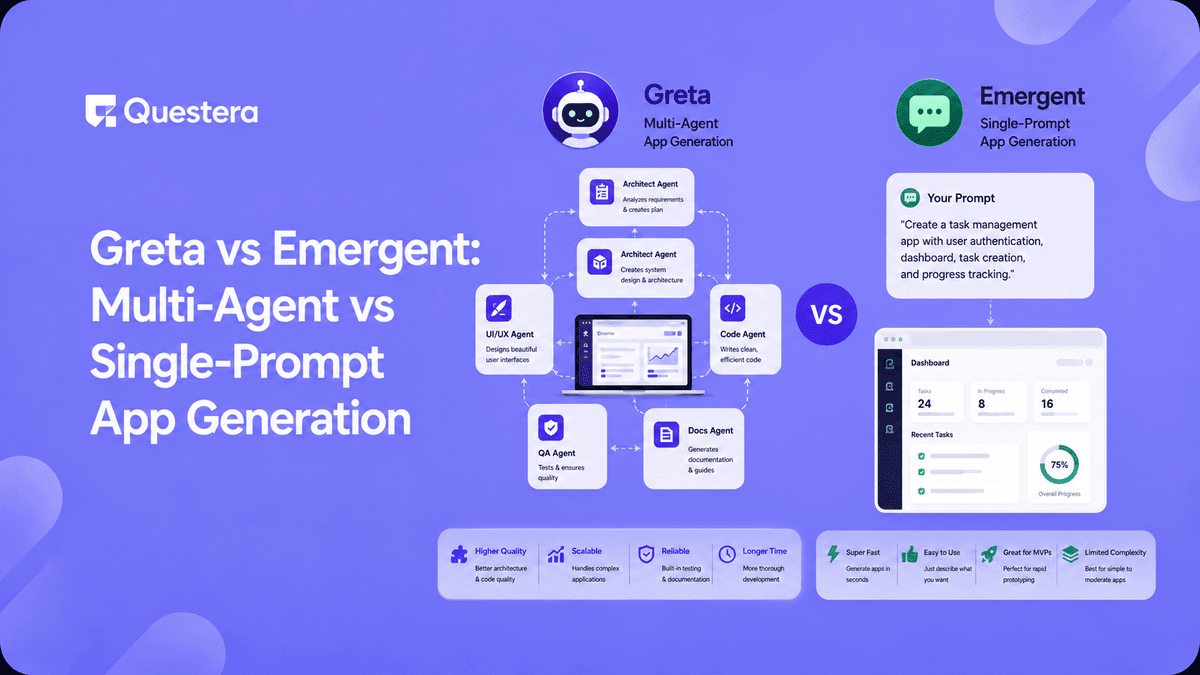
Greta vs Emergent comes down to two different philosophies. Emergent uses multi-agent orchestration — specialized AI agents work in parallel to plan, code, test, and deploy. Greta uses a unified single-prompt-driven flow where one agent handles design, logic, database, and deployment with built-in growth tooling. Emergent suits complex, backend-heavy SaaS builds; Greta suits founders who want speed, polished UI, and integrated marketing infrastructure from day one.
Introduction
The AI app builder market has split into two camps. On one side: platforms like Emergent that orchestrate multiple specialized agents — one for planning, one for coding, one for deployment — to simulate how a real engineering team ships. On the other: platforms like Greta that emphasize a tight, single-prompt-driven flow where one unified agent handles the entire stack end to end.
Both can ship production-ready apps. They just optimize for different builders. This guide breaks down Greta vs Emergent in detail — pricing, architecture, code quality, design output, and the kinds of apps each one handles best. If you're trying to pick between them for your next build, by the end of this post you'll know exactly which one fits your use case.
What is the core difference between Greta and Emergent?
The core difference between Greta and Emergent is architectural. Greta runs as a unified vibe coding platform where one agent handles the full app — UI, backend, logic, deployment — through a single iterative prompt thread. Emergent runs as a multi-agent orchestration system where specialized agents handle different parts of the build in parallel.
In practice, this changes how each platform feels. With Greta, you describe what you want and watch one cohesive output emerge — design and logic move together. With Emergent, the platform's planning agent breaks your prompt into subtasks, then coding, UI, and deployment agents work in parallel before merging the results.
Emergent's own positioning describes this as a team of AI agents coordinating on task breakdown, coding, debugging, and optimization. Neither approach is strictly better. They produce different feel, different speeds, and different output quality depending on the type of app.
How does multi-agent orchestration actually work in Emergent?
Multi-agent orchestration means Emergent doesn't use one large model running in a loop. Instead, it delegates subtasks to specialized agents that work in parallel — one handles the data model, another wires up the UI, a third handles integrations like Stripe or Slack. The user experiences this as a single chat thread, but several agents are running behind the scenes.
The agents you don't see
Emergent's architecture includes agents for planning, coding, UI, testing, and deployment. The planning agent reads your prompt and breaks it into a build plan. The coding agents then execute that plan, often in parallel, while a testing agent validates the output before deployment. This is why Emergent positions itself for complex apps — the orchestration shines when there are many moving parts.
Where multi-agent helps and where it doesn't
Multi-agent orchestration helps most when an app has independent subsystems — auth, payments, dashboards, integrations — that can be built in parallel. It helps less when an app is small, design-heavy, or needs tight feedback loops between UI and logic. For a simple landing page, the overhead of coordination can actually slow things down.
How does Greta's single-prompt approach compare?
Greta runs as a unified flow where one agent handles design, logic, database, and deployment together. Its own marketing describes this clearly — Greta builds everything: design, logic, database, and full deployment at once. The result is a tighter coupling between what you see and what's underneath, with fewer handoffs between specialized agents.
The trade-off is in scope. Greta is optimized for full-stack SaaS apps, landing pages, and tools that need to ship quickly and look great. It also bundles growth tooling — custom domains, search ranking, analytics — directly into the platform, which Emergent treats as separate concerns.
Build this with a prompt on Greta.sh — describe the app, Greta writes and deploys it.Greta vs Emergent: feature-by-feature comparison
Here's how the two platforms compare across the dimensions that matter most to non-developers and small teams.
| Feature | Greta | Emergent |
|---|---|---|
| Architecture | Unified single-prompt flow | Multi-agent orchestration |
| Best For | Solo founders, indie hackers, design-conscious SaaS | Complex full-stack apps, internal tools, integrations |
| UI Quality | High — design and logic built together | Medium-high — functional first, polish iterative |
| Backend & Database | Built-in (Supabase, MongoDB) | Built-in with custom agent support |
| Code Export / GitHub | Yes | Yes (GitHub export on paid plans) |
| Growth Tooling | Built-in (domain, SEO, analytics) | Limited — focus on app generation |
| Free Tier | Yes | Yes — limited credits |
| Starting Price | Affordable paid tier | $20/month for 100 credits |
| Standout Feature | Tight design + growth integration | Custom agents, 1M context (Pro) |
The pattern: Emergent wins on raw orchestration power and complex builds. Greta wins on design polish, speed of iteration, and the marketing-adjacent tooling most solo founders need.
Which one ships better-looking apps?
For UI polish, Greta's unified approach has an edge for most users. Because design, layout, and logic are generated by the same agent in one pass, the visual output is more cohesive on the first try.
Emergent's multi-agent system produces functional apps fast, but several user reviews note that visual design needs more iteration — one detailed reviewer found that Emergent AI is not suitable for design-first product building after testing it on a design-heavy use case.
That doesn't make Emergent's UI bad. It just means Emergent prioritizes shipping a working app first and polishing the UI second. If you care about pixel-level design from prompt one, Greta tends to deliver closer to what you imagined. If you care about backend logic working correctly out of the gate, Emergent has the edge.
For landing pages specifically, both platforms work well — though our AI Prompts for Building Landing Pages guide covers the layered prompting techniques that get the best output from either tool.
Which one is better for complex full-stack apps?
For complex full-stack apps with many integrations, Emergent's multi-agent architecture has a clear advantage. The platform was built specifically for this — apps with auth, multiple user roles, third-party APIs, and custom logic benefit from having specialized agents handle each piece. The Pro tier's 1M context window and custom agents make it more capable than Lovable or Bolt for complex builds.
Greta handles complex apps too, but its strength is in cohesive end-to-end SaaS builds — the kind you'd use to validate an idea or hit early revenue. If you're building something like an AI fitness tracker or a niche SaaS tool, our walkthrough on how to Build a Fitness Tracking App using prompts shows exactly how Greta handles a typical full-stack flow.
For internal tools, CRMs, dashboards with deep integrations, or B2B SaaS with custom roles and permissions, Emergent's multi-agent architecture is the more natural fit.
Greta vs Emergent: pricing and credits
Pricing structures differ meaningfully and affect what you can realistically ship on each platform.
Emergent uses a credit-based pricing model — every action consumes credits. The free tier offers 10 credits per month with core platform features. The Standard plan is $20/month for 100 credits with GitHub integration and private hosting. The Pro plan is $200/month for 750 credits with a 1M context window and custom agents. Active deployment costs additional credits per month.
Greta offers a free tier and paid plans with included build capacity, with the AppSumo lifetime deal occasionally available for solo founders.
Cost predictability is one of Emergent's reported weaknesses — power users have flagged that credit consumption can spike on complex apps with heavy iteration. Greta's growth tooling is bundled, meaning you don't pay extra for domain setup, basic SEO, or analytics — these are separate concerns on Emergent.
For non-technical founders shipping their first app, Greta's pricing tends to be more predictable. For teams building complex internal tools where credits can be justified per feature, Emergent's model scales better.
Want to try one of these? Start on Greta.sh — no setup, no boilerplate — just a prompt.Who should pick Greta and who should pick Emergent?
The right choice depends on what you're building and who you are.
- Pick Greta if you're a solo founder, marketer, or indie hacker shipping a SaaS, a landing page, or a content-driven app and you want design + growth tooling baked in.
- Pick Greta if you care about UI polish from the first prompt and want predictable pricing without credit anxiety.
- Pick Emergent if you're building a complex internal tool, a dashboard with many integrations, or a B2B SaaS with custom roles and workflows.
- Pick Emergent if you want fine-grained control over which agents handle which parts of your build (Pro plan).
- Pick Greta if you're new to vibe coding — the single-agent flow has a shorter learning curve.
- Pick Emergent if you have technical comfort and want to extend the platform with custom agents and your own integrations.
Both platforms are credible, well-funded, and shipping real apps. The decision is about fit, not which one is "better" in absolute terms. If you're still in the idea stage, our roundup of six-figure SaaS ideas and AI app ideas for non-developers covers projects that work well on either platform — and the kind that have powered the recent wave of AI-built apps making $1M ARR.
Common Mistakes to Avoid
- Picking the platform before defining the app — Both Greta and Emergent are capable. The right pick depends on whether your app is design-heavy or integration-heavy, not on which platform is more hyped.
- Underestimating credit consumption on Emergent — Power users routinely burn through credits faster than expected. Calculate your iteration cost before committing.
- Expecting one-prompt perfection on either platform — Both work best with iterative prompting. The "one-shot complete app" promise is marketing; real builds take 10–50 prompts.
- Ignoring design feedback loops — If UI matters, plan to iterate visually regardless of platform. Emergent often needs more design passes than Greta.
- Not testing the export path — Both platforms support code export, but the quality and structure of exported code varies. Test this early if long-term ownership matters to you.
- Comparing on price alone — A $20/month Emergent plan may cost more than a $30/month Greta plan once credits, deployment, and add-ons are factored in. Compare on total cost for your actual workload.
Frequently Asked Questions
1. Is Greta or Emergent better for non-developers?
Greta tends to be easier for non-developers because the single-agent flow is more conversational and the platform bundles design, hosting, and growth tooling. Emergent is more capable for complex builds but has a steeper learning curve, especially around credit management and agent configuration.
2. Can both Greta and Emergent build full-stack apps?
Yes — both platforms handle frontend, backend, database, auth, and deployment. The difference is in approach: Greta uses a unified agent flow, while Emergent uses multiple specialized agents that coordinate behind the scenes.
3. Which one has better code quality on export?
Both export real, working codebases that can be self-hosted or extended. Emergent's exported code tends to be more modular because different agents produce different components. Greta's exported code is more cohesive because it comes from a single unified flow. Quality is comparable; structure differs.
4. How much does it cost to build a typical SaaS app on each?
A simple SaaS MVP on Greta typically fits within a $20–$50/month plan with no surprise credit costs. The same app on Emergent starts at $20/month for the Standard plan but can require multiple credit top-ups depending on iteration depth. Budget $30–$100/month for an actively iterated app on either platform.
5. Which platform handles design better?
Greta's unified flow produces more cohesive UI on the first prompt, making it the better pick for design-conscious founders. Emergent ships functional apps first and polishes UI in iteration, which is a trade-off some users find limiting for design-first products.
6. Can I use both Greta and Emergent for the same project?
In theory yes — both platforms export real code. But in practice, switching mid-project usually creates more work than it saves because each platform's conventions differ. Pick one based on your app's needs and stick with it through v1.
Conclusion
Greta vs Emergent isn't about which is better — it's about which fits your build. Greta wins on design polish, growth tooling, and predictable pricing. Emergent wins on complex full-stack apps, multi-agent orchestration, and integration-heavy builds.
Multi-agent orchestration helps when an app has many independent subsystems. Unified single-prompt flows help when design and logic need to move together. Pricing models matter more than sticker price — credit-based pricing can scale unpredictably on Emergent, while Greta's bundled tooling reduces add-on costs.
For most solo founders shipping a SaaS MVP, Greta is the faster path. For teams building complex internal tools or B2B SaaS with deep integrations, Emergent is the better fit. Pick the platform that matches your app, not the headlines. Either way, the bar to ship is now lower than it has ever been — the only thing stopping your build is which one you choose tonight.