






How to Build a SaaS App in 2026 Without Writing Code
TL;DR
You can build a SaaS app in 2026 without writing code by using AI vibe coding platforms like Greta, Emergent, Lovable, and Bolt. The workflow takes 5–14 days: pick a narrow niche, write a one-paragraph product spec, scaffold the app with prompts, wire up payments and auth, polish for mobile, and launch on Product Hunt or X. No developer hire, no $30k budget, no coding skills required.
Introduction
Building a SaaS used to require a developer co-founder, 6–12 months of engineering, and a five-figure budget before you could sell a single subscription. In 2026, that's no longer true. AI vibe coding platforms have collapsed the build timeline from months to days — solo, non-technical founders are now shipping production-ready SaaS apps in under two weeks and hitting paying customers in the first month.
This guide walks through exactly how to build a SaaS app in 2026 without writing code. You'll get the full workflow — from idea selection to launch — including which tools to use, what to prompt, and how to monetize. By the end, you'll have a playbook you can run this weekend.
What does it mean to build a SaaS app without writing code in 2026?
Building a SaaS app without writing code in 2026 means describing the app in natural language to an AI agent, which then writes the actual code, sets up the database, handles authentication, integrates payments, and deploys the live product. You stay focused on the product vision — who the user is, what problem you're solving, how the UI should feel — and the AI handles the engineering.
This is different from the no-code tools of 2020. Old no-code platforms gave you drag-and-drop blocks with hard limits. Modern AI vibe coding tools generate real, exportable code that runs on real infrastructure. You own what you build, and you can scale it past the platform if you want.
According to a 2025 a16z report, over 40% of new indie SaaS apps shipped on Product Hunt are now built primarily with AI coding agents. The pattern is no longer a fringe trend — it's how new SaaS gets shipped.
What kind of SaaS apps can you actually build without code?
You can build almost any standard B2B or B2C SaaS app without code in 2026 — including dashboards, AI tools, internal tools, marketplaces, content platforms, and niche productivity apps. The handful of exceptions are products that require deep custom infrastructure (high-frequency trading, AAA games, advanced video processing).
Best-fit SaaS categories for no-code AI builds
The categories that work best are ones where the core logic is well-defined and the value comes from clean UX, smart workflows, or AI features. These include:
- AI tools that wrap a model with a specific niche workflow (resume tailoring, listing writers, content repurposers)
- B2B internal tools (CRMs, dashboards, admin panels for small businesses)
- Niche productivity apps (workout trackers, meal planners, time trackers)
- Content platforms (newsletter tools, podcast helpers, course platforms)
- Marketplaces (small-scale, single-niche; not eBay-scale)
If you're stuck on what to build, our roundup of six-figure SaaS ideas and our list of AI app ideas for non-developers cover specific projects that fit this workflow.
Categories to avoid for v1
Avoid building anything that needs heavy compliance (HIPAA-regulated health apps), real-time multiplayer infrastructure, or massive data pipelines as your first project. Not because vibe coding can't handle them, but because the iteration cycles are longer and the risk profile is higher.
Build this with a prompt on Greta.sh — describe the app, Greta writes and deploys it.Which tools should you use to build a SaaS app without writing code?
The right tool depends on your app type, design needs, and budget. Each platform optimizes for different builders.
| Tool | Best For | Approach | Standout Feature |
|---|---|---|---|
| Greta | Solo founders, design-conscious SaaS | Unified single-agent flow | Built-in growth tooling (domain, SEO, analytics) |
| Emergent | Complex full-stack apps, internal tools | Multi-agent orchestration | Specialized agents, custom agent support |
| Lovable | Visual-first apps, landing pages | Single-agent, design-led | High UI polish |
| Bolt | Fast prototypes, web-first | Browser-native | Speed of iteration |
| Replit Agent | Full-stack with custom logic | IDE + agent | Flexibility, code control |
| Cursor | Builders comfortable reading code | AI-powered editor | Fine-grained control |
For non-developers, the end-to-end platforms (Greta, Emergent, Lovable) are the easiest path because hosting, auth, database, and deployment come bundled. Bolt and Replit work well if you want more control over the stack, but expect to spend more time wiring things up.
How to build a SaaS app in 2026 without writing code — step by step
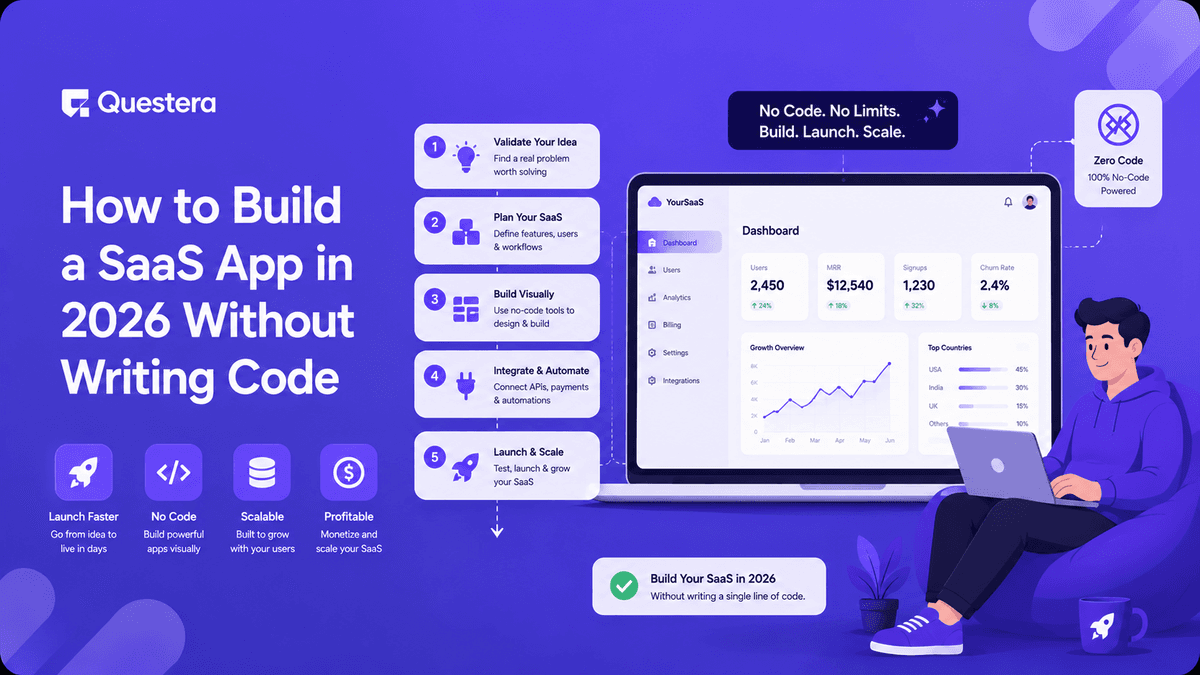
The realistic timeline for shipping a SaaS MVP is 5–14 days of focused work. Here's the exact sequence that works.
- Day 1: Pick your niche and write the spec — One paragraph that names the target user, the specific pain, and the one feature that solves it. Resist the urge to add more.
- Day 2: Scaffold the app — Use your spec as the initial prompt on your chosen vibe coding platform. Don't ask for everything at once; get the core flow working first.
- Day 3: Wire up the database and auth — Most platforms handle this with one or two prompts. Email magic-link auth is fastest; social logins can come later.
- Day 4: Build the core feature — Whatever your single most important feature is, focus the entire day on prompting and refining it. This is what users will pay for.
- Day 5: Add payments — Stripe or LemonSqueezy can be added in under an hour with a clear prompt. Set up your pricing tiers before you wire payments — don't change them mid-build.
- Day 6: Build the landing page — Treat this as a separate project. Use layered prompts the way we cover in our guide on AI Prompts for Building Landing Pages.
- Day 7: Polish UI and mobile — Explicitly prompt "make this fully responsive on mobile" and test on your phone. 60%+ of SaaS traffic is mobile.
- Days 8–10: Soft testing — Send to 5–10 friends or target users. Fix the top 3 bugs. Watch what confuses them.
- Days 11–14: Launch — Product Hunt, X, relevant subreddits, and 2–3 communities where your target user lives.
This timeline assumes one focused person. With a small team, it compresses to 5–7 days.
What does a typical SaaS build look like in practice?
A real example helps. For a fitness tracking SaaS, the workflow would look like this: scaffold with one prompt for the core dashboard, refine workout logging with a second prompt, build the progress chart with a third, add auth and database with one more, then layer in pricing and payments. Our detailed walkthrough on how to Build a Fitness Tracking App using prompts shows exactly how this plays out in a real session.
Prompt order matters more than you think
The single biggest mistake non-developers make is asking for everything in one prompt. The AI ships generic output when you do this. Build features in dependency order: scaffold → database → core feature → auth → payments → landing page → polish. Each step gives the AI a small, sharp job.
Iteration beats perfection
Plan to run 20–50 prompts before launch, not 5. The founders behind today's AI-built apps making $1M+ ARR didn't ship perfect v1s — they shipped fast, iterated based on user feedback, and let the market shape the product.
How do you monetize a SaaS app you built without code?
Monetization for vibe-coded SaaS works exactly like traditional SaaS, with one big advantage — your unit economics are usually better because you didn't hire engineers.
Pricing models that work
The fastest path to revenue is a freemium tier with a hard paywall after 3–5 uses, priced at $9–$29/month for unlimited access. For B2B tools, $49–$199/month with a 14-day free trial works well. For high-stakes one-time use cases (wedding speeches, resume tailoring), one-time pricing of $19–$49 outperforms subscriptions.
Things to set up before launch
- Stripe or LemonSqueezy — Both integrate in under an hour with a clear prompt
- A real domain — Not a platform subdomain. Costs $12 and signals legitimacy.
- Basic analytics — PostHog, Plausible, or GA4. You can't iterate on what you can't see.
- One transactional email flow — Welcome email + payment receipt. Most platforms have this built in.
- A pricing page — Even a simple one. Hiding pricing tanks B2B conversion rates.
Common Mistakes to Avoid
- Building too broad — "AI assistant for marketers" will never ship in 14 days. "AI tool that writes Instagram captions for yoga studios" will.
- Skipping the spec — Jumping straight to prompting without a one-paragraph product description leads to feature drift by prompt 10.
- Prompting for everything at once — Asking for the dashboard, payments, and email flow in one prompt produces a buggy mess. One feature per prompt.
- Launching without payments wired up — Free betas with "we'll figure pricing out later" almost always undershoot what users would have paid on day one.
- Ignoring mobile until the end — Most SaaS traffic is mobile. Test mobile after every major feature.
- Underestimating AI costs — If a power user costs $20/month in API calls and pays $10, you're losing money on every signup. Calculate cost-per-user before launch.
- Picking the wrong platform — Don't pick a tool because it's trending. Pick based on your app's complexity, design needs, and budget.
Frequently Asked Questions
1. Can a non-developer really build a SaaS app in 2026 without writing code?
Yes — modern AI vibe coding platforms like Greta, Emergent, Lovable, and Bolt let non-technical founders ship full-stack SaaS apps in days. The bottleneck is no longer code; it's clarity of niche, willingness to iterate, and distribution.
2. How long does it take to build a SaaS app without writing code?
A focused solo founder can ship a working SaaS MVP in 5–14 days. The first day is spec writing, days 2–7 cover the build, and days 8–14 cover testing and launch. Small teams can compress this further.
3. How much does it cost to build a SaaS app without code in 2026?
Total launch costs typically run $50–$200: domain ($12), vibe coding platform subscription ($20–$50/month), AI API credits ($20–$50 to start), and hosting (often bundled). No developer or agency fees.
4. Do I need any coding skills to build a SaaS without code?
No traditional coding skills are required, but you do need to read what the AI generates and describe problems clearly. Think of it like managing a junior developer — you guide the work and the AI executes it.
5. Can a vibe-coded SaaS scale to real revenue?
Yes. Multiple AI-built SaaS apps have crossed $1M+ ARR using exactly this workflow. The scaling bottleneck is usually distribution and pricing strategy, not the codebase.
6. Which AI platform is best for building a SaaS app without code?
There's no single best tool. For solo founders shipping design-conscious SaaS, Greta or Lovable work well. For complex internal tools or integration-heavy apps, Emergent's multi-agent setup is stronger. Bolt and Replit suit builders who want more control.
7. What happens if my SaaS app outgrows the no-code platform?
Most modern vibe coding platforms (Greta, Emergent, Bolt, Lovable) export real code you can self-host or extend with developers later. This is a key difference from old no-code tools — you're not locked in if the app takes off.
Conclusion
- Building a SaaS app in 2026 without writing code is no longer experimental — it's how new indie and B2B SaaS gets shipped, with founders going from spec to revenue in under two weeks.
- The right tool depends on your app type — Greta for design-conscious SaaS, Emergent for complex multi-system builds, Lovable for visual-heavy products, Bolt and Replit for more control.
- Prompt order matters more than prompt quality. Scaffold first, database second, features third, payments fourth, polish last. Skip steps and you'll rebuild.
- Distribution and pricing now matter more than the build itself. The founders shipping $1M ARR apps spend more time on customer conversations than on code prompts.
Pick your niche, write your one-paragraph spec tonight, and start building tomorrow. The barrier between you and a launched SaaS is no longer engineering — it's commitment.





© 2026 Questera
Follow in Google