






Vibe Coding vs Traditional Coding: Which Is Right for You?
TL;DR
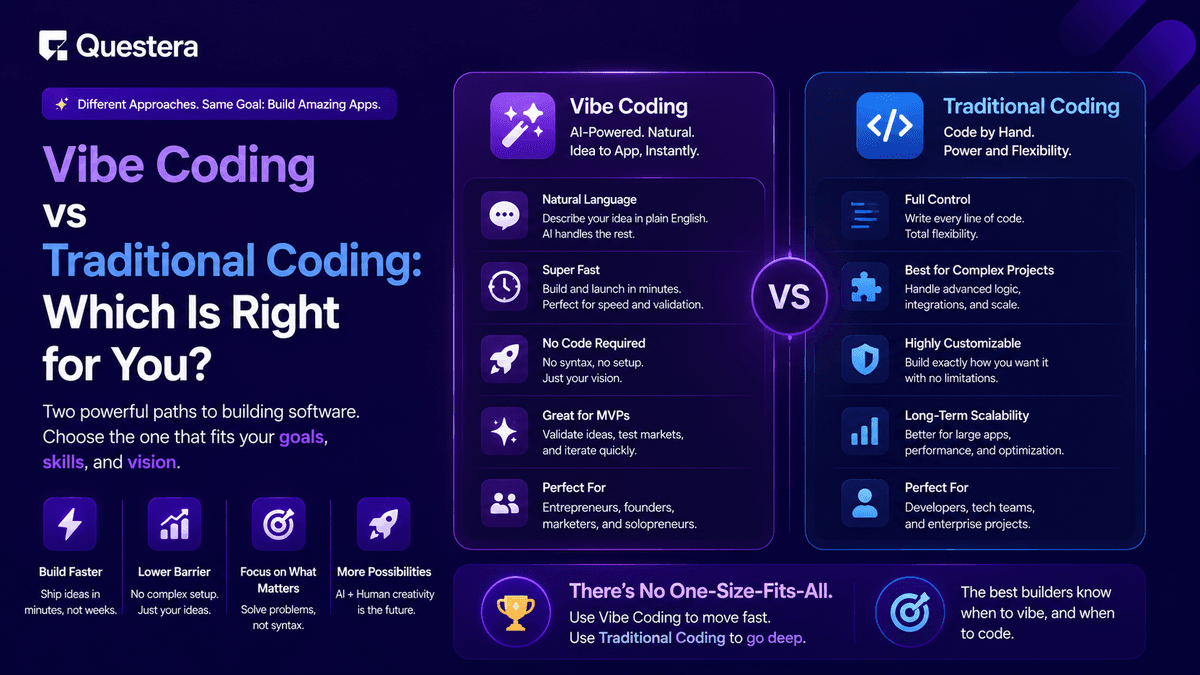
Vibe coding vs traditional coding isn't either/or — it's about matching the approach to the project. Vibe coding wins for MVPs, prototypes, landing pages, internal tools, and content-driven SaaS where speed and iteration matter most. Traditional coding wins for complex systems, regulated industries, high-traffic production apps, and performance-critical software. Most modern teams use both — vibe coding to ship fast, traditional coding to scale and harden.
Introduction
Two camps shout past each other on X every week. One says vibe coding is the future and traditional coding is dying. The other says vibe coding produces brittle toy apps that fall apart at scale. Both are wrong, and both are right — depending on what you're building.
This post gives you the honest comparison. Not a hype piece, not a doomer take — just a clear breakdown of where each approach wins, where each fails, and how to pick the right one for your specific project. By the end, you'll know which approach fits your next build and why.
What is vibe coding and how is it different from traditional coding?
Vibe coding is the practice of building software by describing what you want in natural language, while an AI agent writes, tests, and deploys the actual code. The term was coined by AI researcher Andrej Karpathy in early 2025 and has since become shorthand for the entire AI-assisted development category.
Traditional coding is the older approach — engineers write code by hand, line by line, using IDEs, frameworks, and language-specific tooling. They debug manually, write tests deliberately, and own every architectural decision themselves.
The core difference is who writes the code. In vibe coding, you describe outcomes and the AI handles syntax and dependencies. In traditional coding, you handle both. According to a 2025 GitHub developer survey, over 70% of developers now use AI coding tools daily, and 30%+ of new code in active repos is AI-generated — meaning even traditional engineers are leaning more on vibe coding patterns than they used to.
When does vibe coding win?
Vibe coding wins when the goal is shipping fast, validating an idea, or building something well-defined where the AI has seen thousands of similar examples in training data. The pattern is consistent across categories.
The categories where vibe coding excels
These are the projects where vibe coding produces output that's genuinely competitive with hand-coded work:
- MVPs and prototypes — where speed matters more than polish
- Landing pages and marketing sites — well-defined patterns the AI handles cleanly
- Internal tools and admin dashboards — CRUD-heavy, low-risk, fast iteration
- Single-feature AI tools — resume tailors, listing writers, content repurposers
- Niche vertical SaaS — apps with clear scope and a single user type
- Mobile and web apps with simple data models — trackers, calculators, journaling
- Solo founder side projects — where one person owns the entire stack
If you're building anything from this list, vibe coding usually beats traditional coding on time to market by 5–10x.
Why speed matters more than polish for these projects
The economics of vibe coding flip the equation for MVPs. A traditional dev team building an MVP spends 80% of their time on infrastructure, auth, payments, and deployment — and 20% on the actual product idea. Vibe coding inverts this. You spend 80% on the idea and 20% on the wiring, because the AI handles most of the boilerplate.
Build this with a prompt on Greta.sh — describe the app, Greta writes and deploys it.When does traditional coding win?
Traditional coding still wins for projects where the cost of mistakes is high, the complexity outstrips what AI agents can reason about, or the performance demands require deep optimization. These are areas where AI tools produce output that looks fine but breaks in production.
Categories where traditional coding remains essential
- Distributed systems and high-traffic backend infrastructure — AI agents struggle with race conditions, consistency models, and complex concurrency
- Regulated industries — healthcare, finance, government — where compliance audits demand human accountability for every line
- Performance-critical software — game engines, real-time video, high-frequency trading
- Security-sensitive systems — auth providers, payment processors, anything handling sensitive data at scale
- Legacy codebases — long-lived production systems where context spans years of decisions
- Custom infrastructure — bespoke databases, novel algorithms, research-grade ML
- Operating system and embedded software — where every byte and cycle matters
Why control matters more than speed for these projects
For these categories, the cost of a subtle bug — a security hole, a data race, a compliance violation — vastly outweighs the time saved by AI generation. Traditional coding gives the engineer total context, total review, and total ownership. That's exactly what regulated and high-stakes work requires.
Vibe coding vs traditional coding: feature-by-feature comparison
Here's how the two approaches compare across the dimensions that matter most when picking one.
| Dimension | Vibe Coding | Traditional Coding |
|---|---|---|
| Time to MVP | Hours to days | Weeks to months |
| Skill required | Clear thinking, prompt structure | Years of language and framework expertise |
| Cost to launch | $50–$500 | $5,000–$50,000+ |
| Code quality (simple apps) | High | High |
| Code quality (complex apps) | Variable, needs review | High with skilled engineers |
| Long-term maintenance | Easier if code is exported | Requires ongoing engineering |
| Performance at scale | Often needs hardening | Designed for it from day one |
| Debugging complex issues | Limited — AI can loop | Deep, owned by the engineer |
| Compliance and audit | Limited human accountability | Full accountability per line |
| Iteration speed | Fast, conversational | Slower, deliberate |
The pattern: vibe coding wins on speed, cost, and accessibility. Traditional coding wins on control, performance, and reliability at scale.
Which approach is right for which builder?
The right approach depends on who you are, what you're building, and what your constraints are. Match honestly — the wrong choice wastes weeks.
- Pick vibe coding if you're a non-developer shipping your first SaaS or mobile app. Our guide on How to Build a SaaS App in 2026 without writing code covers this workflow in detail.
- Pick vibe coding if you're a solo founder validating an idea with real users and need to ship within a week.
- Pick vibe coding if you're a marketer or operator who needs an internal tool and don't want to wait six months for engineering capacity.
- Pick traditional coding if you're building infrastructure that other systems depend on — auth providers, payment rails, data pipelines.
- Pick traditional coding if you're working in healthcare, finance, or government where compliance is non-negotiable.
- Pick both if you're a senior engineer using AI tools as a force multiplier — most experienced devs now use vibe coding for boilerplate and traditional coding for the hard parts.
- Pick vibe coding first if you're not sure your idea has a market. Validate cheaply, then rebuild in traditional code if it takes off.
This last pattern — vibe code the MVP, then traditional code the v2 — has become the default playbook for ambitious founders in 2026.
How vibe coding and traditional coding work together
The most pragmatic teams in 2026 don't pick one over the other — they use both, deliberately. The most common patterns:
- Prototype with vibe coding, harden with traditional coding — Ship an MVP in a week, validate with users, then rebuild critical paths with an engineer once revenue justifies it.
- Use vibe coding for surface area, traditional for core — Marketing site, blog, dashboards, and internal tools get vibe coded. The core product logic gets engineered.
- AI generates, engineers review — Most senior engineers now use AI tools daily but still review every line before it ships to production.
- Vibe code the boring parts — Auth flows, CRUD admin panels, email templates, landing pages. Engineers focus on the interesting 20%.
- Traditional code the hot path, vibe code everything else — High-traffic API endpoints get hand-tuned; lower-traffic features get AI-generated.
This hybrid approach is producing the strongest outcomes in 2026 — small teams shipping at the speed of a much larger one, without the brittleness pure vibe coding sometimes produces.
What about cost? Vibe coding vs traditional coding compared
The cost gap is the single biggest reason vibe coding has exploded since 2024. The math is dramatic.
- Vibe coding cost for an MVP — $50–$500 total. Subscription to a vibe coding platform ($20–$50/month), AI API credits ($20–$50), domain ($12), hosting (often free or bundled).
- Traditional cost for the same MVP — $15,000–$50,000+ if outsourced to an agency or freelancer; 1–2 months of a full-time engineer's salary if hired.
- Vibe coding ongoing cost — Subscription + AI usage, typically $30–$200/month including hosting.
- Traditional ongoing cost — Engineering headcount (usually starting at $100k+ per engineer/year for in-house) or ongoing freelance retainers ($3k–$10k/month).
The cost gap shrinks for complex production systems, where AI tools alone aren't enough and you need engineers anyway. But for everything in the MVP-to-early-traction range, vibe coding is 50–100x cheaper. If you're picking app ideas where this cost gap matters most, our list of profitable AI app ideas covers 25 specific builds that fit the vibe coding cost profile.
Want to try one of these? Start on Greta.sh — no setup, no boilerplate — just a prompt.Common Mistakes to Avoid
- Treating it as either/or — Vibe coding and traditional coding are complementary. The right answer for most builders involves both.
- Vibe coding a complex production system on day one — A vibe-coded MVP is great. A vibe-coded healthcare app handling patient data with no engineering review is dangerous.
- Traditional coding a landing page — Hiring a developer to hand-code a marketing site in 2026 is wasted budget. Vibe coding handles this category better and faster.
- Skipping prompt structure — Vibe coding only beats traditional coding when prompts are well-structured. Our Ultimate Prompt Library for AI App Builders covers the prompt formulas that consistently produce quality output.
- Dismissing traditional coding as obsolete — Senior engineering demand is still strong and growing for complex systems. We unpack this in our piece on whether Vibe Coding is the End of Software Engineering Jobs.
- Underestimating production hardening — A working vibe-coded app is not the same as a production-ready system. Plan for engineering review before scaling.
- Comparing on code quality alone — The better question isn't "which writes prettier code" but "which produces a working product faster for my use case."
Frequently Asked Questions
1. Is vibe coding better than traditional coding?
Neither is better in absolute terms. Vibe coding wins for MVPs, prototypes, internal tools, and content-driven SaaS where speed matters most. Traditional coding wins for complex systems, regulated industries, and performance-critical software. The right answer depends entirely on what you're building.
2. Can I learn to code by vibe coding?
Partially — vibe coding teaches product thinking, debugging instincts, and how to describe systems clearly. It doesn't teach syntax, algorithms, or low-level systems thinking. Most engineers recommend doing both: build with vibe coding to learn quickly, then study fundamentals to deepen your skills.
3. Will traditional coding skills become obsolete?
No. Senior engineering demand for distributed systems, security, infrastructure, and complex domain work is still growing. What's changing is the bar for entry — generic full-stack skills are being commoditized, while specialized engineering expertise is becoming more valuable.
4. How do I know when to switch from vibe coding to traditional coding?
Common triggers include: hitting scale issues your AI builder can't solve, needing compliance audits, handling sensitive data, or reaching MRR where engineering investment makes financial sense (usually $5k–$20k MRR depending on the project). When in doubt, validate with vibe coding first and bring in engineering once revenue justifies it.
5. Which approach is better for solo founders in 2026?
Vibe coding, almost without exception. Solo founders rarely need to build at scale on day one. Validate the idea fast with vibe coding, get to revenue, then invest in engineering as the product grows. Founders who insist on traditional coding from day one often run out of time or money before validating product-market fit.
6. What about code quality and maintainability?
Vibe-coded code from modern platforms is generally clean and exportable, especially from Greta, Lovable, Bolt, and Emergent. Long-term maintainability depends on how the code is structured and reviewed — both approaches benefit from engineering review for anything that will live in production for years.
7. Can vibe-coded apps handle real production traffic?
Yes, up to a point. Most vibe-coded apps run fine at hundreds to low thousands of users. Beyond that, you usually need engineering review to harden hot paths, add caching, and scale the database. Several vibe-coded apps have crossed $1M ARR without traditional engineering — but they all got engineering review eventually.
Conclusion
- Vibe coding vs traditional coding is the wrong framing — the right framing is when to use each, often in combination.
- Vibe coding wins for MVPs, prototypes, landing pages, internal tools, and content-driven SaaS where time-to-market and cost dominate.
- Traditional coding wins for complex systems, regulated industries, high-traffic infrastructure, and security-critical software where control and audit matter most.
- The strongest 2026 teams use both — vibe coding for surface area and speed, traditional coding for core logic, performance, and production hardening.
If you're early in a project, default to vibe coding. Validate fast, charge from day one, and bring in engineering when your revenue justifies it. The barrier between you and a working product is no longer code — it's the clarity of your idea and the discipline of your prompts.





© 2026 Questera
Follow in Google