






Vibe Coding vs Agentic Coding: How Developer Thinking Is Changing
TL;DR
- Vibe coding focuses on prompt-driven development, where developers iteratively guide AI to generate code, features, and UI components.
- Agentic coding introduces autonomous AI agents capable of planning tasks, writing code, running tests, debugging, and deploying with minimal supervision.
- The main difference lies in autonomy: vibe coding is human-guided, while agentic coding is goal-driven automation.
- Vibe coding is ideal for rapid prototyping, MVP building, experimentation, and indie development workflows.
- Agentic coding excels in large-scale engineering systems, CI/CD automation, infrastructure management, and enterprise workflows.
- Developers using vibe coding primarily develop prompt engineering, rapid iteration, and UX-focused thinking skills.
- Agentic coding requires systems thinking, orchestration design, guardrails, monitoring, and governance skills.
- Organizations adopting agentic workflows benefit from scalability, reduced manual engineering effort, and continuous autonomous improvement cycles.
- The industry shift is not a replacement of vibe coding but an evolution from assisted coding → autonomous execution pipelines.
- Future development environments will likely combine both approaches: vibe coding for creativity and ideation, agentic coding for execution and scaling.
Introdution
The way we build software is changing fast. Not just the tools. Not just the frameworks. The thinking behind it.
If you’ve been anywhere near tech Twitter, GitHub, or startup circles lately, you’ve probably heard the debate: Vibe coding vs agentic coding. It’s more than buzzwords. It represents real developer thinking trends and a deeper coding mindset evolution happening right now.
So what’s actually changing? And why does it matter for the future of software development?
Let’s break it down.
Understanding the New Coding Paradigms
The conversation around Vibe coding vs agentic coding isn’t just about AI tools. It’s about how developers approach problems. It’s about the shift in cognitive approaches in coding.
We’re moving from writing every line manually to collaborating with intelligence. That’s a huge leap in developer thinking trends.
Let’s define both sides clearly.
What Is Vibe Coding?
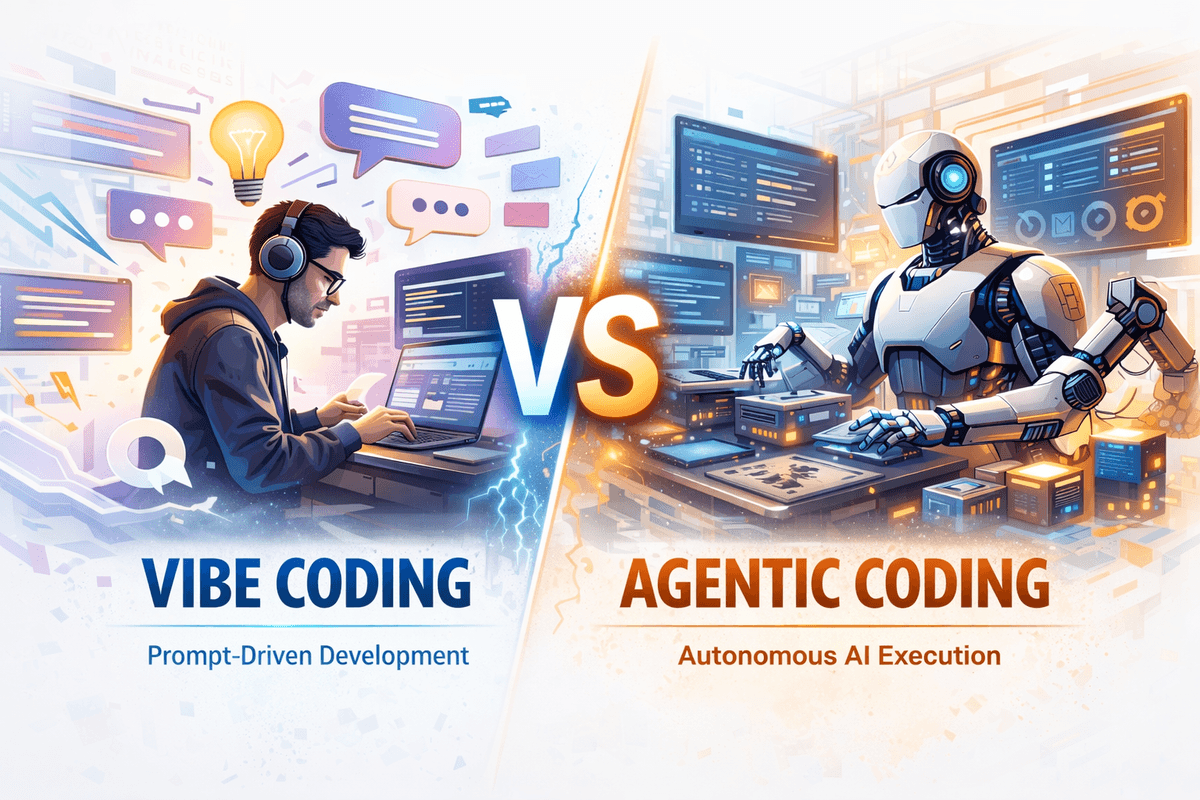
Vibe coding is exactly what it sounds like. You sit down with an idea. You open your editor. You prompt your AI assistant. You tweak. You refine. You follow momentum.
It’s flow-driven. It’s creative. It’s conversational.
In the Vibe coding vs agentic coding debate, vibe coding is the jazz musician. Improvising. Reacting. Building as inspiration strikes.
You describe what you want. AI generates code. You adjust it. It adjusts with you. That loop, prompt → generate → refine, is the heart of AI-assisted development in vibe mode.
This style fits perfectly into modern developer thinking trends because it lowers friction. You’re not wrestling with syntax. You’re shaping ideas.
Vibe coding reflects the early stage of coding mindset evolution, where creativity and speed matter more than structure.
- MVPs
- Side projects
- Rapid experimentation
- Learning new frameworks
But here’s the catch: vibe coding can get messy. Fast.
What Is Agentic Coding?
Agentic coding is structured. Intentional. Strategic.
Instead of generating snippets step by step, you define a goal. Then an AI agent plans, executes, tests, and sometimes even refines the work.
In the Vibe coding vs agentic coding comparison, agentic coding is the orchestra conductor. You don’t play every instrument. You direct the performance.
This is where modern developer workflows are heading. Developers define objectives. AI agents break tasks down. Systems run tests automatically. Feedback loops tighten.
Agentic coding represents a more advanced phase of coding mindset evolution. It’s not about writing code. It’s about orchestrating outcomes.
This shift reflects deeper developer thinking trends, moving from implementation to oversight.
- Large-scale systems
- Automated refactoring
- Continuous integration tasks
- Infrastructure orchestration
If vibe coding is creative momentum, agentic coding is controlled execution.
Key Differences at a Glance
Let’s simplify the Vibe coding vs agentic coding debate.
Role of the developer
- Vibe coding: Creator
- Agentic coding: Director
Interaction style
- Vibe coding: Conversational
- Agentic coding: Delegated and goal-driven
Best use cases
- Vibe coding: Prototyping and exploration
- Agentic coding: Scaling and automation
Risk
- Vibe coding: Technical debt
- Agentic coding: Over-automation complexity
Both reflect major developer thinking trends. Both are part of the broader coding mindset evolution shaping the future of software development.
Build this with a prompt on Greta.sh — describe the app, Greta writes and deploys it.Why the Shift in Thinking Matters
Here’s the real story behind Vibe coding vs agentic coding.
The scarce skill is no longer typing code.
It’s thinking clearly.
The biggest transformation in developer thinking trends isn’t tool-based. It’s cognitive. Developers are shifting toward higher-level cognitive approaches in coding, problem framing, system design, constraint definition.
This is the real coding mindset evolution.
In traditional development, you translated logic into syntax.
In today’s AI-assisted development, you translate intent into structured instructions.
See the difference?
You’re no longer just solving problems. You’re teaching systems how to solve them.
That’s a fundamental shift in the future of software development.
The Developer’s New Role
In the world of Vibe coding vs agentic coding, developers are evolving.
Old role:
- Write code
- Debug code
- Optimize code
New role:
- Define goals
- Architect workflows
- Validate outputs
- Set guardrails
This aligns perfectly with emerging developer thinking trends.
Developers are becoming:
- System designers
- AI supervisors
- Workflow architects
This coding mindset evolution demands stronger conceptual thinking. You need to understand how systems connect. How failures propagate. How constraints interact.
The code still matters. But the thinking matters more.
Comparing the Workflows
Let’s zoom in on how these styles actually operate inside modern developer workflows.
Vibe Coding Workflow
- You describe what you want.
- AI generates code.
- You test it.
- You refine the prompt.
- Repeat.
It’s fast. It’s reactive. It thrives in AI-assisted development environments.
This style supports rapid creativity and reflects early-stage coding mindset evolution where speed wins.
But it requires discipline. Without structure, vibe coding can spiral into fragile architecture.
Agentic Coding Workflow
- Define the outcome.
- AI agent breaks it into tasks.
- Agent executes across tools.
- Tests run automatically.
- You review summaries and logs.
This approach fits structured modern developer workflows and signals deeper developer thinking trends toward automation.
It’s less about lines of code and more about outcome alignment.
And it’s central to the future of software development.
Expert Tips for Thriving in Both Worlds
Want to master Vibe coding vs agentic coding?
Here’s what works:
- Think in systems, not snippets.
- Always define constraints clearly.
- Validate AI outputs aggressively.
- Write tests early.
- Shift modes intentionally.
The best engineers understand that coding mindset evolution isn’t about abandoning fundamentals. It’s about expanding cognitive capacity.
Strong cognitive approaches in coding still rely on logic, architecture, and design patterns.
AI just amplifies them.
Security and Quality Considerations
Here’s where things get serious.
With AI-assisted development, errors scale quickly.
In the Vibe coding vs agentic coding debate, agentic systems can automate mistakes just as efficiently as they automate productivity.
So what matters?
- Code reviews
- Automated testing
- Logging and monitoring
- Clear human checkpoints
The more autonomous your modern developer workflows become, the more critical oversight becomes.
This is a core theme in today’s developer thinking trends, responsible automation.
How Platforms Enable Both Approaches
Tooling is evolving fast.
We now have:
- AI copilots for vibe coding
- Multi-agent frameworks for agentic coding
- Integrated CI/CD with AI orchestration
- Smart refactoring assistants
These tools are shaping the future of software development and accelerating coding mindset evolution.
But remember, tools don’t replace thinking.
They magnify it.
Real-World Use Cases
Let’s make this practical.
When Vibe Coding Shines:
- Hackathons
- Startup prototypes
- Internal dashboards
- Learning experiments
When Agentic Coding Wins:
- Enterprise automation
- Codebase migrations
- Continuous testing pipelines
- Infrastructure management
Both approaches define current developer thinking trends and contribute to the broader coding mindset evolution shaping tech.
It’s not either/or.
It’s knowing when to switch gears.
Team and Cultural Shifts
The ripple effects of Vibe coding vs agentic coding go beyond individuals.
Teams are changing.
Product managers now think in terms of AI-enabled execution. QA teams integrate automated reasoning tools. Documentation becomes more structured to support agents.
This evolution reshapes modern developer workflows and accelerates the future of software development.
Culture shifts from “Who writes this?” to “How do we orchestrate this?”
That’s a massive transformation in developer thinking trends.
Navigating the Coding Mindset Evolution
So where does this leave us?
Right in the middle of a profound coding mindset evolution.
Developers are no longer just builders. They’re intelligence directors.
The real power in Vibe coding vs agentic coding isn’t speed or automation. It’s leverage.
And leverage changes everything.
If you adapt to these developer thinking trends, you stay ahead. If you resist, you risk becoming a manual executor in an automated world.
The future of software development belongs to developers who can think clearly, define problems precisely, and guide AI strategically.
| Dimension | Vibe Coding | Agentic Coding |
|---|---|---|
| Core Concept | Conversational code generation driven by prompts and intent | Autonomous AI agents that plan, execute, and validate tasks |
| Developer Role | Prompt designer and output reviewer | Goal setter, system orchestrator, and supervisor |
| Level of Autonomy | Moderate , AI generates code but requires frequent human interaction | High , AI agents can plan, write, test, and iterate independently |
| Interaction Style | Iterative prompting and conversational refinement | Objective-driven workflows with minimal prompting |
| Workflow Control | Human-guided step-by-step generation | AI-driven multi-step execution pipelines |
| Ideal Use Cases | Prototyping, MVPs, experiments, internal tools | Enterprise automation, large systems, CI/CD processes |
| Speed of Development | Very fast for early-stage development | Efficient for large-scale repetitive engineering tasks |
| Complexity Handling | Best for smaller or modular tasks | Designed for multi-system and complex workflows |
| Risk Profile | Inconsistent maintainability if prompts are weak | Reduced visibility into decision logic of agents |
| Testing Approach | Mostly manual validation by developers | Automated testing integrated into agent workflows |
| Skill Focus for Developers | Prompt engineering, rapid iteration, UX thinking | Systems thinking, orchestration, governance, guardrails |
| Organizational Impact | Speeds experimentation and product ideation | Enables automation, scalability, and operational efficiency |
| Typical Output Pattern | Snippets, modules, or feature implementations | End-to-end task execution and lifecycle updates |
Conclusion
The debate around Vibe coding vs agentic coding isn’t about which one wins. It’s about understanding how both reflect deeper developer thinking trends and a sweeping coding mindset evolution.
Vibe coding fuels creativity and speed. Agentic coding enables scale and structure. Together, they represent the next chapter in the future of software development.
The smartest developers won’t just write better code.
They’ll think better.
And in this era of AI-assisted development, thinking is the ultimate superpower.
FAQs
1. What is the main difference in Vibe coding vs agentic coding?
Vibe coding is interactive and flow-based, while agentic coding uses autonomous AI agents to execute defined goals.
2. How do developer thinking trends influence coding styles?
Modern developer thinking trends emphasize system design, orchestration, and high-level reasoning over manual implementation.
3. Is vibe coding suitable for large projects?
It can work early on, but without structure it may create technical debt in large systems.
4. Does agentic coding replace developers?
No. It shifts their role toward oversight and strategy within evolving modern developer workflows.
5. How does coding mindset evolution impact junior developers?
It lowers entry barriers but requires stronger focus on fundamentals and validation skills.
6. What role does AI-assisted development play in this shift?
AI-assisted development accelerates both vibe and agentic coding by automating repetitive tasks and enabling faster experimentation.
7. Are cognitive approaches in coding becoming more important?
Absolutely. Clear thinking and problem framing are central to the ongoing coding mindset evolution.
8. Which approach is better for startups?
Vibe coding works great for rapid prototypes, while agentic coding helps as systems scale.
9. How does this affect the future of software development?
The future of software development will prioritize orchestration, automation, and intelligent workflows.
10. Can teams combine both approaches?
Yes. The most effective teams blend vibe coding for exploration and agentic coding for scaling within modern developer workflows





© 2026 Questera
Follow in Google