






Questera vs Braze: Agentic Engagement vs Traditional Campaign Tools
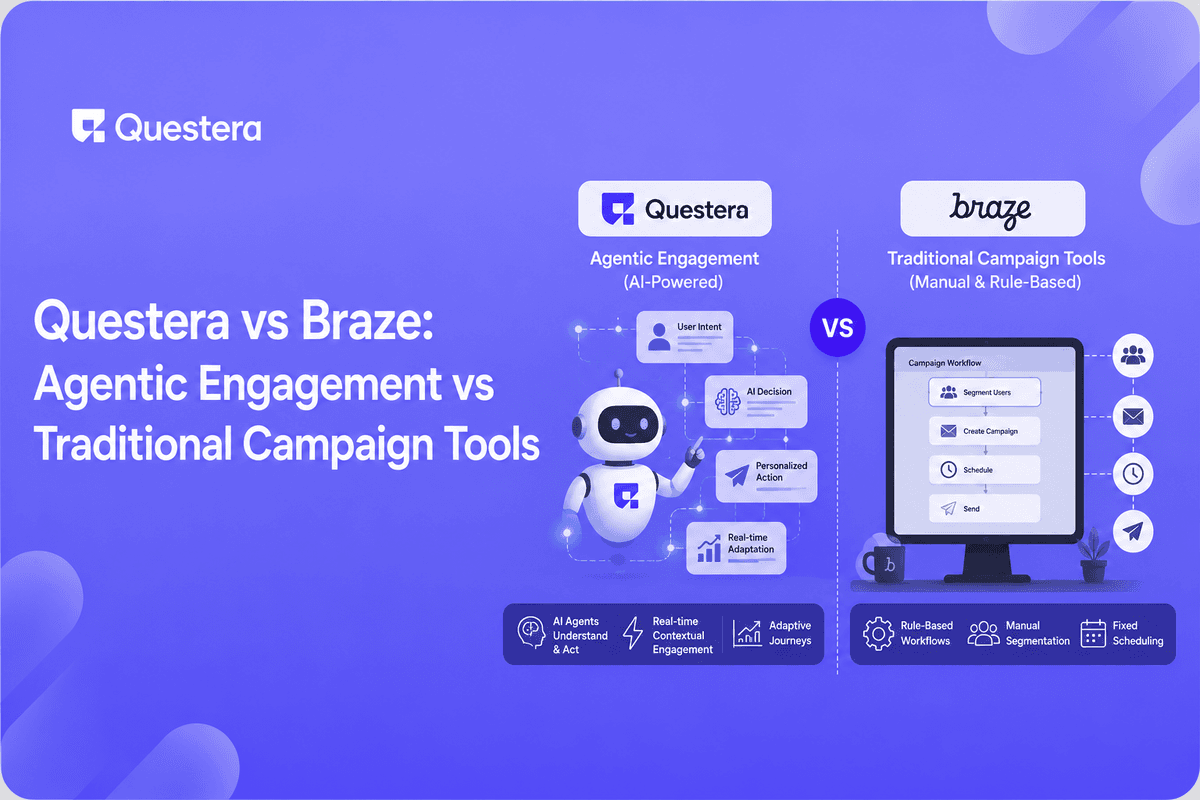
Questera vs Braze contrasts two engagement models. Braze is a powerful campaign orchestration platform where teams build and manage journeys manually. Questera is agentic — AI agents autonomously decide, personalize, and act on engagement. Braze suits hands-on campaign teams; Questera suits teams who want AI to run engagement.
Customer engagement tools are splitting into two philosophies: orchestrate campaigns yourself, or let AI agents run engagement for you. Questera vs Braze captures that divide between traditional campaign tooling and agentic engagement. This guide compares the two across approach, automation, personalization, and ideal use cases — so you can decide whether you want to drive engagement manually or hand it to AI agents in 2026.
Got an idea? Build it now!
Just start with a simple Prompt
Get Started Today


What Is Braze?
Braze is a customer engagement platform built around campaign orchestration — teams design messaging journeys, segments, and triggers across channels like email, push, and in-app, then manage and optimize them.
Its strength is robust, hands-on control over multichannel campaigns. The model assumes a team actively building and tuning journeys.
What Is Questera?
Questera is an agentic customer engagement platform where AI agents autonomously analyze behavior, decide on actions, personalize messaging, and execute engagement — rather than waiting for a marketer to build each journey.
Instead of manually orchestrating campaigns, you set goals and Questera agents drive engagement toward them, adapting in real time.
Questera vs Braze: Feature Comparison
The table maps the core differences between agentic and traditional campaign engagement.
| Factor | Braze | Questera |
|---|---|---|
| Model | Manual campaign orchestration | Agentic, AI-driven |
| Who acts | Marketing team builds journeys | AI agents decide + act |
| Personalization | Rule + segment based | Agent-driven, adaptive |
| Effort | Hands-on setup + tuning | Goal-set, agents execute |
| Adaptation | Manual optimization | Real-time autonomous |
| Best for | Hands-on campaign teams | Teams wanting AI to run engagement |
Got an idea? Build it now!
Just start with a simple Prompt
Get Started Today
When Should You Choose Braze Over Questera?
Choose Braze when your team wants granular, hands-on control over multichannel campaigns and has the resources to build and tune journeys. For mature campaign teams with established processes, that control is valuable.
If you prefer to design every journey yourself, a traditional orchestration platform fits that working style.
When Should You Choose Questera Over Braze?
Choose Questera when you'd rather set goals and let AI agents run engagement — deciding, personalizing, and acting autonomously — instead of manually building each journey. It suits lean teams and those scaling personalization beyond manual capacity.
Agentic engagement is part of a broader shift toward autonomous AI features in software, the same direction explored in adding AI agents inside your app. And because agents act on customer data, access control matters — apply role-based access on the data they touch.
Key Benefits at a Glance
- Braze offers deep, hands-on control of multichannel campaigns.
- Questera runs engagement with autonomous AI agents.
- Questera adapts in real time; Braze relies on manual optimization.
- Questera scales personalization beyond manual team capacity.
- Braze suits established campaign teams; Questera suits AI-first engagement.
Common Mistakes to Avoid
- Choosing a manual platform if you lack the team to run campaigns.
- Expecting agentic tools to need zero strategy — you still set goals.
- Ignoring data quality, which both models depend on.
- Overlooking access control on customer data used by AI agents.
- Comparing on features alone instead of the engagement model that fits.
Frequently Asked Questions
What's the difference between Questera and Braze?
Braze is manual campaign orchestration; Questera is agentic, with AI agents autonomously deciding and acting on engagement.
Is agentic engagement better than campaigns?
It depends. Agentic suits teams wanting AI to run engagement at scale; manual campaigns suit hands-on teams wanting granular control.
Does Questera require a big marketing team?
No. The point of agentic engagement is that AI agents handle execution, suiting leaner teams who set goals rather than build every journey.
Can I still control the strategy with Questera?
Yes. You set goals and guardrails; agents execute within them. It's direction-setting rather than manual journey-building.
Which scales personalization better?
Questera, because AI agents personalize adaptively beyond what a team can manually orchestrate.
Key Takeaways
- Braze is manual campaign orchestration; Questera is agentic engagement.
- Questera's AI agents decide, personalize, and act autonomously.
- Choose by working style — hands-on control vs AI-run engagement.
- In Questera vs Braze, pick Questera to let AI agents run engagement at scale.
Want AI to run your engagement instead of building every journey? Explore Questera and see agentic engagement in action.
Got an idea? Build it now!
Just start with a simple Prompt
Get Started Today
Ready to be a
10x Marketer?
See it in action