






AI App Builders for E-commerce Brands (Beyond Shopify)
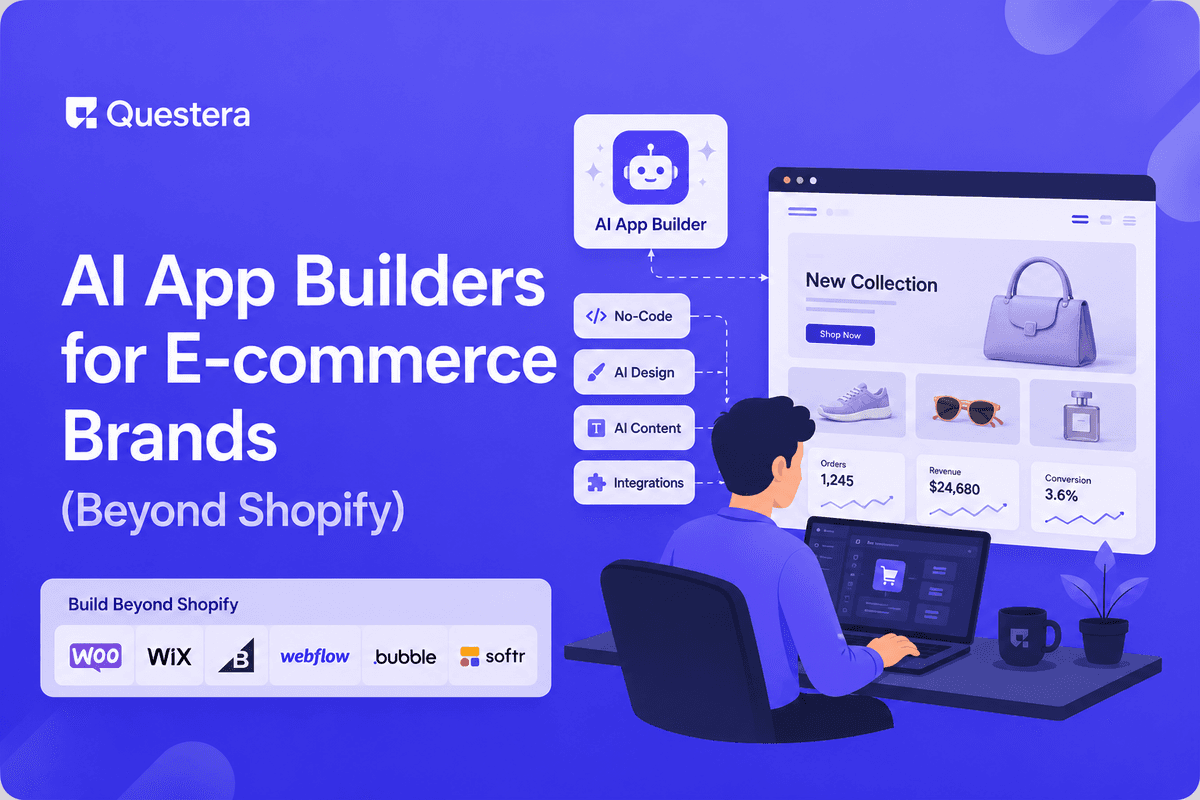
Shopify handles the e-commerce core (catalog, cart, checkout, payments) better than AI app builders can. But e-commerce brands need more than the core — custom storefronts, post-purchase experiences, loyalty programs, subscription management, customer portals, B2B wholesale portals, internal operations dashboards. AI app builders excel at these adjacent applications that Shopify themes can't deliver. The pattern that works: keep Shopify for commerce; use AI app builders for everything around it. This guide covers what to build beyond Shopify, the integration patterns (Shopify Storefront API, headless commerce, webhook-driven sync), and the realistic stack for modern e-commerce brands.
E-commerce brands need much more than the core. Custom storefronts that don't look like every other Shopify theme. Post-purchase experiences (order tracking, returns portals, support). Loyalty and rewards programs tailored to your brand. Subscription management beyond what Shopify Subscriptions handles. Customer portals for repeat buyers. B2B wholesale portals with different pricing for trade customers. Internal operations dashboards combining Shopify data with other systems. This is where AI app builders shine for e-commerce — building everything around Shopify, not replacing it.
Why Not Replace Shopify Entirely?
- Payment processing and fraud detection at e-commerce scale is hard
- Tax compliance (sales tax, VAT, international) is complex and changing
- Shipping integrations (USPS, UPS, FedEx, DHL) require ongoing maintenance
- Inventory management across SKUs, variants, locations is mature in Shopify
- Mature app ecosystem covers most niche needs
- Building the commerce core in AI app builder = 6+ months that adds no differentiation
- Brand competitive advantage isn't checkout flow; it's everything around it
What to Build with AI App Builders for E-commerce
Custom Storefronts (Headless Commerce)
- Marketing-led storefront that doesn't look like a Shopify theme
- Editorial product pages with rich content
- Interactive product configurators
- Quiz-driven product recommendations
- Lookbook-style browsing experiences
- Speed: AI app builder generated frontends often faster than Shopify themes
Post-Purchase Experiences
- Custom order tracking page with brand experience
- Returns portal that handles brand-specific return policies
- Self-serve customer support portal with order context
- Review and rating submission flows
- Cross-sell and upsell after purchase
Loyalty and Rewards Programs
- Custom points system tied to your brand identity
- Tier-based rewards (bronze/silver/gold based on lifetime spend)
- Referral programs with custom tracking
- Birthday and anniversary rewards
- Integration with Shopify customer data via Customer API
Subscription Management
- Beyond basic Shopify Subscriptions — pause, swap, customize
- Subscription customer portal with full self-service
- Bundles and curated boxes
- Subscription analytics dashboards
B2B Wholesale Portals
- Different pricing tiers for trade customers
- Net 30 / Net 60 payment terms
- Bulk ordering interfaces
- Account-level permissions and approvals
- Catalog filtering by trade-only products
Internal Operations Dashboards
- Combine Shopify data with marketing, fulfillment, customer service data
- Custom inventory views with reordering automation
- Profitability dashboards combining cost, shipping, returns data
- Customer LTV analysis across multiple touchpoints
- Team coordination tools
Marketing Landing Pages and Quizzes
- Campaign-specific landing pages
- Product recommendation quizzes
- Comparison tools
- Educational content sites that funnel to product
- Influencer-specific landing pages
Integration Patterns with Shopify
Shopify Storefront API (Most Common)
- GraphQL API for reading products, customers, orders from your app
- Add-to-cart and checkout via Shopify (your app redirects to Shopify checkout)
- Real-time product data without managing your own inventory
- Works for headless storefronts, custom product pages, configurators
Shopify Admin API
- Full access to store data (orders, customers, inventory)
- Used for internal tools, operations dashboards, reporting
- Webhooks for real-time updates
- Rate limits to respect
Webhook-Driven Sync
- Shopify sends webhooks when orders, customers, products change
- Your app receives webhook, updates own database
- Pattern for loyalty programs, customer portals, internal tools
- Eventually consistent (not real-time but close)
Customer Account API (Newer)
- Shopify's customer authentication available to apps
- Customer logs in via Shopify; your app verifies token
- Single sign-on across Shopify and your custom apps
- Reduces auth complexity significantly
The Realistic Stack for Modern E-commerce Brands
- Shopify — Commerce core (catalog, cart, checkout, payments)
- AI app builder (Greta, Lovable) — Custom storefronts, customer portals, operational tools
- Klaviyo or Mailchimp — Email marketing
- Recharge or Loop — Subscriptions if Shopify Subscriptions insufficient
- Yotpo or Stamped — Reviews and UGC
- Postscript or Attentive — SMS marketing
- Triple Whale or Polar — Analytics and attribution
- Custom-built — Adjacent apps via AI app builder (loyalty, B2B, etc.)
Build Sequences for Common Projects
Want to try one of these? Start on Greta.sh — no setup, no boilerplate — just a prompt.Custom Headless Storefront (5–10 Days)
- Day 1–2: Connect Shopify Storefront API; product listing page
- Day 3–4: Product detail page with variant selection
- Day 5–6: Cart and checkout redirect to Shopify
- Day 7–8: Brand-specific design polish
- Day 9–10: Performance optimization, SEO, launch
Customer Portal (3–5 Days)
- Day 1: Shopify Customer Account API integration for auth
- Day 2: Order history page with reorder
- Day 3: Account settings, addresses, payment methods
- Day 4: Wishlist, loyalty status integration
- Day 5: Polish and launch
Loyalty Program (5–7 Days)
- Day 1–2: Data model (Customer, Points, Tier, Reward, Transaction)
- Day 3: Webhook integration with Shopify (order webhooks → points)
- Day 4–5: Customer-facing portal (points balance, available rewards, history)
- Day 6–7: Admin tools (point rules, reward management, customer support)
B2B Wholesale Portal (10–14 Days)
- Day 1–3: Data model (B2BCustomer, PricingTier, NetTerms, BulkOrder)
- Day 4–5: B2B-specific catalog with trade pricing
- Day 6–8: Bulk ordering interface
- Day 9–11: Approval workflows for multi-user accounts
- Day 12–14: Integration with Shopify for order fulfillment
When AI App Builders Win vs Shopify Apps
AI App Builders Win When
- Custom brand experience is differentiator
- Specific workflows that no Shopify app handles well
- Need cross-system data (Shopify + other tools)
- Want to own the customer experience entirely
- Subscription costs to Shopify apps exceed AI app builder cost
Shopify Apps Win When
- Standard functionality where Shopify app is well-built
- No time to build custom (Shopify app is install-and-go)
- Don't need brand customization beyond standard configuration
- Limited technical bandwidth for ongoing maintenance
Honest framing: at small e-commerce scale (under $500K/year), Shopify apps usually win on speed and convenience. At larger scale ($500K–$10M/year) where 1–2% conversion improvements matter, custom builds via AI app builders increasingly win because of fit.
Real E-commerce Brand Example Patterns
DTC Apparel Brand with Custom Storefront
- Shopify for catalog and checkout
- Custom storefront in Next.js (via AI app builder) for editorial content
- Brand-specific design that doesn't look like Shopify theme
- Outcome: 2–3× engagement on product pages vs theme; conversion holds or improves
Subscription Box Brand with Custom Portal
- Shopify for one-time and subscription billing (or Recharge alongside)
- Custom customer portal for box customization, pause/swap, history
- Brand-specific monthly box reveals and content
- Outcome: lower subscription churn, higher LTV
Beauty Brand with Quiz-Driven Recommendations
- Shopify for products and checkout
- Custom quiz on landing pages (skin type, concerns, preferences)
- AI-driven product recommendations based on quiz answers
- Funnel into Shopify checkout with recommended bundle
- Outcome: significantly higher AOV; lower bounce rate
Common Mistakes
- Trying to replace Shopify entirely — Almost always wrong. Build around it, not instead of it.
- Building things Shopify apps already solve well — Don't reinvent loyalty if Smile.io solves it adequately.
- Ignoring webhook-driven sync — Real-time sync is overkill; webhooks with eventual consistency works.
- Underestimating Shopify's commerce core — Payments, fraud, tax, shipping are hard. Don't replicate.
- Skipping Customer Account API — Reinventing auth when Shopify provides it integrated.
- Custom storefront without performance attention — Headless storefronts can be slower if not optimized.
- Building before measuring conversion impact — Custom storefronts cost time; measure they're winning vs themes.
- Forgetting SEO when going headless — Theme-based stores get SEO via Shopify; headless requires SEO investment.
- Treating Shopify integration as one-time — APIs evolve. Maintain integration as ongoing work.
- Underestimating support burden — Custom apps need support; budget the operational time.
Frequently Asked Questions
Why not use Shopify themes for everything?
Shopify themes excel at standard commerce. They struggle with brand-specific experiences, complex customer portals, custom B2B workflows, deep loyalty integrations, and cross-system internal tools. For brand experience differentiation, custom builds win. For commerce basics, themes are fine.
What about Shopify Hydrogen?
Hydrogen is Shopify's official React framework for headless storefronts. Excellent choice when you want Shopify-native tooling. AI app builders provide more flexibility but require building the integration patterns yourself. Both valid; pick based on team preferences.
Can I use AI app builders for the main checkout flow?
Technically yes; practically no. Shopify Checkout handles payments, fraud, tax, address validation, shipping rates — all hard problems. Custom checkout adds significant maintenance burden with marginal benefit. Use Shopify Checkout via Storefront API.
What about cost?
Shopify ($29–$2000/month) + AI app builder (~$30–$80/month) + Klaviyo ($30–$2000/month) — total stack at small DTC scale is $90–$500/month, scaling with revenue. Cost-effective compared to custom development at any scale.
Can I migrate off Shopify later if needed?
Yes — Shopify provides data export. Migration is significant work (typically 3–6 months for established brands) but possible. Most brands stay on Shopify long-term; the question rarely comes up in practice for thriving brands.
Shopify handles e-commerce core better than AI app builders can replicate. Don't replace Shopify; build around it. AI app builders excel at: custom storefronts, post-purchase experiences, loyalty programs, customer portals, B2B wholesale portals, internal operations dashboards, marketing landing pages and quizzes. The combination — Shopify for commerce, AI app builders for everything else — is the modern e-commerce stack. Start with one project — a custom landing page, customer portal, or loyalty program. Measure impact. Iterate. The brands using AI app builders alongside Shopify in 2026 are creating experiences competitors can't match with themes alone.





© 2026 Questera
Follow in Google