






12 Prompt Patterns Every AI User Should Know
Introduction
Have you ever wondered why some people get incredible results from AI tools while others struggle? The answer often lies in how they use prompt patterns, how they design Greta prompt patterns, and how consistently they apply prompts. Instead of writing random instructions and hoping for good results, experienced AI users rely on structured, repeatable, and strategic prompt patterns for AI. That guides the model toward accurate and meaningful outputs.
In this guide, we will explore prompt patterns, how Greta prompt patterns work, and why Greta prompts can dramatically improve your productivity, creativity, and decision making. We will also walk through prompt engineering for Greta, discuss Greta AI prompts, and explore how advanced prompting techniques, prompt design patterns, structured AI prompts, and reusable prompt template approaches help you unlock the full power of AI.
By the end, we will not only understand AI prompt patterns, but we will also be equipped with practical Greta prompt patterns you can start using immediately.
TL;DR
Most AI users get inconsistent results because they rely on ad-hoc prompts instead of structured, reusable prompt patterns. Prompt patterns provide clear frameworks that guide model reasoning, improve accuracy, and make outputs more predictable. When applied consistently, especially in Greta workflows, they enhance productivity, reasoning quality, and content reliability.
The article explains how prompt engineering and structured AI prompts create scalable, repeatable Greta prompts that support better logic, formatting consistency, and output control.
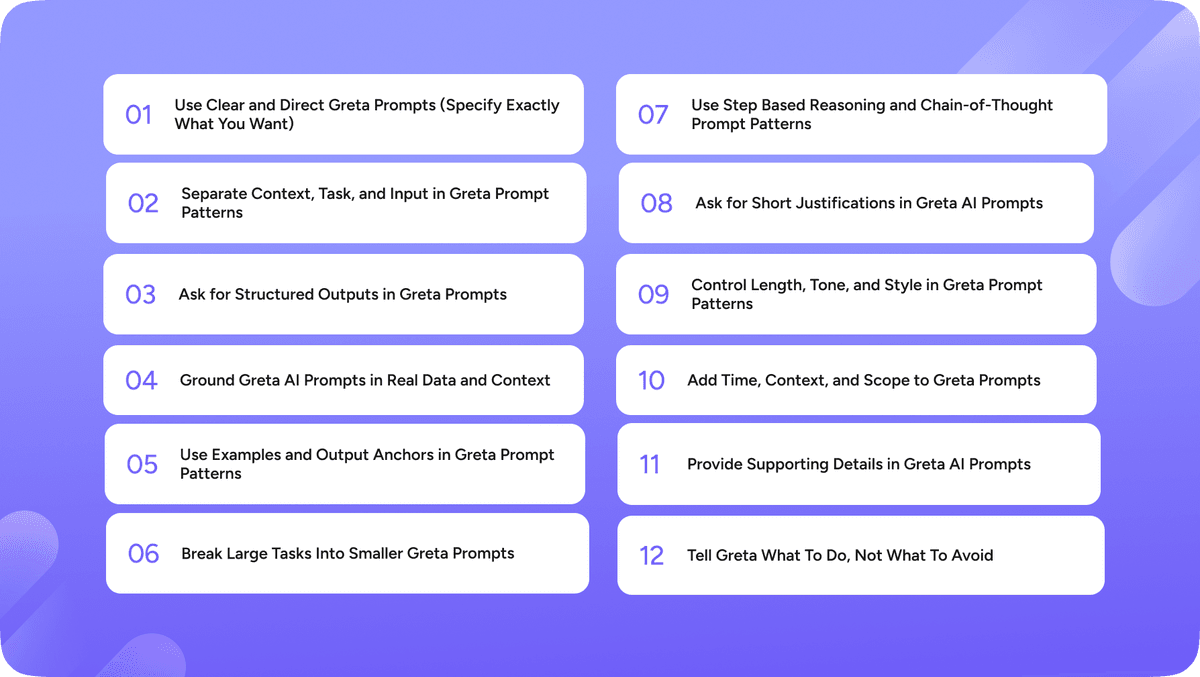
The 12 prompt patterns highlighted focus on:
- writing clear and direct task-focused prompts
- separating context, task, and input
- requesting structured outputs
- grounding responses in real data
- using examples and output anchors
- breaking complex tasks into smaller steps
- asking for short justifications
- defining tone, length, and style
- adding time, scope, and context
- supplying supporting details
- using positive, action-driven instructions
- encouraging step-based reasoning and chain-of-thought
Together, these prompt design patterns create more accurate, explainable, and reusable AI workflows, enabling users to produce reliable outputs across analytical, creative, and decision-support tasks.
What are AI Prompt Patterns?
Prompt patterns are simple frameworks that guide how AI thinks and responds. When you design Greta prompt patterns and reuse prompts, you create more effective results. These prompt patterns for AI help reduce confusion and improve structure in every interaction.
Users who apply AI prompt patterns see stronger reasoning, clearer explanations, and more refined outputs. That is why prompt patterns and Greta prompts are essential in modern AI workflows.
Key points:
- Prompt patterns make prompts easier to reuse and refine.
- Greta prompt patterns improve clarity, tone, and style.
- Greta prompts create more accurate and effective AI responses.
- Prompt patterns for AI support organized thinking and structured output.
- AI prompt patterns help guide logic and reduce unnecessary guesswork.
What is the Role of Prompt Engineering for Greta?
Prompt engineering for Greta focuses on building strong Greta prompts and reusable Greta prompt patterns. It uses structured AI prompts and prompt design patterns to improve accuracy and consistency. These methods make Greta AI prompts more reliable and more meaningful.
When users design prompts intentionally, they unlock the real value of prompt patterns, AI prompt patterns, and Greta prompt patterns. This approach turns every Greta prompt into a powerful productivity tool.
Key points:
- Prompt engineering for Greta improves output control and consistency.
- Greta AI prompts work best when built on strong prompt patterns.
- Structured AI prompts reduce errors and irrelevant responses.
- Prompt design patterns keep prompts clean and focused.
- Greta prompt patterns make prompts easier to reuse and scale.
- Greta prompts support for better reasoning and clearer explanations.
- AI prompt patterns guide structured thinking and logical output.
Prompt patterns for AI help create reliable workflows.
1. Use Clear and Direct Greta Prompts (Specify Exactly What You Want)
One of the most important prompt patterns is clarity. When you write Greta prompts that are simple, direct, and goal focused, the outputs become more accurate and consistent. Strong Greta prompt patterns remove ambiguity and guide Greta toward the right response.
This is a core principle in prompt engineering for Greta and helps create more effective AI prompts.
2. Separate Context, Task, and Input in Greta Prompt Patterns
Well structured Greta prompt patterns work best when the system role, task instructions, and user input are clearly separated. This aligns with professional prompt patterns for AI and supports predictable behavior across different Greta AI prompts.
This organization strengthens:
- prompt design patterns
- structured AI prompts
- advanced prompting techniques
It ensures Greta always understands what part of the prompt is instruction, and what part is content.
3. Ask for Structured Outputs in Greta Prompts
Many users improve response quality by writing Greta prompts that request structured output formats. These prompt patterns turn long responses into organized and readable results.
Structured outputs work especially well with:
- tables
- bullet lists
- keypoint summaries
This approach is central to AI prompt patterns and professional prompt engineering for Greta, and it helps create reliable, effective AI prompts for real workflows.
4. Ground Greta AI Prompts in Real Data and Context
Strong Greta prompt patterns often include real examples, numbers, datasets, or input text. When Greta prompts for concrete information, the response becomes more accurate and context aware.
This grounding process enhances:
- reasoning quality
- factual reliability
- output relevance
It is one of the most important prompt patterns for AI, especially for analytical or decisionsupport tasks.
5. Use Examples and Output Anchors in Greta Prompt Patterns
One of the most useful advanced prompting techniques is showing Greta what “good output” looks like. When Greta prompts include examples or sample formats, the AI aligns more closely with your expectations.
These patterns strengthen:
- prompt design patterns
- Greta AI prompts
- reusable prompt template systems
They turn one time prompts into repeatable, scalable workflows.
6. Break Large Tasks Into Smaller Greta Prompts
Complex requests work better when broken into smaller, focused Greta prompts. This is one of the most effective Greta prompt patterns because it improves clarity and helps Greta reason step by step.
This aligns with proven:
- AI prompt patterns
- structured AI prompts
- prompt engineering for Greta
Smaller tasks lead to cleaner responses and fewer revisions.
7. Ask for Short Justifications in Greta AI Prompts
Many users create effective AI prompts by asking Greta to provide short reasoning or justification instead of long explanations. This keeps responses concise while still preserving logical depth.
This pattern improves:
- transparency
- evaluation quality
- decisionmaking confidence
It is widely used in strategic Greta prompt patterns and analytical Greta prompts.
8. Control Length, Tone, and Style in Greta Prompt Patterns
Great Greta prompt patterns include formatting and tone constraints. These prompt patterns for AI define how detailed, formal, simple, or conversational the output should be.
This supports:
- consistent voice
- reusable formatting
- predictable output behavior
It is also a core element of professional prompt design patterns.
9. Add Time, Context, and Scope to Greta Prompts
Strong Greta prompts specify whether content should be:
- industryspecific
- regionfocused
- trendbased
These Greta prompt patterns help Greta produce results that are more relevant to realworld scenarios.
This technique improves:
- contextual awareness
- research alignment
- output specificity
and is commonly used in advanced prompting techniques.
10. Provide Supporting Details in Greta AI Prompts
Well-designed Greta prompt patterns often include additional background or reference material. The more context Greta has, the smarter and more actionable the response becomes.
This is especially valuable for:
- analysis tasks
- research support
- structured reasoning
It strengthens the quality of effective AI prompts.
11. Tell Greta What To Do, Not What To Avoid
One of the most reliable AI prompt patterns is instructing Greta positively rather than negatively. Instead of telling Greta what not to do, strong Greta prompts give clear action based direction.
This leads to:
- cleaner reasoning
- less confusion
- clearer task alignment
and reflects best practice prompt engineering for Greta.
12. Use Step Based Reasoning and Chain-of-Thought Prompt Patterns
This is one of the most valuable Greta prompt patterns in the G12 framework. When Greta prompts request step by step reasoning, Greta produces deeper, more reliable answers.
This method supports:
- logical breakdowns
- progressive thinking
- structured responses
It is widely recognized as a core advanced prompting technique and works perfectly with structured AI prompts and reusable prompt template workflows.
FAQs
1. What are prompt patterns in AI?
Prompt patterns are structured ways of writing prompts, so AI responds more clearly and consistently. They help improve the quality of Greta prompts and Greta prompt patterns.
2. Why are Greta prompt patterns useful?
Greta prompt patterns, guide tone, structure, and reasoning. They help create more accurate, reliable, and effective AI prompts across different tasks.
3. What is prompt engineering for Greta?
Prompt engineering for Greta is the process of designing Greta AI prompts using prompt patterns for AI, AI prompt patterns, and structured instructions to improve output quality.
4. How do structured AI prompts help?
Structured AI prompts make responses easier to read and reuse. They work well with prompt design patterns, Greta prompt patterns, and advanced prompting techniques.
5. What is a reusable prompt template?
A reusable prompt template is a repeatable format you can use for multiple Greta prompts, helping save time and maintain consistency.
Ready to be a
10x Marketer?
See it in action





© 2026 Questera
Follow in Google