






Will AI Replace Developers? Honest 2026 Analysis
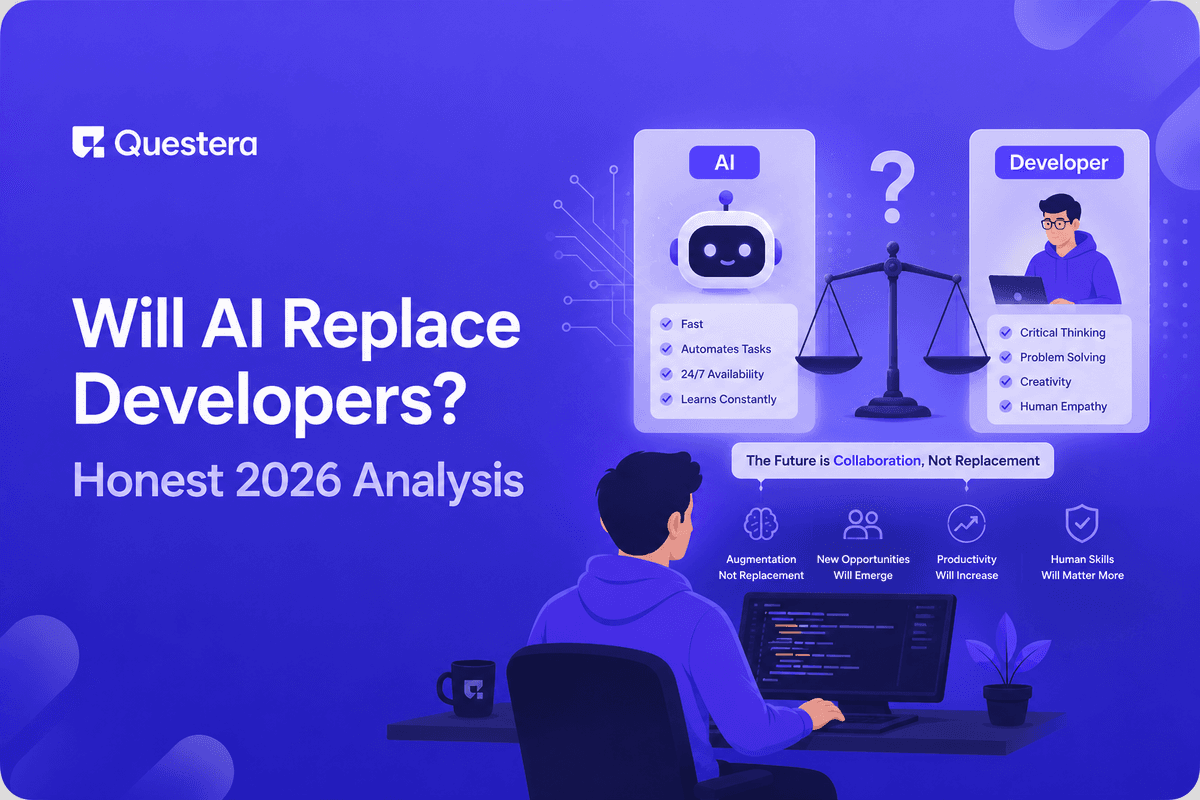
Will AI replace developers? Short answer: no, but it's replacing some kinds of developer work. Honest 2026 analysis: routine coding tasks compress dramatically. Junior engineering roles concentrate. Mid-tier framework specialists feel pressure. Senior engineers and domain experts thrive. Hiring rates dropped at large companies; indie SaaS exploded with solo founders shipping full products. The category 'developer' didn't disappear; it stratified.
'Will AI replace developers?' became one of the most-Googled developer questions starting in 2023. Three years later, the data is clearer. The short answer remains: no, AI isn't replacing developers as a category — but it is replacing some kinds of developer work, compressing some roles, and stratifying the profession in ways that didn't exist before. This guide gives the honest 2026 analysis — no doom; no hype; just the picture as it actually exists.
What 'Replacing Developers' Actually Means
The framing 'will AI replace developers' is too broad. Developers do many different kinds of work; AI is good at some and bad at others. The right question is: which developer activities is AI replacing, and which is it amplifying?
Activities AI Is Replacing or Compressing
- Boilerplate code generation — Auth scaffolding, CRUD APIs, form validation, basic UI components
- Translating spec docs to implementations — AI now does direct translation
- Greenfield feature implementation in well-understood domains
- Test scaffolding (test setup, not test quality)
- Documentation generation
- Code formatting and style fixes
- Basic refactoring (renaming, extraction, modernization)
- API client code generation from OpenAPI specs
Activities AI Is Amplifying (Not Replacing)
- Code review — Engineers reviewing AI-generated code as critical skill
- Architecture and system design — Trade-offs, scalability, integration patterns
- Security analysis — Catching subtle issues AI doesn't always flag
- Performance optimization at scale
- Edge case handling and resilience design
- Customer empathy and product judgment
- Cross-functional negotiation and influence
- Mentorship and culture-building
Activities AI Is Bad At (Largely Unchanged)
- Novel problem-solving in unfamiliar domains
- Strategic technical decisions with long-term implications
- Crisis judgment under ambiguity
- Reading organizational dynamics
- Long-term system stewardship
- Vision-setting and influence
Who's Winning in 2026
Solo Founders and Indie SaaS Operators
- Building full SaaS without engineering hires
- Indie SaaS at $10K–$200K MRR with solo operators
- Niche-fit products serving specific audiences
- Lifestyle businesses without VC pressure
Senior Engineers with Judgment + AI Proficiency
- Higher leverage than ever — same engineer shipping 3–5× more
- Code review expertise increasingly valuable
- Architecture skills appreciate
- Domain expertise + AI fluency wins
Specialists in Judgment-Heavy Areas
- Security engineers
- Performance engineers at scale
- Infrastructure engineers
- Compliance-focused engineers (HIPAA, SOC 2, financial)
- ML engineers building genuine ML systems
Junior Engineers Who Skill Up Fast
- AI is leverage; juniors using it well punch above their level
- Faster path to senior responsibility
- Broader foundations early in career
Who's Struggling in 2026
Mid-Tier Framework Specialists
- Engineers whose primary value was framework-specific expertise
- AI handles framework patterns; specialist depth less rare and less valuable
- Path forward: deepen judgment skills, broaden across stack, develop domain expertise
Engineers Who Resist AI Tools
- Output gap with AI-using peers is real and growing
- 5× difference in feature shipping cadence common between AI-using and non-AI-using engineers
- Path forward: adopt the tools; the gap closes quickly with practice
Junior Engineers in Routine Implementation Roles
- Some traditional junior tasks (boilerplate, simple CRUD) automated
- Junior roles concentrate at companies that can absorb training cost
- Path forward: skill up faster than peers, learn code review, develop broader foundations
Offshore Development Shops at Low-Skill Tiers
- Body-shop work compresses as AI handles routine implementation
- High-skill offshore engineering thrives at same level as onshore
- Path forward (for shops): move up the value chain to judgment-heavy work
Hiring Market Shifts
- Big tech hiring slowed dramatically — Layoffs in 2023–2025 plus reduced hiring through 2026
- Startup hiring tightened — Solo founders shipping more before hiring; first hires often later
- Smaller engineering teams average — Where 20-person teams ran, 5-person teams now suffice
- Engineering compensation stratified — Top engineers paid more; commodity work pays less
- Indie SaaS contractor market expanded — More freelance and contract opportunities
- International remote market matured — Global talent pool more accessible
Honest framing: the engineering labor market in 2026 is less abundant than 2020–2022 peak but more abundant than 2023–2024 trough. Engineers with the right skills are in strong demand; engineers with depreciated skill sets face longer searches.
Compensation Patterns in 2026
| Tier | Pattern | Typical Direction |
|---|---|---|
| Top tier (FAANG-level) | Compensation maintained or rose | Demand for top talent remained |
| Senior generalists at startups | Compensation maintained | Lean teams need experienced engineers |
| Mid-tier engineers | Pressure on compensation | Commodity work compressed |
| Junior engineers | Compressed; fewer openings | Boilerplate work absorbed by AI |
| Specialists (security, infra, ML) | Compensation rose | Judgment-heavy work in demand |
| Indie SaaS operators | Revenue uncapped; highly variable | No salary; equity in own business |
What Developers Should Do Based on Career Stage
If You're a Junior Engineer
- Use AI tools daily — Cursor, Greta, AI app builders; don't wait for permission
- Learn code review fast — Reviewing AI-generated code is the new junior superpower
- Build broad foundations — Cross-stack competence increasingly valuable
- Develop domain expertise alongside technical skill — Healthcare, fintech, real estate, etc.
- Ship side projects — Demonstrate AI-augmented shipping cadence in your portfolio
- Contribute to open source — Especially AI-tooling adjacent projects
If You're a Mid-Level Engineer
- Audit your skill stack — How much value comes from framework-specific knowledge vs judgment?
- Invest in judgment-heavy work — Architecture, security, performance, customer empathy
- Develop a domain specialty — Become the go-to person for a specific vertical
- Get good at AI tooling — Prompt design, code review, AI cost optimization
- Mentor junior engineers — Both contribute to team and develop senior skills
- Consider indie SaaS — Side projects can become real businesses now
If You're a Senior Engineer
- Use your judgment leverage — AI amplifies senior skills (architecture, review, mentorship)
- Lead AI tooling adoption — Be the senior who brings AI workflows to the team
- Mentor and coach — Junior engineers need senior judgment in AI-built systems
- Develop technical leadership skills — Influence beyond code
- Consider founder/CTO paths — Senior engineers are well-positioned to start companies now
- Avoid pure-implementation roles — Move toward judgment-heavy work
If You're an Engineering Manager
- Restructure team operations for compressed build cycles — Question every ceremony
- Invest in team AI tooling competence — Training, examples, shared patterns
- Adjust hiring criteria — Judgment, code review skill, customer empathy as primary
- Run smaller, higher-output teams — Resist the urge to grow team size in old ratios
- Focus on technical leadership and quality — Project management overhead should reduce
If You're a Founder or Technical Founder
- Build longer before hiring — Solo SaaS at $50K–$200K MRR is achievable now
- When you hire, hire for judgment — First engineering hire should be experienced
- Use AI tooling as competitive advantage — Lean teams competing with VC-funded incumbents
- Pick niche markets where AI advantage compounds
- Document AI workflows as company knowledge
What the Data Shows About Hiring
- Big tech engineering hiring dropped 30–50% from 2022 peak — Real and persistent
- Total engineering jobs in the economy actually grew modestly through 2026 — Distribution shifted
- Indie SaaS counts as employment shift — Solo founders aren't 'employees' but are still in the field
- Stratification more pronounced — Top engineers paid more; commodity engineering pays less
- Time-to-hire for senior engineers extended — But salaries held for top candidates
- Junior engineer time-to-first-job extended — Reflects compressed entry-level openings
The Trajectory: What to Expect in 2027–2030
- Agent-driven workflows handle more routine engineering — Deploys, incident response, code maintenance
- AI gets better at edge cases and security — But not fast enough to displace senior judgment
- Engineering teams continue compressing — 5-person teams doing what 20-person teams did becomes 3-person teams
- New role categories emerge — Agent engineering, evaluation engineering, AI safety engineering
- Domain specialists retain and grow value — Industry-specific expertise hard to replicate
- Indie SaaS market grows substantially — Many more solo founders shipping real products
- Code review skill remains central — As AI generates more code, reviewing it well stays critical
Common Misconceptions
- 'AI will replace all developers in 5 years' — No. AI is replacing specific kinds of developer work; expanding others. Engineers as a category persist for the foreseeable future.
- 'AI changes nothing structurally' — Wrong. Build cycles compressed dramatically. Team structures shifted. Career paths changed. The structural impact is real.
- 'Only senior engineers benefit' — Juniors who skill up fast benefit too. The path is harder; the path exists.
- 'Engineers should just learn AI prompting' — Necessary but not sufficient. Code review, architecture, security, customer empathy are at least as important as prompt design.
- 'AI will plateau and engineering returns to normal' — Unlikely. The capability trajectory continues; the new workflow is structural, not transitional.
- 'Engineering jobs are doomed' — Top engineering jobs are paid more than ever. The market stratified; commodity work compressed. Quality engineering work continues to be high-value.
Common Mistakes Developers Make
- Resisting AI tools — Refusing to use AI = falling behind peers who do. Adoption isn't optional anymore.
- Over-specializing in single framework — Framework specialists are less rare. Broaden.
- Skipping prompt design as a skill — Prompt skill compounds; lack of skill becomes career-limiting.
- Underestimating code review — Reviewing AI-generated code well is now core engineering value.
- Neglecting customer empathy — Building right things matters more than ever.
- Staying in pure implementation roles — Move toward judgment-heavy work where you can.
- Comparing 2026 market to 2021 — Different market; expectations should adjust.
- Not building side projects — Side projects demonstrate AI-augmented shipping cadence.
- Ignoring indie SaaS as an option — Solo SaaS path is more viable than ever.
- Catastrophizing — The market is harder than 2021 but better than 2024. Top engineers in strong demand.
Frequently Asked Questions
Should I still go into software engineering as a career?
Yes if you're willing to adapt. The career exists and provides good compensation for the right skills. The path is harder than 2018–2021 but the upside for skilled engineers remains strong. Engineers with judgment, code review skill, and AI fluency are in demand.
What about CS degrees — still valuable?
Yes. CS fundamentals (algorithms, data structures, systems, networks, theory) enable the judgment that AI can't replicate. Degrees from competitive programs continue to signal capability. But degree alone isn't enough; modern AI-augmented workflow proficiency required.
Should I quit my engineering job and start an indie SaaS?
Depends. Indie SaaS is viable now but requires niche selection, customer development, and operational discipline beyond the technical build. Many engineers benefit from side-project experimentation before going full-time on indie SaaS.
What if my current company doesn't use AI tools?
Adopt them on your own time. Side projects. Open source contributions. Build proficiency before you need it. Your next role likely will require AI tool fluency.
Will compensation continue rising for top engineers?
Likely yes, with caveats. Top engineering work remains in demand. Compensation reflects scarcity of judgment-heavy skills. Below the top tier, more variance — commodity work pays less, specialists pay more.
What about AI engineering specifically — should I specialize?
ML engineering remains a strong specialization. Prompt engineering at production scale, AI cost optimization, evaluation engineering, and agent engineering are emerging specializations with growing demand. Specialization helps; foundational engineering skills still required underneath.
I'm a developer who's been laid off. What now?
Focus on rebuilding skill stack toward judgment-heavy work. Use AI tools daily; demonstrate AI-augmented shipping in your portfolio. Consider indie SaaS as alternative or complement. Network with AI-using engineers; they reference AI-using peers.
Will AI replace developers? No — but it's replacing specific kinds of developer work. Winners: solo founders shipping indie SaaS, senior engineers with judgment + AI proficiency, specialists in security/performance/infrastructure, junior engineers who skill up fast. Concrete actions: adopt AI tools immediately; develop code review skill; build broader foundations across stack; pick a domain to develop expertise in; ship side projects; consider indie SaaS as an option. The honest 2026 analysis: developers aren't being replaced as a category, but the rules of advancement changed. The career exists and provides good outcomes for engineers willing to adapt.





© 2026 Questera
Follow in Google