






Why Vibe Coding Is the Biggest Shift Since Mobile
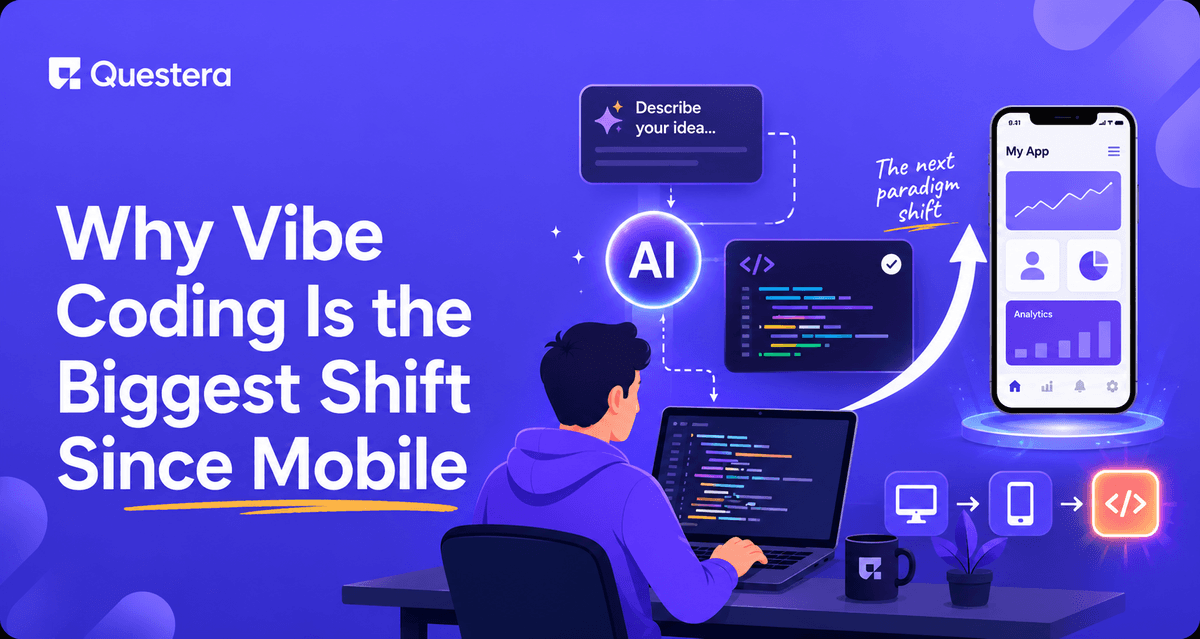
The shift to vibe coding in 2025–2026 looks structurally similar to the mobile revolution of 2008–2012. New category of creators (non-developers building real apps), new economics (build cycles compressed 10–20×), new winners (indie SaaS founders shipping full products solo), new distribution patterns (community-led growth, niche-fit products), and new losers (incumbents whose advantage was capital and engineering capacity). This guide draws the parallels between the two shifts and what indie founders and operators should learn from the mobile playbook to navigate the current moment.
The mobile revolution from 2008–2012 was the biggest shift in software since the web went mainstream. Fifteen years later, vibe coding is doing the same thing again — new category of creators, new economics, new winners and losers. This guide draws the structural parallels, why vibe coding is the biggest software shift since mobile, what the comparison gets right and wrong, and what lessons from mobile apply today.
What 'Vibe Coding' Actually Means
Vibe coding emerged as the name for prompt-driven software creation in 2024–2025. The term captures the workflow: developers (and increasingly non-developers) describe what they want to build in plain language; AI app builders or AI IDEs generate the implementation; the human iterates, hardens, and ships. The 'vibe' part captures the intuitive, conversational nature of the workflow compared to traditional sit-down-and-write-code sessions.
- Prompt-driven creation, not line-by-line coding
- Iterative refinement through conversation
- Built on AI app builders (Greta, Lovable, Bolt) or AI IDEs (Cursor, Windsurf)
- Output is real code (Next.js/React typically), not visual no-code lock-in
- Engineering discipline still required — review, harden, ship
- Accessible to non-developers with operational discipline
The Structural Parallels Between Mobile and Vibe Coding
Parallel 1: New Category of Creators
Mobile (2008–2012): Developers without enterprise sales channels could build directly to consumers. Indie iOS/Android shops emerged. New creator category that didn't exist before App Store. Vibe coding (2025–2026): Non-developers building real applications. Indie SaaS founders shipping without engineering hires. New creator category — the 'technical founder who can't code' or the 'designer who ships full products' or the 'PM who builds directly.'
Parallel 2: Build Economics Compressed Dramatically
Mobile: App Store distribution removed enterprise sales overhead. A solo developer could reach millions without a sales team. Distribution economics flipped favorable to small operators. Vibe coding: Build cycles compressed 10–20×. A solo founder ships a SaaS that would have required a 5-person team. Build economics flipped favorable to small operators.
Parallel 3: New Winners from Non-Traditional Backgrounds
Mobile: Instagram founders, Snapchat, indie iOS app makers — many came from outside the established tech companies. Mobile-native thinking was an advantage. Vibe coding: Indie SaaS founders, non-technical operators with domain expertise, designers who ship products. Vibe-coding-native thinking is an advantage.
Parallel 4: Incumbents Slow to Adapt
Mobile: Established desktop software companies took years to ship competitive mobile products. Some never did. Mobile-native startups ate their lunch in adjacent categories. Vibe coding: Established SaaS with high engineering headcounts find it harder to adapt than they expected. Lean AI-native startups ship competitive products in 1/10 the engineering team size.
Parallel 5: Niche Markets Opened Up
Mobile: Many niches that didn't justify desktop software became viable as mobile apps. Local services, hyperlocal apps, vertical-specific tools. Vibe coding: Many niches that didn't justify SaaS engineering investment become viable now. Hyper-niche workflows, vertical tools for specific industries, internal tools for specific use cases.
Build this with a prompt on Greta.sh — describe the app, Greta writes and deploys it.Parallel 6: New Distribution Channels and Patterns
Mobile: App Store discovery, viral growth via social sharing, ASO (App Store Optimization) emerged as discipline. Vibe coding: Product Hunt launches, indie hacker communities, Twitter/X distribution, niche subreddits and Discords, content-led SEO for specific niches.
Parallel 7: New Tooling Ecosystem
Mobile: Xcode, Android Studio, third-party SDKs (analytics, crash reporting, monetization), MBaaS platforms (Parse, Firebase). Vibe coding: AI app builders, AI IDEs, component generators, prompt-engineering tools, evaluation frameworks, AI cost optimization tools.
Parallel 8: Cultural Moment of Shared Learning
Mobile: Indie hacker communities, mobile-specific conferences, 'how I built an app' content explosion, a generation of creators learning the new paradigm together. Vibe coding: Indie SaaS communities, vibe-coding-specific content, 'how I built a SaaS solo' content explosion, generation learning together.
Where the Parallel Breaks Down
Distribution Still Hard
- Mobile had App Store as built-in distribution layer — install funnel was clear
- Vibe coding doesn't have an equivalent built-in distribution layer — SaaS founders still need to figure out customer acquisition
- Result: vibe coding compresses build but not distribution; both required for product success
Engineering Required in Different Ways
- Mobile: skilled mobile development still required engineering judgment; not eliminated
- Vibe coding: engineering judgment still required (architecture, review, harden); eliminated only commodity implementation
- Both: 'no coding required' framings overstate; engineering discipline matters in both shifts
Speed of Category Maturation
- Mobile took ~5–7 years to mature (2008–2014 hot growth period)
- Vibe coding compressing faster — 2–3 years from emergence to mainstream
- Speed advantage for early movers but also less time to figure things out
Platform Risk Differs
- Mobile platform risk concentrated on App Store and Google Play policies
- Vibe coding platform risk distributed across AI providers, app builders, hosting platforms
- But: code in your GitHub repo limits AI app builder platform risk significantly
Lessons from Mobile That Apply to Vibe Coding
Move First in Your Niche
- Mobile: first viable mobile apps in many categories built strong defensive positions
- Vibe coding: first viable AI-native SaaS in many niches will build similar positions
- Niche-fit + first-mover advantage compounds
Build for the New Economics, Not the Old
- Mobile: companies that built 'mobile versions of desktop apps' generally lost to mobile-native apps
- Vibe coding: SaaS that ports old workflows directly often loses to AI-native SaaS designed for the new economics
- Question whether existing workflow assumptions still apply; many don't
Community Matters More Than Ever
- Mobile: indie hacker communities provided distribution, learning, peer support
- Vibe coding: same community dynamics — communities help with distribution and skill-up
- Investing in community participation is high-leverage
Distribution Still Requires Work
- Mobile: building a great app wasn't enough; getting it discovered required real distribution work
- Vibe coding: building a great SaaS isn't enough; distribution discipline required
- Don't assume the platform will distribute for you
Operational Excellence Underrated
- Mobile: many indie apps failed not because they were bad but because operational discipline (crash fixes, updates, customer support) was weak
- Vibe coding: same pattern. Building is easier; operational discipline still matters
- Build cycles compressed but harden phase is non-optional
What's Specifically Different About Vibe Coding
Output Is Portable
- Mobile apps were locked to platforms (iOS-specific, Android-specific)
- Vibe-coded output is real Next.js/React in GitHub — portable across hosting and tooling
- Migration risk between AI app builders is much lower than mobile platform risk was
Skill Transfer Faster
- Mobile required learning new languages (Objective-C, Swift, Java/Kotlin) and platform-specific patterns
- Vibe coding builds on existing web stack (Next.js, React) that engineers and many non-developers already know
- Lower learning curve = faster category maturation
Cross-Functional Roles Emerging
- Mobile had developer roles, designer roles, PM roles, marketer roles — relatively distinct
- Vibe coding blurs roles — PMs build directly, designers ship products, marketers build internal tools
- Hybrid roles increasingly common
The Trajectory: Where This Goes
- Indie SaaS becomes increasingly viable career path — Many more solo founders in 2027–2030
- Engineering team sizes continue compressing — 3-person teams doing what 20-person teams did becomes common
- Niche markets continue opening — More verticals get purpose-built SaaS
- Distribution remains the hard problem — Build advantage doesn't extend to distribution advantage
- Operational excellence becomes competitive differentiation — Building is easier; operating well is the moat
- AI tooling continues evolving — Agent-driven workflows, better domain-specific generation, improved evaluation
- Incumbents adapt or get displaced — Same pattern as mobile incumbents
- New categories of creators emerge — Roles we don't yet have names for
What to Do Based on Your Role
If You're a Developer
Embrace vibe coding workflows. Use AI app builders for side projects; AI IDEs for production work. Build broader stack foundations. Develop code review skill specifically for AI-generated code.
If You're a Non-Developer
This is the moment to start. Pick a niche you understand deeply. Use AI app builders to ship a real product. Invest in distribution and operational discipline. The category of 'non-developer who ships full products' is wide open.
Ready to ship? Open Greta.sh — your idea → a working app, in one chat.If You're a Founder
Build longer before hiring. Lean teams ship more. Pick niches the AI advantage compounds in.
If You're at an Established Company
Treat this like mobile in 2010 — most companies missed the early signals. Your competitive position depends on absorbing vibe coding workflows before competitors do. Internal tools, side projects, AI tooling adoption matter more than they look.
Common Mistakes (Lessons from Mobile)
- Underestimating the shift — Many missed mobile's significance until competitors had already won. Don't repeat the pattern with vibe coding.
- Building for old economics — Mobile companies that ported desktop UX failed. Vibe coding companies that port old SaaS workflows underperform AI-native ones.
- Skipping distribution work — Mobile lesson: great products without distribution discipline fail. Same for vibe coding.
- Treating it as a tool, not a category shift — Vibe coding isn't just better tooling; it's a structural category change like mobile was.
- Assuming engineering eliminated — Mobile needed skilled mobile engineers; vibe coding needs engineering judgment for production-grade output.
- Hiring as if nothing changed — Companies that hire 20-person teams in 2026 for what could be done by 5-person teams handicap themselves.
- Ignoring community — Mobile indie communities mattered enormously; same for vibe coding communities now.
- Operational discipline gaps — Building is easier; operating well still matters. Mobile apps that didn't iterate operationally died.
- Missing niche opportunities — Mobile opened many niches; vibe coding opens different niches. Pay attention to what becomes addressable.
- Defensive complexity in product — Mobile apps that bloated died; same applies. Lean, fast products win in both shifts.
Frequently Asked Questions
Is the mobile analogy actually right?
Yes, in structural ways. New creator category, new economics, new distribution dynamics, new winners and losers, incumbent adaptation challenges — all parallel. Not perfect (distribution differs), but the structural shift is comparable in magnitude and shape.
How quickly does this play out?
Faster than mobile. Mobile took ~5–7 years (2008–2014) for the hot growth phase. Vibe coding compressing into 2–3 years (2024–2027). Same magnitude in faster time = more disruption per unit time.
Will established SaaS companies disappear?
Some, like desktop companies in mobile. Most that adapted in time will survive transformed. The ones that didn't adapt to mobile faded. The same dynamic applies.
Is this just hype like Web3 was?
No. Real revenue is being generated. Real apps are being shipped. Real companies are being built at scale. Web3 had usage gaps; vibe coding has usage backed by real product economics.
What if I missed the early moment?
Like mobile, there's still room for many more entrants. Mobile started in 2008; companies were still being built in 2014 and later. Vibe coding is mid-cycle; significant opportunity remains for the next 3–5 years.
What category should I build in?
Niches where you have domain expertise. The mobile pattern: niche-fit + first-viable-product + distribution discipline = competitive position. Same applies to vibe coding.
Vibe coding is the biggest software shift since mobile. Structural parallels are strong — new creators, new economics, new winners and losers, new distribution patterns, new tooling ecosystem. Lessons from mobile apply: move first in your niche, build for new economics not old, invest in community, distribution still requires work, operational excellence underrated. The shift is real and continuing. The companies and creators who move first in their niches will build defensible positions. The incumbents who treat this as 'just another tool wave' will be where their counterparts were in 2010 — surprised by how much changed. Position yourself now for the new economics.





© 2026 Questera
Follow in Google