






Vibe Coding Statistics 2026: Adoption, Pricing, Productivity
Vibe coding hit critical mass between February 2025 and 2026, and tools like Cursor, Lovable, Bolt, v0, Greta, and Windsurf became a category of their own. This guide collects only the numbers we could trace to a named, dated source — platform adoption, vendor pricing, developer AI use, productivity studies and security findings — and links each one.
Introduction
Vibe coding statistics are everywhere now, and many of them circulate without a source. This guide only includes figures we could trace to the company, survey or study that published them, each with a date and a link, checked in September 2026. Where we could not find a source for a number, we left it out.
Category Origins
- 1. Andrej Karpathy named "vibe coding" in a post on X on February 2, 2025.
- 2. Collins Dictionary named "vibe coding" its Word of the Year for 2025 on 6 November 2025.
Platform Adoption and User Counts
- 3. v0 by Vercel: more than 4 million people had used it by February 2026, according to Vercel (3 February 2026).
- 4. Lovable crossed $100M ARR in July 2025, eight months after launch, according to CEO Anton Osika (post on X, 23 July 2025).
- 5. Cursor passed $100M in recurring revenue by January 2025 and $1B in annualized revenue by November 2025, according to its Series B and Series D announcements.
- 6. Bolt.new reached about $40M ARR five months after launch, according to CEO Eric Simons (Lenny's Podcast, 13 March 2025).
- 7. Windsurf, which Cognition agreed to acquire in July 2025 and has since renamed Devin Desktop, says it is trusted by over a million developers (September 2026).
Pricing Benchmarks Across Platforms
| Platform | Free plan | Entry paid plan | Team or business plan |
|---|---|---|---|
| Cursor | Hobby: free | Pro: $20/month | Teams: $40/user/month |
| Devin Desktop (formerly Windsurf) | Free: $0 | Pro: $20/month | Teams: $80/month + $40/month per full seat |
| Lovable | Free: $0/month | Pro: $25/month (100 monthly credits) | Business: $50/month |
| v0 by Vercel | Free: $0/month ($5 of monthly credits) | Plus: $30/user/month | Business: $100/user/month |
| Bolt.new | Free: $0 (1M tokens/month) | Pro: $25/month, billed monthly | Teams: $30/month per member |
| Emergent | Free: $0/month (10 credits) | Standard: $20/month on annual billing | Enterprise: listed separately, no price shown |
| Greta | Free: $0 (5 credits daily) | Starter: $20/month list price | Business: $200/month |
Prices as listed on each vendor's own pricing page as of September 2026, in US dollars: Cursor, Devin Desktop, Lovable, v0, Bolt.new, Emergent and Greta. Greta's page also showed a welcome offer of $5/month for Starter. Plans change often, so check the vendor's page before quoting.
- 8. Entry-level paid plans on these seven platforms cost $20 to $30 a month at list price (September 2026).
- 9. Per-seat team plans range from $30 per member per month (Bolt.new Teams) to $100 per user per month (v0 Business).
- 10. All seven platforms offer a free plan.
Developer Adoption Numbers
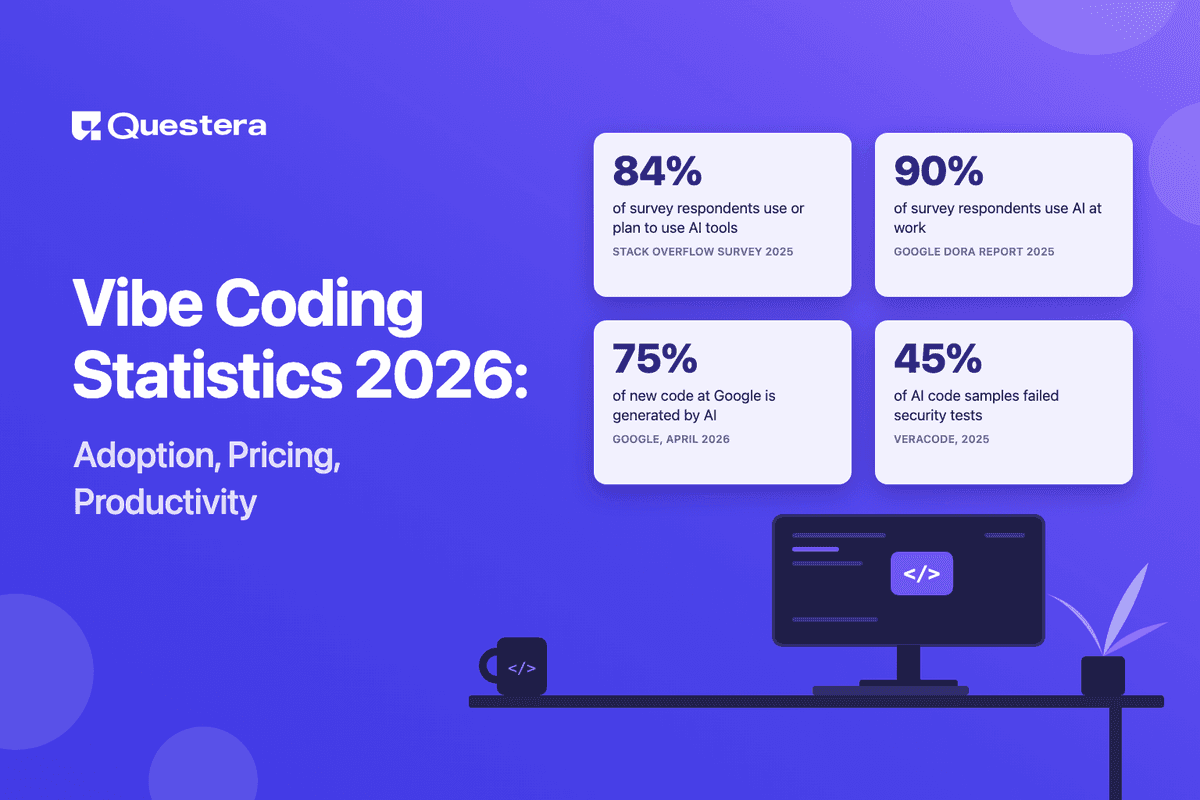
- 11. 84% of respondents to Stack Overflow's 2025 Developer Survey use or plan to use AI tools in their development process, up from 76% the year before, and 51% of professional developers use them daily.
- 12. Trust lags use: in the same survey, 46% of respondents distrust the accuracy of AI tools and 33% trust it, and 66% cite AI solutions that are "almost right, but not quite" as their biggest frustration.
- 13. 90% of respondents to Google's 2025 DORA report (September 2025) use AI at work, more than 80% believe it has increased their productivity, and 30% report little or no trust in AI-generated code.
- 14. 75% of all new code at Google is AI-generated and approved by engineers, up from 50% the previous fall, according to Sundar Pichai (22 April 2026).
- 15. A quarter of Y Combinator's Winter 2025 batch had codebases that were 95% AI-generated, YC managing partner Jared Friedman said, as reported by TechCrunch (6 March 2025).
- 16. Employment of workers aged 22–25 in AI-exposed occupations stood 19% below where it would have been had it kept pace with less-exposed peers, with no comparable gap for experienced workers, according to Stanford Digital Economy Lab researchers' payroll-data study (August 2026). They find the gap works mainly through reduced hiring of young workers.
Productivity Studies
- 17. In a controlled experiment, developers with GitHub Copilot implemented an HTTP server in JavaScript 55.8% faster than a control group (Peng et al., February 2023).
- 18. In METR's randomized study of experienced open-source developers working on their own repositories, AI tools made tasks take 19% longer, although the developers expected a 24% speedup (METR, July 2025). In a February 2026 update, METR said developers are likely more sped up by early-2026 tools, but that its newer data is only weak evidence of how much.
Security Findings
- 19. 45% of AI-generated code samples failed security tests and introduced OWASP Top 10 vulnerabilities in Veracode's tests of more than 100 models (2025 GenAI Code Security Report, July 2025). Its Spring 2026 update (March 2026) still found a known security flaw in 45% of generation tasks.
- 20. Missing row-level security is a documented risk: CVE-2025-48757 (published 30 May 2025) describes insufficient Row-Level Security policies in sites generated by Lovable through 15 April 2025, allowing unauthenticated access to their database tables. Lovable disputes it, saying each customer is responsible for protecting their app's data.
Category Trends to Watch in 2026–2027
- Agentic workflows are converging — major platforms are moving toward autonomous multi-step agents.
- Native mobile generation is a growing focus alongside web apps.
- Vertical specialization is emerging — industry-specific AI app builders for legal, healthcare, e-commerce, education.
- Falling AI inference costs make more generous free tiers possible.
- Enterprise features are standard on higher tiers — Cursor, Lovable, v0, Bolt.new and Greta all list SSO on a team, business or enterprise plan (pricing pages, September 2026).
How to Read These Numbers
- Verify before quoting publicly — Specific dollar figures and user counts shift quarterly. The directional shape is reliable; the exact decimal place isn't.
- Treat the median as the realistic outcome — Most statistics describe outcomes for builders who execute the workflow with discipline.
- Watch for survivorship bias — Statistics about successful vibe-coded apps don't capture the much larger universe of attempts that stalled.
What These Numbers Mean for Builders Today
- The category is established — mainstream awareness was confirmed when Collins named 'vibe coding' its Word of the Year 2025.
- Adoption is near-universal, trust is not — 90% of DORA respondents use AI at work, yet 46% of Stack Overflow respondents distrust the accuracy of AI tools.
- Early-career developers feel it first — the Stanford payroll study finds the employment gap among 22–25-year-olds in AI-exposed jobs, with no comparable gap for experienced workers.
- Security review still matters — Veracode keeps finding known flaws in about 45% of AI-generated code samples.
Common Mistakes When Citing These Numbers
- Treating one study as the answer — the Copilot experiment and METR's trial measured different tasks and developers, and reached different results.
- Mixing definitions of vibe coding — Some statistics include all AI-assisted dev; others narrow to natural-language-only app builders.
- Quoting last year's pricing — Plans update quarterly. Verify on the vendor's pricing page before citing.
- Generalizing from edge cases — one founder's revenue says little about the typical outcome.
- Ignoring the gap between adoption and effective use — 51% of professional developers using AI tools daily does not mean all of them get a productivity benefit.
Frequently Asked Questions
How many people use vibe coding tools?
No combined figure is published. Individual platforms report their own: Vercel says more than 4 million people had used v0 by February 2026, and Devin Desktop (formerly Windsurf) says over a million developers use it.
How much faster do vibe coding tools make software development?
It depends on the task and the developer. In a 2023 controlled experiment, developers with GitHub Copilot finished a coding task 55.8% faster. In METR's 2025 randomized study, experienced open-source developers took 19% longer with AI tools; METR said in February 2026 that newer tools likely help more, without a reliable estimate of how much.
Are vibe-coded apps actually production-ready?
Not without review. Veracode's Spring 2026 update found that only 55% of AI code-generation tasks produced secure code, so security testing before launch matters, especially for apps that handle sensitive data.
Where can I verify these numbers myself?
Every figure on this page links to its source: vendor pricing pages, company announcements, Stack Overflow's Developer Survey, Google's DORA report, METR, Veracode and the Stanford Digital Economy Lab. Check the source before quoting, since figures change.
Is the category still growing or peaking?
Usage is still rising. The share of Stack Overflow respondents using or planning to use AI tools rose from 76% to 84% year over year, and Google says 75% of its new code is now AI-generated, up from 50% the previous fall.
Key Takeaways
- Adoption is near-universal: 84% of Stack Overflow respondents use or plan to use AI tools, and 90% of DORA respondents use AI at work.
- Entry-level paid plans on seven major platforms cost $20–$30 a month (September 2026).
- Productivity evidence is mixed: controlled studies range from 55.8% faster (Copilot, 2023) to 19% slower (METR, 2025), depending on the task and the developer.





© 2026 Questera
Follow in Google