






From Vibe-Coded MVP to Production: A Hardening Checklist
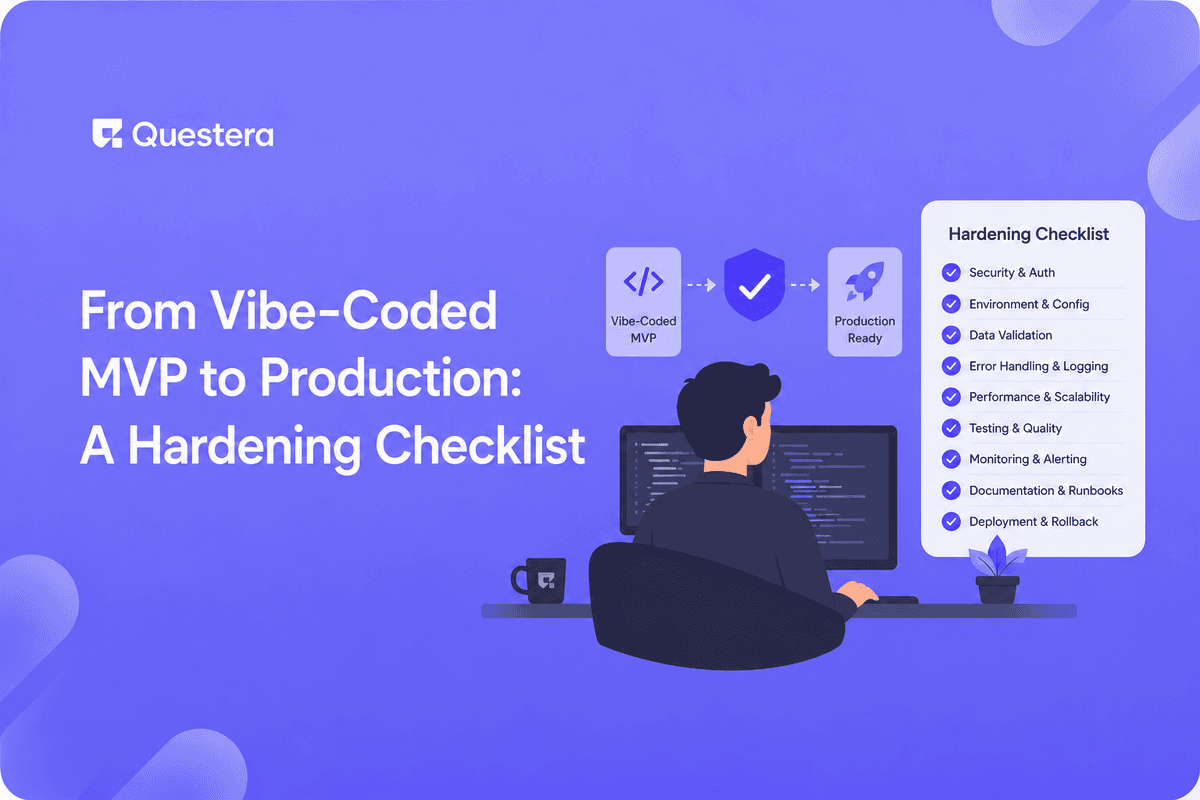
Taking a vibe-coded MVP to production means hardening it: lock down auth and secrets, validate inputs, add rate limiting, set up monitoring and backups, load-test hot paths, and run a security review. The MVP proves the idea; hardening makes it safe and reliable for real users.
A vibe-coded MVP gets you to a working product fast — but "it works in the demo" and "it's ready for real users" are different bars. The gap between them is hardening. This checklist walks through taking a vibe-coded MVP to production in 2026 — covering security, performance, reliability, and the review steps that prevent a launch-day disaster.
What Does 'Hardening' Actually Mean?
Hardening is the process of making software secure, reliable, and performant enough for real-world use. It addresses the edge cases, attacks, and load that a demo never sees.
An MVP optimizes for proving the idea; hardening optimizes for not breaking — or leaking — once real users arrive.
What's on the Production Hardening Checklist?
The table groups the essential checks by category. Treat none as optional for a customer-facing launch.
| Category | Checks | Why It Matters |
|---|---|---|
| Security | Auth, secrets, input validation | Prevents breaches & data leaks |
| Performance | Indexes, caching, query review | Holds up under real load |
| Reliability | Backups, rollbacks, error handling | Recover from failures fast |
| Monitoring | Logs, alerts, uptime checks | Catch issues before users do |
| Compliance | Privacy policy, data retention | Meet legal obligations |
What Are the Must-Do Security Steps?
- Enforce authentication and authorization on every protected route.
- Move secrets out of code into environment variables or a vault.
- Validate and sanitize all user input to block injection attacks.
- Add rate limiting and abuse protection on public endpoints.
- Use a PCI-compliant processor for payments — never store raw card data.
- Run a full security review before inviting real users.
How Do You Make Sure It Scales After Launch?
Hardening for scale means reviewing queries, adding indexes, and load-testing the paths real users hit hardest. A clean architecture scales; an unreviewed one breaks at the worst moment.
The realities of growth are detailed in our guide on whether AI-built apps can scale to 10k, 100k, and 1M users. And if you're still choosing tooling, ownership and extensibility matter — compare options in Greta vs Lovable vs Bolt vs v0.
Common Mistakes to Avoid
- Treating the MVP as production-ready because the demo worked.
- Leaving API keys or secrets hardcoded in the codebase.
- Shipping without backups or a tested rollback plan.
- Skipping load tests, then crashing on launch-day traffic.
- Deferring the security review until after real users are exposed.
Frequently Asked Questions
Is a vibe-coded MVP safe to launch as-is?
Usually not. An MVP proves the idea but needs hardening — security, performance, monitoring — before real users rely on it.
Want to try one of these? Start on Greta.sh — no setup, no boilerplate — just a prompt.What's the most important hardening step?
Security: enforce auth, move secrets out of code, validate inputs, and run a security review before launch.
How do I know if my app will handle load?
Load-test the hottest paths, review queries and indexes, and monitor performance under simulated traffic before launch.
Do I need monitoring for a small launch?
Yes. Even small launches need logs, alerts, and uptime checks so you catch issues before users report them.
Can AI help with hardening too?
Yes. You can prompt an AI builder to add validation, rate limiting, and error handling — but still review the changes.
Key Takeaways
- An MVP proves the idea; hardening makes it safe for real users.
- Security, performance, reliability, and monitoring are all non-negotiable.
- Load-test hot paths and review queries before launch day.
- Always run a security review when moving a vibe-coded MVP to production.
Ready to take your MVP live? Use this checklist, then harden and ship with confidence — Greta lets you own the code so you can review every step.