






Solo Founder Stack: Tools to Run a Whole Business by Yourself
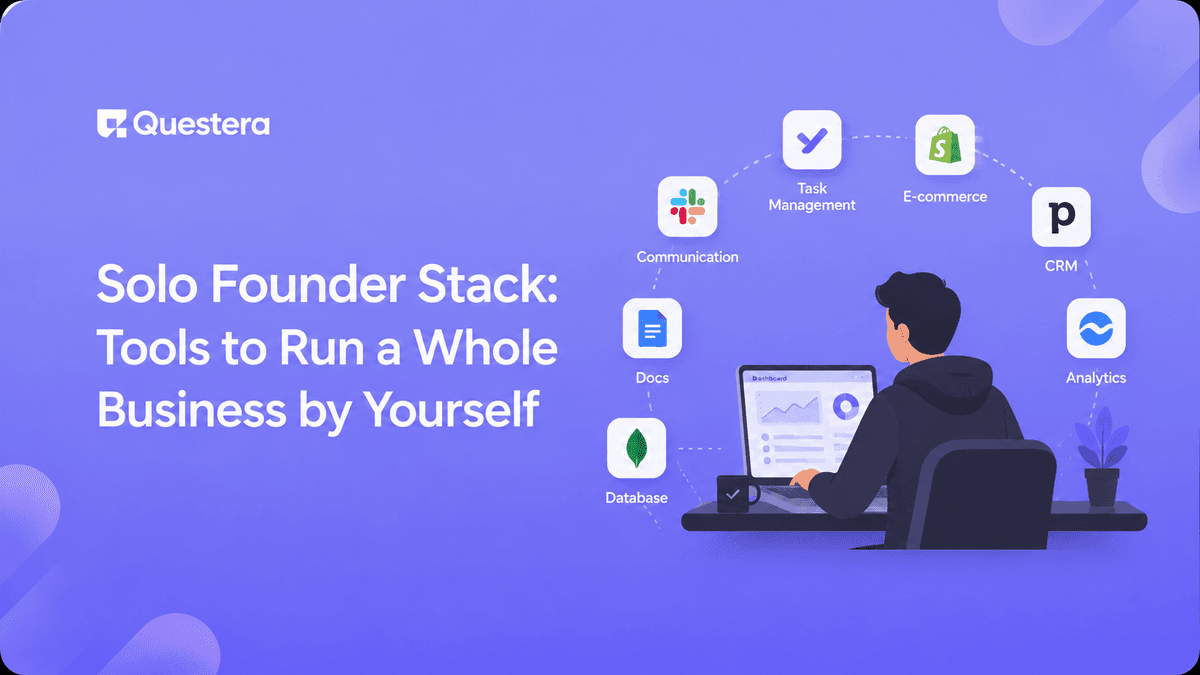
Running a real business solo used to mean either staying tiny on purpose or burning out trying to do every job manually. In 2026, that's no longer the trade-off. The combination of AI app builders, AI customer support, AI content tools, and a mature SaaS automation ecosystem has made it genuinely realistic for one person to run a multi-six-figure business — building, selling, supporting, and growing without hiring anyone.
This guide is the honest stack. Not a 50-tool list, not a marketing roundup — the specific tools that solo founders consistently use to run actual businesses, organized by the function each one handles. By the end, you'll know exactly what to subscribe to, what to skip, and what the total bill comes to.
Got an idea? Build it now!
Just start with a simple Prompt
Get Started Today


Why Running a Whole Business Solo Is Realistic in 2026
The structural shift is real. Five categories of work that used to require dedicated employees can now be handled solo: software engineering (AI app builders), customer support (AI-first support tools), marketing (AI content tools), operations (no-code automation), and design (AI design tools). Each one used to cost a salary; each one now costs a subscription.
According to a 2025 Indie Hackers survey, the median solo founder hitting $10k+ MRR in 2025 was running on a stack of 8–12 subscription tools totaling under $400/month, compared to typical 2020-era stacks of 18–25 tools totaling $1,200+/month. The compression is dramatic — both in tool count and in monthly spend.
The constraint is no longer headcount or budget. It's focus. The same tools that let one person do everything also enable infinite sprawl. The solo founders running profitable businesses share the discipline of keeping the stack lean and the priorities narrow.
The Seven Categories Every Solo Founder Stack Needs
A complete solo founder stack covers seven functional categories. Skip any one and the missing function will eventually consume disproportionate manual time.
- Build — How you ship and maintain your product
- Distribute — How you reach potential customers
- Sell — How you convert visitors into paying customers
- Support — How you handle customer questions and issues
- Operate — How you manage internal work, tasks, and finances
- Measure — How you track what's working
- Grow — How you compound the above into ongoing growth
The right tool in each category depends on the type of business. The structure stays the same.
Category 1: Build
The build layer is where solo founders save the most time vs. traditional setups. AI app builders have collapsed the cost of shipping software from months of engineering to days of prompting.
Primary Picks
- Greta — Unified vibe coding platform with bundled growth tooling. Best for solo founders shipping SaaS plus its marketing stack from one workspace. $20–$50/month.
- Lovable — AI app builder with strong React + Tailwind + Supabase output and Visual Edits mode. Best for design-conscious solo founders. $25/month Pro.
- Cursor — AI-powered IDE for solo founders who can code. Force multiplier inside a familiar IDE workflow. $20/month Pro.
- v0 by Vercel — Best-in-class React/Next.js UI quality with tight Vercel deployment. Best for solo founders shipping Next.js production apps. $20/month Premium.
When to Pick Which
If you can't code: start with Greta or Lovable. If you can code: Cursor for stack flexibility, v0 for Next.js production work. Most solo founders settle on one primary build tool and reach for others as projects require.
Category 2: Distribute
Distribution is the hard part now that the build is easy. Solo founders need to pick one or two primary channels and go deep — not subscribe to every distribution tool ever made.
Primary Picks
- Typefully or Buffer — Schedule and analyze X/Twitter content. $10–$20/month.
- Hypefury — X-specific tooling with smart queues and engagement features. $19/month.
- Shield Analytics — LinkedIn analytics for solo founders posting there. $15–$30/month.
- Beehiiv or Substack — Newsletter platform for content-driven distribution. Free up to ~2,500 subscribers; paid plans $30–$60/month.
- Ahrefs Webmaster Tools (free) or Semrush — SEO and content tracking. Free or $130+/month depending on volume.
What to Skip
Multi-channel posting tools that try to cover every platform usually do every platform poorly. Pick the one or two channels where your audience lives and use channel-native tools.
Category 3: Sell
The sales layer is mostly the landing page and the payment flow. Solo founders rarely need full CRM software early — they need clean conversion.
Primary Picks
- Stripe — Payment processing. 2.9% + 30¢ per transaction. Stripe Atlas, Tax, and Billing add features as you grow.
- Lemon Squeezy — Alternative to Stripe with merchant-of-record handling. Especially good for digital products and global sales tax compliance. 5% + 50¢.
- Tally or Typeform — Forms for lead capture, surveys, and onboarding. Free–$30/month.
- Cal.com or SavvyCal — Booking for sales calls or onboarding. Free–$15/month.
- Your AI app builder's landing page — Most builders (Greta, Lovable, v0) ship landing pages alongside your app. No separate landing page builder needed.
Light CRM When Needed
Solo founders rarely need HubSpot. For early-stage tracking, a custom AI-built CRM or a simple Airtable base with deal stages handles 95% of needs at a fraction of the cost.
Category 4: Support
Support is where AI has changed solo founder economics most dramatically. AI-first support tools can handle 60–80% of common questions without human involvement, leaving the founder to handle only the genuinely novel ones.
Primary Picks
- Intercom Fin — AI customer support with deep knowledge base integration. Premium pricing but handles real volume.
- Crisp — Simpler alternative with AI features. Free–$95/month.
- Plain — Modern support tool designed for product teams. Per-seat pricing starting at $59/seat/month.
- Help Scout — Email-first support for businesses that prefer asynchronous handling. From $25/user/month.
- Your own AI app — For some products, the AI features inside the product effectively double as a first-line support layer.
The Solo Founder Support Pattern
Set up an AI-first inbox that handles common questions automatically, escalates ambiguity to you, and learns from your responses. Aim for under 30 minutes per day of personal support time once the system is running.
Category 5: Operate
Operations is where solo founders lose the most time without realizing it. The right operate stack automates the boring work so the founder can focus on growth.
Primary Picks
- Notion or Linear — Tasks, docs, and project tracking. Notion is more flexible; Linear is more opinionated and faster. Free–$15/month.
- Airtable or Supabase — Lightweight database for operations data (leads, content calendar, partners). Free–$25/month.
- Zapier, Make, or n8n — Automation between your tools. Free–$50/month depending on volume.
- Stripe Atlas, Mercury, or Wise — Banking and incorporation. Mercury for US founders; Wise for international.
- QuickBooks Self-Employed or Xero — Bookkeeping. $15–$30/month. Most solo founders also work with a part-time accountant for tax filing.
- 1Password or Bitwarden — Password management. Essential security baseline. $3–$5/month.
- Google Workspace — Email, calendar, docs. $6/user/month.
The Automation Rule
If you do something manually three times, automate it. Most solo founders save 5–10 hours per week within a month of disciplined automation across their operate stack.
Category 6: Measure
You can't iterate on what you can't see. The measure stack should be lean — overdoing analytics is a real failure mode that produces dashboards instead of decisions.
Primary Picks
- PostHog — Product analytics with funnels, retention, and session replay. Free up to 1M events/month; paid above.
- Plausible or Fathom — Privacy-friendly web analytics. $9–$50/month.
- Stripe Dashboard — Revenue, MRR, churn, customer counts. Free with Stripe.
- ChartMogul or ProfitWell (free) — SaaS metrics for subscription businesses. Free–$200+/month.
What to Track and What to Ignore
Track three things weekly: MRR (or revenue), activated users (people who completed your core flow this week), and your one conversion bottleneck (the funnel step where you're losing the most people). Ignore everything else until something specific demands attention.
Category 7: Grow
Growth tools amplify the rest of the stack. They're the highest-leverage category and the easiest to over-buy.
Primary Picks
- Loops, Resend, or Postmark — Transactional and lifecycle email. $0–$50/month.
- ConvertKit, MailerLite, or Beehiiv — Newsletter and marketing email. $0–$50/month at solo founder scale.
- Google Search Console — Free, essential for SEO tracking.
- Ahrefs or SE Ranking — SEO research and rank tracking. $50–$150/month.
- Affiliate or referral software — Rewardful, FirstPromoter, or built-in solutions. $50–$150/month.
What to Add vs. Defer
Add email tools when you have your first 50 users. Add SEO tools when content marketing becomes a deliberate channel. Add affiliate software only when you have a clear partner motion. Pre-installing growth tools without a use case is wasted spend.
What the Complete Solo Founder Stack Actually Costs
Here's the math on a typical complete solo founder stack at different stages of growth.
| Stage | Monthly Cost | Typical Stack |
|---|---|---|
| Pre-launch / first $1k MRR | $50–$150 | AI builder, Stripe, Notion, free analytics, basic email |
| Early growth / $1–$10k MRR | $150–$300 | Add AI support, paid analytics, automation, content tools |
| Growing / $10–$50k MRR | $300–$500 | Add SEO tools, advanced email, light CRM, financial tooling |
| Mature solo / $50k+ MRR | $500–$800 | Higher-tier plans across stack; outsourced bookkeeping/legal |
Compare with a comparable 4–6 person startup running a similar business: typically $3,000–$8,000/month in tools plus $40,000–$80,000/month in salaries. The solo founder stack runs at roughly 5–10% of the total cost of an equivalent small team.
How Solo Founders Make This Actually Work
Running a whole business solo isn't about tools alone — it's about the discipline that wraps around the tools. The solo founders who make it work share a handful of habits.
- Ruthless prioritization — One focus per week, one focus per quarter. Multitasking kills solo founders faster than anything else.
- Automation by default — Anything done three times gets automated. The compound savings over a year are massive.
- Saying no to most opportunities — Partnership requests, podcast invites, coffee chats, feature requests. Most should be politely declined to protect time for the actual business.
- Documenting everything as you go — Every process, every decision, every customer conversation. Solo founders who don't document end up rebuilding context every month.
- Working in long focused blocks — Solo founders thrive on 3–4 hour deep work sessions, not fragmented days. Calendar protection matters more than productivity hacks.
- Investing in the build tools and the support tools — These two categories produce the biggest ROI. Cheap out elsewhere if needed.
- Knowing when to bring in fractional help — Bookkeeping, legal, complex engineering. Some functions don't need full-time hires but do need expertise solo founders shouldn't try to do themselves.
Common Mistakes to Avoid
- Over-subscribing tools — Most solo founders have 5–10 unused subscriptions at any time. Audit quarterly and cancel anything that didn't get used in the last 30 days.
- Skipping the operate category — Working without good task management and automation means working harder, not smarter.
- Underinvesting in support tooling — Manual support is the single most common reason solo founders burn out. AI-first support is the single most impactful tool category.
- Treating measure as a vanity exercise — Dashboards that don't drive decisions are wasted spend. Track only what you'll act on.
- Picking too many distribution channels — One or two channels deeply beats five channels shallowly for solo founders.
- Building too much custom — If a $20/month tool handles a function well, use it. Custom-building everything because you can wastes the time you saved with AI builders.
- Not setting boundaries — Solo founders without clear work-time boundaries end up working all the time. The stack only works if you actually log off.
- Treating the stack as static — The right tools change as the business grows. Re-evaluate quarterly.
Frequently Asked Questions
Is running a whole business solo really realistic in 2026?
Yes for SaaS, info products, digital services, and many e-commerce niches. The combination of AI app builders, AI customer support, AI content tools, and SaaS automation has genuinely made one-person operations viable at scales that previously required teams of 5–10. The constraint is focus and discipline, not capability.
What's the minimum solo founder stack?
Pre-launch: AI builder ($20–$50/month), Stripe (no monthly cost), Notion (free), and free analytics (PostHog/Plausible). Total: $20–$50/month. Most solo founders can launch a real business on this minimum stack and add categories as they grow.
When should a solo founder hire?
Most successful solo founders delay first hires until $20k+ MRR and a clear, repeatable bottleneck that a hire would solve. Hire reactively to specific bottlenecks, not proactively to feel like a "real" company. Many profitable businesses stay solo or 2-person indefinitely on purpose.
Which category produces the highest ROI on subscription spend?
Build (AI app builder) and support (AI customer support). The build tool replaces what would have been an engineering hire; the support tool replaces what would have been a customer success hire. Together they account for 60–80% of the stack's leverage.
How much does the average solo founder stack cost?
At early stages, $50–$150/month. At $10k+ MRR, $150–$300/month. At $50k+ MRR, $300–$500/month. Stacks grow with the business, but rarely exceed $1,000/month for solo operations. Compared to equivalent team costs, the solo stack is 5–10% of the total.
What's the biggest mistake solo founders make with their stack?
Over-subscribing. Most solo founders have 5–10 tools they don't actively use at any given time. Audit your subscriptions quarterly, cancel anything you haven't used in 30 days, and resist the urge to subscribe to every shiny new tool.
Can solo founders really compete with funded startups?
Yes — and increasingly often, win against them. Solo founders ship faster, have lower costs, can profit from smaller niches, and don't have investor pressure forcing them into bad pricing or scope. Many of the most profitable businesses in any niche are run by 1–3 people, not VC-funded teams.
Key Takeaways
- Running a whole business solo is realistic in 2026 — for SaaS, info products, digital services, and many e-commerce niches.
- The complete solo stack covers seven categories: build, distribute, sell, support, operate, measure, grow. Skipping any one means the missing function consumes disproportionate time.
- Total monthly cost runs $150–$500 for most solo businesses — roughly 5–10% of the equivalent cost of running the same business with a team.
- The constraint is no longer headcount or budget. It's focus. Keep the stack lean and priorities narrow.
Pick one category where your business is weakest. Pick the one or two highest-leverage tools in that category. Subscribe, set them up, automate what you can, and move to the next category next month. The full solo founder stack doesn't get assembled in a weekend — it gets built deliberately over a quarter. And once it's in place, the business runs at a scale that would have been impossible for one person five years ago.
Got an idea? Build it now!
Just start with a simple Prompt
Get Started Today
Ready to be a
10x Marketer?
See it in action



© 2026 Questera
Follow in Google