






Restaurant Tech: Building POS & Loyalty Apps with AI
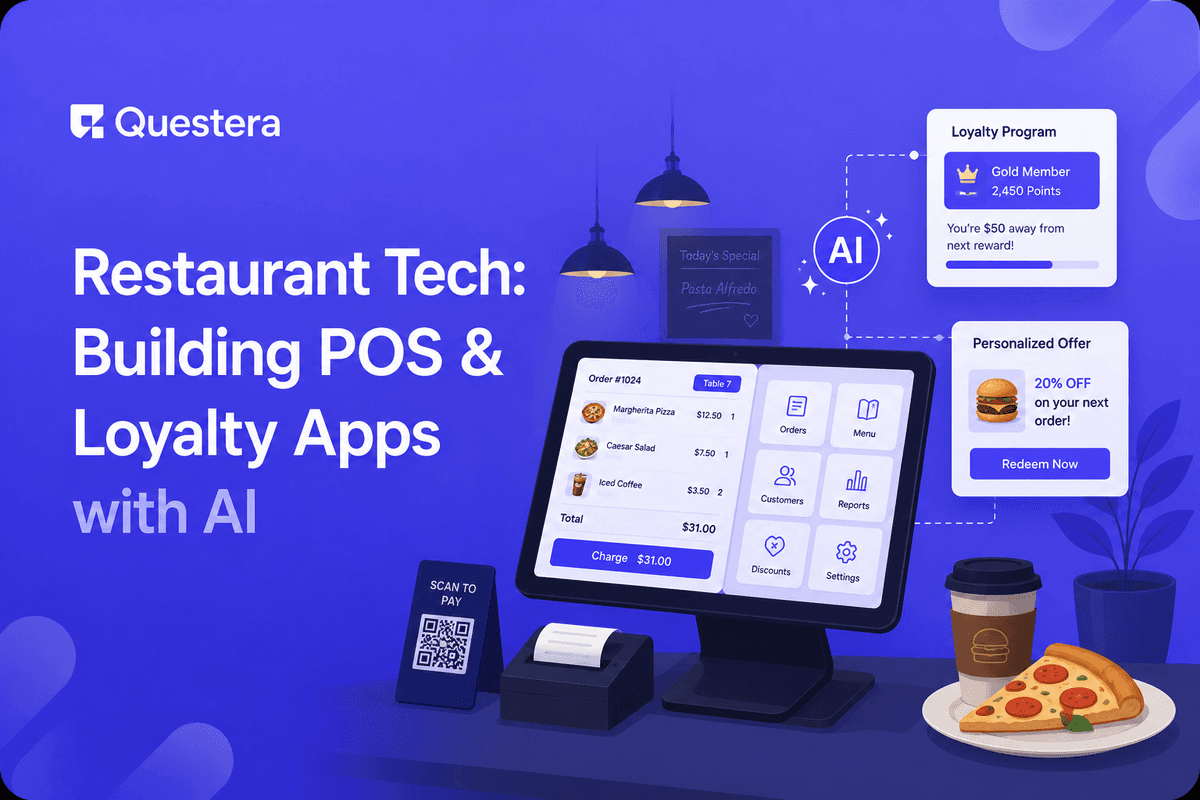
Restaurant tech is a massive, fragmented market — Toast, Square, Clover dominate horizontal POS but leave niches underserved (specific cuisines, small chains, food trucks, ghost kitchens, breweries). AI app builders enable building niche restaurant tech in 6–10 days for the core software. Hardware (terminals, card readers, kitchen printers) is the harder part and usually requires partnering with hardware vendors (Square Reader, Stripe Terminal). This guide covers what's buildable, what requires hardware, the niche opportunities that work, the integration patterns (Stripe Terminal, kitchen display systems, accounting), and the operational realities of restaurant tech.
Restaurant tech is one of the largest underserved tech markets. Toast at $4B+ revenue. Square's restaurant business at multi-billion scale. Clover, TouchBistro, Lightspeed, Revel — incumbents dominate horizontal restaurant POS. Yet the market remains fragmented because restaurant verticals have specific needs incumbents serve poorly. In 2026, AI app builders make niche restaurant tech buildable in 6–10 days for the core software. The opportunity is real but the work is more than just shipping a build.
Important: this guide is not legal or compliance advice. Restaurant tech operates under significant regulation — food safety, PCI compliance, sales tax varying by jurisdiction, labor laws, ADA accessibility. Consult counsel before launching any restaurant tech operation in your specific jurisdiction.
Why Restaurant Tech Is Hard (Be Honest)
- Hardware dependency — POS systems need terminals, card readers, kitchen printers. Software-only solutions limited.
- Reliability requirements — Restaurant downtime during service = lost revenue + furious owners. Higher bar than most SaaS.
- Integration complexity — Connects to accounting, payroll, inventory, suppliers, online ordering platforms
- PCI compliance for card handling
- Long sales cycles — Restaurant owners are conservative; switching POS is risky
- Service-heavy support — Restaurants need real support during operating hours
- Margin pressure — Restaurant operations are low-margin; POS pricing pressure is real
- Incumbent moats — Toast and Square have hardware, integrations, switching costs
Why Niche Restaurant Tech Still Works
- Horizontal players serve generic restaurants well; vertical-specific workflows poorly
- Specific cuisines have specific needs (Sushi: omakase courses; Pizza: complex modifiers; Ramen: ticket timing)
- Small chains need consistency tools incumbents don't focus on
- Food trucks have mobile-first, offline-tolerant needs
- Ghost kitchens need multi-brand routing on shared kitchen capacity
- Breweries combine retail + on-premise + production needs
- Coffee shops with subscription/loyalty have specific customer relationship patterns
- Fine dining needs reservation + POS + customer profile integration
Niche Opportunities in Restaurant Tech
Mobile-First POS for Food Trucks
- Tablet-based POS designed for outdoor mobile operations
- Offline-tolerant (orders queue when network drops)
- Geographic-aware (track sales by location)
- Integration with Stripe Terminal for card payments
Ghost Kitchen Multi-Brand Platform
- Single kitchen runs 5–10 virtual restaurant brands
- Orders from delivery platforms (DoorDash, Uber Eats) route to appropriate brand
- Kitchen sees consolidated ticket view
- Performance tracking per virtual brand
Brewery / Taproom Hybrid POS
- Tap room sales (beer by the glass, flights)
- Retail sales (cans, growlers, merchandise)
- Production tracking (batch numbers for compliance)
- Distribution accounting
Coffee Shop with Subscription Loyalty
- Monthly subscription tiers (e.g., $30/month for one drink per day)
- Customer mobile app with QR code at checkout
- Visit frequency analytics for the cafe
- Subscription customer LTV substantially higher than transactional
Fine Dining Reservation + POS Integration
- OpenTable or Resy data flows into POS at customer arrival
- Server sees customer profile, allergies, preferences, past orders
- POS captures preferences for next visit
- Customer profile compounds value over visits
Loyalty-Only Apps (Not Full POS)
- Brand-specific customer mobile app
- Integrate with existing POS via Square API, Toast API
- Points, rewards, customer profiles
- Lower-friction entry than full POS replacement
Hardware: What You Partner vs Build
Don't Build (Partner Instead)
- Card readers — Use Stripe Terminal SDK, Square Reader SDK
- Cash drawers — Generic POS cash drawers work with USB triggers
- Receipt printers — Star Micronics, Epson are industry standard with simple API
- Kitchen display systems — Hardware available from multiple vendors
- iPad / tablet hardware — Standard consumer hardware
Hardware Integration Patterns
- Stripe Terminal SDK — Card payments via Stripe Terminal readers; full PCI compliance from Stripe
- Square Reader SDK — Alternative to Stripe Terminal; mature for retail
- ESC/POS protocol — Industry standard for receipt printers; libraries available in Node.js
- Bluetooth Low Energy (BLE) — For scales, scanners, payment devices
- WebUSB / WebHID — Modern web standards for hardware integration
Stripe Terminal Integration Specifically
- Stripe Terminal: hardware (BBPOS Chipper 2X, WisePOS E) + SDK
- Customers tap/insert card at terminal — card never touches your application (PCI compliance from Stripe)
- Your app initiates payment intent; terminal collects; Stripe processes
- Works for iOS, Android, web SDKs
- Pricing: standard Stripe rates (~2.9% + $0.30) + Terminal hardware costs
Core Software V1 Scope
POS Interface
- Menu navigation (categories, items, modifiers)
- Order ticket assembly
- Tax calculation by jurisdiction
- Payment collection (Stripe Terminal for cards; cash management)
- Receipt printing or email receipts
- Order send to kitchen (kitchen display or print)
- Refunds and voids with appropriate authorization
Menu Management
- Categories, items, modifiers, variants
- Pricing rules (happy hour, discounts)
- Item availability (86'd items)
- Photo upload for items
Reporting Basics
- Daily sales summary
- Item-level sales
- Payment method breakdown
- Tax collected (for remittance)
- Discounts and voids tracking
What to Skip in V1
- Inventory management (use partner solutions or defer to v2)
- Payroll integration (defer or use existing tools)
- Multi-location consolidation (single-location v1)
- Online ordering integration (defer or use marketplace platforms)
- Reservation system (use partner like OpenTable/Resy)
- Advanced analytics (basic reports v1)
The 6–10 Day Build Sequence
Days 1–3: Core POS Interface
- Day 1: PRD, data model (Menu, Item, Modifier, Order, OrderItem, Payment)
- Day 2: Menu management interface
- Day 3: Order assembly UI with category navigation, modifiers, ticket view
Days 4–5: Payments and Kitchen Flow
- Day 4: Stripe Terminal integration for card payments
- Day 5: Kitchen ticket routing (print or display)
Days 6–7: Reporting and Admin
- Day 6: Daily sales reports, item-level breakdown
- Day 7: Tax collection report, admin dashboards
Days 8–10: Customer/Loyalty (Optional V1)
- Day 8: Customer profiles, visit tracking
- Day 9: Points and rewards logic
- Day 10: Customer mobile app (PWA) or integration into existing app
Reliability Considerations
- Restaurants need POS that works during service or revenue stops
- Local-first architecture (orders work offline; sync when network returns)
- Multiple devices for redundancy
- Fallback to manual order writing during outages
- Status page or alerts for any service degradation
- Test extensively before deploying to first paying restaurant
Pricing Patterns in Restaurant Tech
| Solution Tier | Pricing Pattern | Note |
|---|---|---|
| Full POS (per terminal) | $69–$299/month/terminal | Toast, Square restaurant |
| POS + payments bundled | Lower base + ~2.5% transaction | Toast typical pattern |
| Software-only POS (BYO hardware) | $30–$100/month/location | Lighter-weight solutions |
| Loyalty-only apps | $50–$200/month/location | Layered on existing POS |
| Niche solutions | $50–$500/month/location | Vertical-specific premium |
Common Mistakes
- Building horizontal POS to compete with Toast/Square — Capital and time required exceed indie founder capacity. Pick niche.
- Underestimating hardware integration complexity — Card readers, printers, kitchen displays all have edge cases. Partner where possible.
- Ignoring reliability requirements — Restaurant downtime during service is unacceptable. Test extensively.
- Skipping offline mode — Network drops during service happen. POS must keep working.
- Forgetting PCI compliance — Don't handle cards directly. Use Stripe Terminal or Square Reader.
- Building without restaurant feedback — Talk to actual restaurant operators throughout. Don't build in isolation.
- Underestimating tax complexity — Sales tax varies by location, item type, dine-in vs takeout. Get this right.
- Skipping integration with accounting — Restaurant owners need numbers flowing to QuickBooks/Xero.
- Inadequate support model — Restaurants need real support during service hours.
- Underpriced — Restaurant POS commands premium pricing. Toast charges $69–$299/month/terminal plus payment processing.
- Treating it as software-only — Hardware, integrations, support, ongoing relationship matter.
- Ignoring existing restaurant tech stack — Restaurants already use OpenTable, QuickBooks, etc.
Frequently Asked Questions
Can an indie founder really compete in restaurant tech?
Yes, but only in niche. Horizontal POS requires capital and time indie founders don't have. Niche restaurant tech (specific cuisine, food trucks, ghost kitchens, breweries, coffee shops with subscription loyalty) is genuinely viable for indie founders willing to commit to the vertical.
What about iPad-only POS systems?
Many niche POS systems run on iPad with Bluetooth card readers (Stripe Terminal, Square Reader). Lower hardware investment for restaurants. Works for low-to-medium volume operations.
How do I handle the existing POS migration problem?
Restaurants change POS reluctantly. Best entry: target new restaurants opening, restaurants frustrated with current POS, or restaurants in your specific niche underserved by current providers. Migration assistance is a service offering, not just software.
How does this work with delivery platforms (DoorDash, Uber Eats)?
Either: (1) Manual entry into your POS when orders come in (small restaurants accept this). (2) Direct integration with delivery platforms via their APIs. For indie POS, manual entry initially; build delivery integration in v2 if it's a niche requirement.
How do I handle gratuity and tip distribution?
Built into POS as standard. Customer adds tip at checkout; system tracks. Distribution to staff (pooled vs individual) requires payroll integration. Many restaurants handle tip distribution manually outside POS.
What about online ordering for the restaurant itself?
Build as separate module or integrate Olo, ChowNow, or similar. Online ordering has its own complexity (delivery vs pickup logic, scheduling, payment); leveraging existing platforms is usually faster than custom building.
Restaurant tech is a massive market; horizontal players (Toast, Square) dominate but niche verticals remain underserved. Niche fit is the indie founder opportunity. AI app builders enable building niche restaurant tech in 6–10 days for core software. Hardware (terminals, card readers, kitchen printers) via partnerships (Stripe Terminal, Square Reader, ESC/POS printers). Reliability matters enormously. Restaurant downtime during service is unacceptable. Offline mode, redundancy, manual fallback all required. Restaurants need real support during operating hours. Pick your niche carefully. Build deliberately. Support intensely. The niche restaurant tech businesses that thrive in 2026 are built by founders who took the vertical seriously.





© 2026 Questera
Follow in Google