






Questera vs Zaius: How AI Can Optimize Customer Journeys Differently
The evolution of customer journeys has grown from simple, rule-based campaigns to intelligent, AI-driven personalization. Years ago, Zaius was one of the preferred platforms for marketers who wanted to automate their outreach and observe customer behavior. Zaius served its purpose well, but as customer expectations grew, so did the need for systems that were smarter and constantly learned and adapted. This is where Questera comes in. This next-generation, agentic AI platform thinks, learns, and acts in real time to deliver personalized experiences to consumers.
This comparison of Questera vs Zaius will illustrate how AI customer journey tools have evolved and likewise, why Zaius' customer journey optimization needs a new evolution. For brands searching for Zaius alternatives in 2025 or interested in a dynamic journey orchestration with AI, Questera is leading the way of what is next in customer engagement.
Understanding Zaius: The Traditional Approach to Customer Journeys
When we talk about customer journey optimization, Zaius was once a familiar name. Known for combining a Customer Data Platform (CDP) with marketing automation and analytics, it helped brands manage their data and deliver targeted campaigns. Later acquired by Optimizely, it became a part of a larger marketing suite. But even with its strengths, Zaius followed a traditional path: manual segmentation, static rules, and repetitive workflows. You’d collect data, create a segment, send an email, and wait for reports. Over time, this rigid approach caused what many marketers call “campaign fatigue.”
Understanding Questera: The Agentic AI Approach
Now, let’s look at how things have changed with Questera. In the Questera vs Zaius story, Questera represents a complete shift in thinking. It’s an AI-powered customer engagement platform designed around intelligent agents that work autonomously. Each agent plays a unique role: SARA handles ads, ELMA manages lifecycle emails, OMNIA connects omni-channel journeys, SEGA refines segmentation, GRETA drives growth, and GIA uncovers insights. Instead of marketers setting every rule, these agents learn, decide, and act in real time.
Key Difference: Automation vs. Autonomy
When you look closely at Questera vs Zaius, you notice a fundamental shift in how each platform treats the customer journey. Zaius focuses on automation, while Questera moves toward autonomy, a big leap that changes everything about how engagement actually works. Let’s break it down into a few key differences that explain why this shift matters for every brand aiming for smarter personalization.
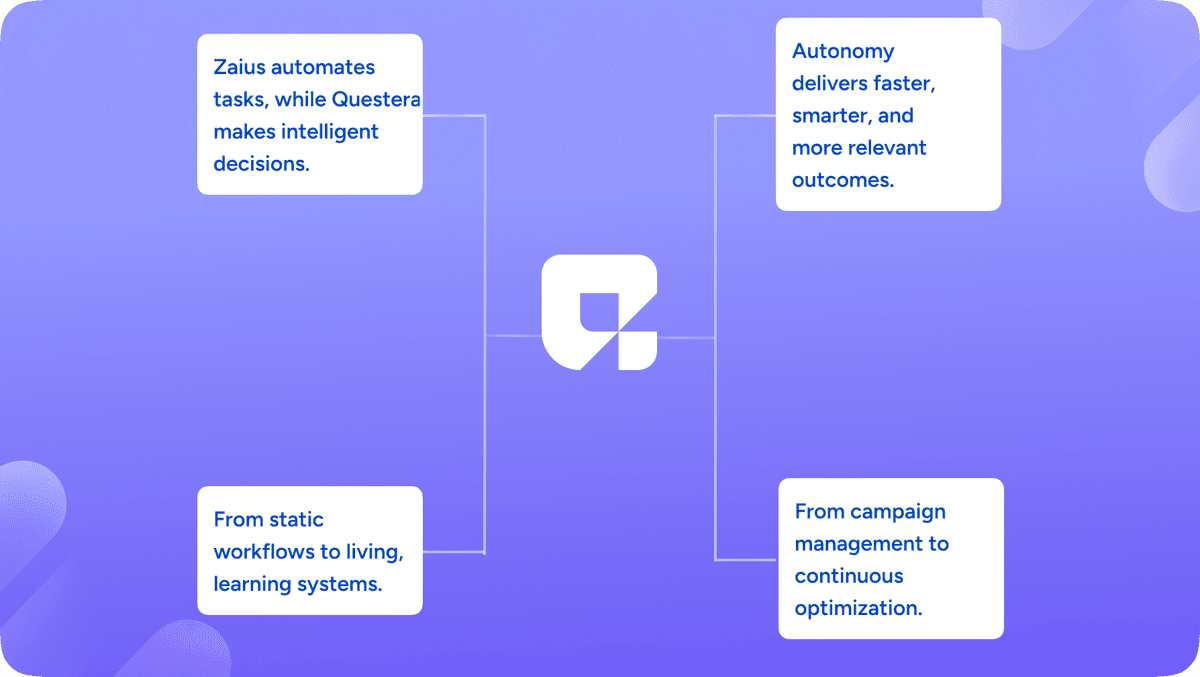
Zaius automates tasks, while Questera makes intelligent decisions.
Zaius helps marketers save time by automating repetitive tasks. It follows set rules like, “If a user abandons a cart, send an email.” This approach works but doesn’t adapt quickly to user behavior changes. In contrast, Questera asks, “What’s the best next step for this user right now?” It uses dynamic journey orchestration with AI to analyze intent and act instantly. That’s where autonomy begins.
From static workflows to living, learning systems.
Zaius workflows are rule-based, meaning marketers design every trigger and flow manually. Questera’s agents, on the other hand, continuously learn from data. They adjust in real time, improving personalization and engagement over time. This makes Zaius customer journey optimization feel outdated next to Questera’s adaptive model.
Autonomy delivers faster, smarter, and more relevant outcomes.
With autonomy, Questera reacts in seconds, not hours. Whether it’s sending an email, launching an ad, or updating a journey path, its agents execute actions based on current data. This speed allows AI for retail and ecommerce journeys to feel human, timely, and naturally connected to the customer’s experience.
From campaign management to continuous optimization.
Zaius still requires human input to build, test, and tweak campaigns. Questera doesn’t. Its agents collaborate, optimize, and evolve automatically. That’s why many marketers exploring Zaius alternatives or reviewing Zaius competitors now see Questera as the logical next step.
| Feature | Zaius | Questera |
|---|---|---|
| Core Technology | Rule-based automation | Agentic AI execution |
| Personalization | Static segments | Dynamic real-time insights |
| Channels | Email, ads, web | Omni-channel (email, ads, in-app, SMS, web, etc.) |
| Learning | Manual optimization | Continuous self-learning |
| Scalability | Moderate | Highly adaptive and scalable |
| Integration | CDP + Optimizely | Multi-platform + AI data connectors |
| Ideal For | Data-driven marketers | Growth-focused startups & enterprises |
How Questera Optimizes Journeys Differently
When we look at Questera vs Zaius, the real difference lies in how each platform thinks and acts. Zaius follows predefined paths. Questera, on the other hand, learns from every user interaction, adjusts instantly, and executes with precision. It doesn’t just automate, it decides. That’s what makes it so powerful for brands that want to move beyond old-school Zaius customer journey optimization. Let’s understand how Questera takes customer journeys to a new level.
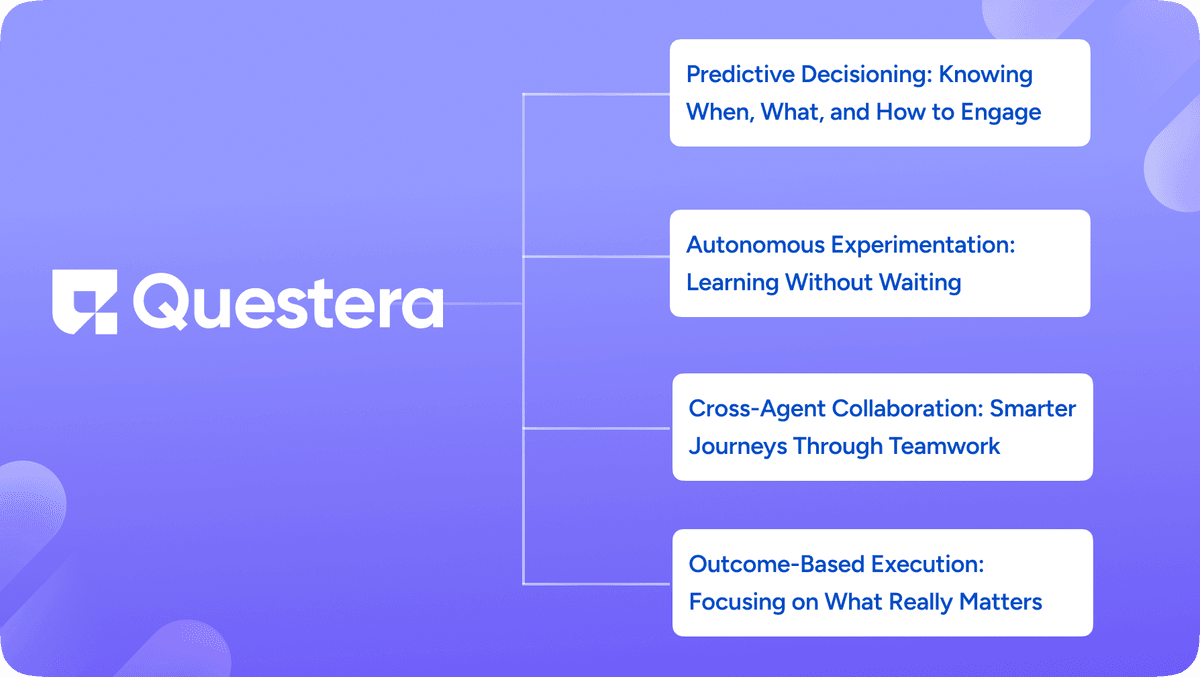
Predictive Decisioning: Knowing When, What, and How to Engage
Questera doesn’t wait for marketers to define every trigger. It reads data in real time and predicts the next move. Whether it’s the right time to send an email, recommend a product, or re-engage a user, its AI understands intent before action happens. This is what modern AI customer journey tools are designed for, making decisions that feel personal and perfectly timed.
Autonomous Experimentation: Learning Without Waiting
Traditional tools like Zaius rely on marketers to test and tweak campaigns. Questera removes that delay. Its agents experiment, compare results, and optimize performance continuously. They don’t wait for manual input. That’s why, for brands exploring Zaius alternatives in 2025, Questera feels like a leap forward, a system that learns on its own.
Cross-Agent Collaboration: Smarter Journeys Through Teamwork
What makes Questera stand out among Zaius competitors is how its AI agents work together. For example, ELMA crafts personalized emails, OMNIA manages omni-channel engagement, and SEGA refines segmentation in real time. Together, they create dynamic journey orchestration with AI- a flow that’s natural, seamless, and truly adaptive.
Outcome-Based Execution: Focusing on What Really Matters
Zaius measures success by campaign delivery. Questera measures outcomes, conversions, retention, and growth. Its focus is not just on sending messages but achieving results. For AI for retail and ecommerce journeys, this means every interaction moves users closer to action.
Conclusion
Customer journeys are no longer about setting rules and hoping for results. The world of Zaius customer journey optimization served marketers well for years, but today’s expectations demand more than manual workflows. In the ongoing discussion of Questera vs Zaius, the difference is clear: Questera’s agentic AI doesn’t just follow instructions, it learns, predicts, and acts autonomously. By using AI customer journey tools that continuously adapt, Questera transforms engagement into a living, evolving experience.
Brands exploring Zaius alternatives in 2025 or comparing Zaius competitors will see the advantage of dynamic journey orchestration with AI, especially for AI for retail and ecommerce journeys. This platform bridges insights and execution, ensuring every interaction feels timely and personal. The future of engagement is no longer reactive; it’s proactive, intelligent, and autonomous. The era of automated campaigns is ending, it’s time for autonomous journeys powered by Questera.
FAQs
1. What is the main difference between Questera and Zaius?
Zaius focuses on traditional automation and rule-based campaigns, while Questera uses agentic AI to make autonomous, real-time decisions.
2. Why should brands consider Questera over Zaius?
For marketers exploring Zaius alternatives in 2025, Questera provides smarter dynamic journey orchestration with AI, faster personalization, and better engagement outcomes.
3. Can Questera replace Zaius for customer journey optimization?
Yes. Questera moves beyond static workflows, offering continuous learning and AI customer journey tools that outperform traditional Zaius customer journey optimization methods.
4. How does Questera improve retail and ecommerce journeys?
Its intelligent agents analyze user behavior across channels and optimize actions automatically, making AI for retail and ecommerce journeys more effective and timely.
5. Is Questera suitable for small businesses or only enterprises?
Questera scales to any business size. Even startups can leverage its AI customer journey tools to drive smarter engagement without heavy manual effort.
6. How does Questera handle multi-channel campaigns?
Through agents like OMNIA and ELMA, Questera executes dynamic journey orchestration with AI across email, ads, in-app messaging, and web touchpoints seamlessly.
Ready to be a
10x Marketer?
See it in action





© 2026 Questera
Follow in Google