






Questera vs HubSpot vs Braze: Lifecycle Email Campaigns Compared
Lifecycle email campaigns influence how users engage with a product on day one. Many teams are still grappling with the idea of what lifecycle email campaign is and how it can drive activation, conversion, and retention in a real journey. Brands currently are looking for best practices on the email lifecycle campaign and what is the right lifecycle email automation platform to help facilitate growth. In most conversations we hear about Questera vs HubSpot, or Braze vs HubSpot because each platform represents a different way to execute. Some will even discuss Questera vs Braze, or broader Questera vs HubSpot vs Braze in regard to depth and speed. HubSpot provides CRM-first workflows whereas Braze capitalizes on cross-channel moments. Questera utilizes agentic AI to improve the message in real-time and feel more customized. Each is capable of accomplishing email marketing lifecycle plans, but which email marketing software you choose is an important step in developing consistent engagement across channels as teams strengthen their lifecycle strategy.
What Makes for a Good Lifecycle Email Platform?
When we talk about lifecycle email campaigns, we really mean the act of moving users through an emotional and practical journey. Most teams first see what is lifecycle email campaign when they witness timing, context, and personalization affecting how users engage. No matter if you’re exploring Questera vs HubSpot, Braze vs HubSpot, or even Questera vs Braze from a more in-depth angle, the question remains the same - what actually makes a lifecycle platform effective? Let's get into it clearly.
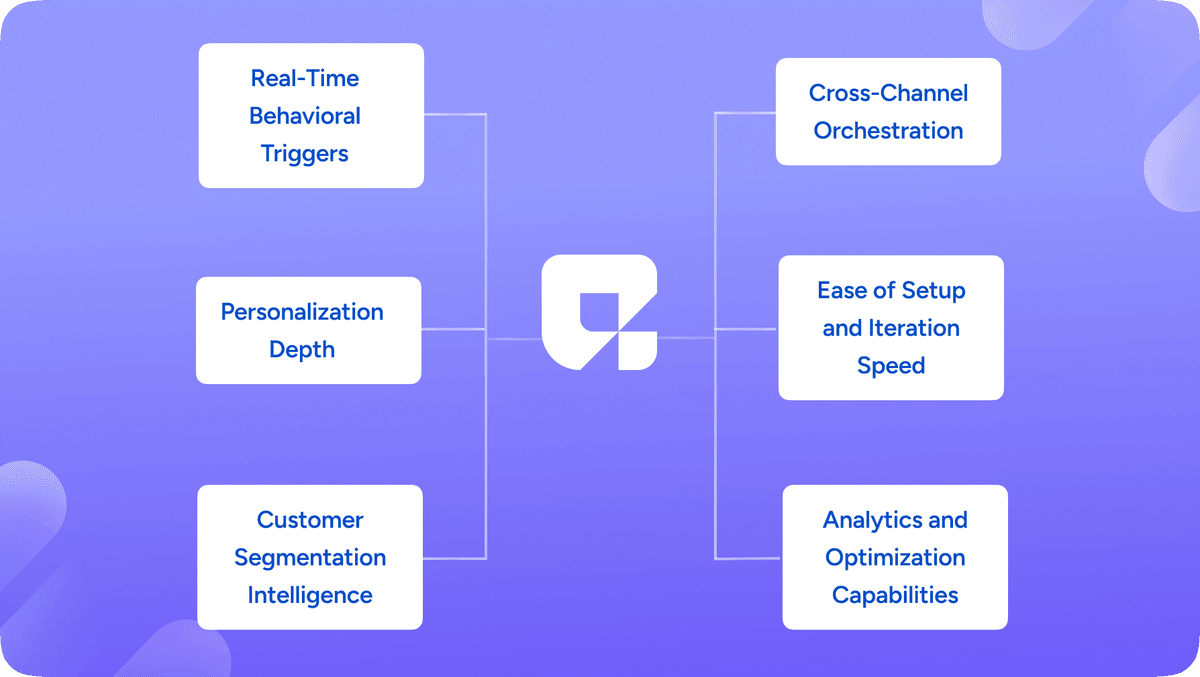
Real-Time Behavioral Triggers
Great email should never be driven by a wait. A strong lifecycle email automation platform reacts, reacts when the user does something meaningful. If they explore pricing pages, or they come back after weeks, the system should instantly react. When the message hasn’t arrived contextually even in a minute, the delay creates their disconnect. To illustrate, real-time triggers form the 'heartbeat' of any email marketing lifecycle strategy.
Personalization Depth
Personalization is more than just switching name tags. Personalization is about tonality and timing in message precept based on user intent. In a HubSpot vs. Braze evaluation, HubSpot utilizes CRM data while Braze leverages events. Questera does both, plus takes advantage of deeper layering of emotional cues. The best lifecycle email marketing software recognizes context over identity.
Customer Segmentation Intelligence
Segmentation needs to be living and dynamic, not stagnant. Lists that never change lead to making all communications feel generic. The platforms being compared have a unique characteristic in how they deal with segmentation. Questera is the only option that provides automatic updates to segments based on behavior. HubSpot has some segments, but requires repeated configuration whenever behavior changes. Braze creates dynamic cohorts of segments, but it still needs to be set up. True intelligence reduces the need for ongoing busywork.
Cross-Channel Orchestration
Email is just one piece of a journey. A user might open one email and ignore the next email in the sequence, but eventually respond to a push notification. Platforms must coordinate the messaging across multiple channels, but not frustrate the customer. This coordination represents the best practice of email lifecycle campaigns today.
Ease of Setup and Iteration Speed
Teams have to move at 100 mph. If it takes hours or days to create or adjust a workflow, campaigns miss that opportunity to be relevant again. Ease of action matters. A platform should offer the ability to test anything quickly, effortlessly make edits, and allow teams to collaborate simply.
Analytics and Optimization Capabilities
A strong platform doesn't just provide a number, it tells a story. When opting in to optimization, it should feel like your whole workflow, your whole audience, all worked perfectly. There really should be nothing better than seeing success and then trying to figure out what made that happen. Insight is the last and final piece that pulls the entire lifecycle journey together.
Platform Overview
Understanding how these platforms differ helps teams choose the right partner for their email marketing lifecycle strategy. When people compare Questera vs HubSpot or Braze vs HubSpot, they aren’t just comparing tools. They’re comparing philosophies. Each platform approaches lifecycle email campaigns in its own way, shaped by how it understands users, data, and timing. Let’s look at each one closely and clearly.
Questera
Questera acts like an adaptive system that learns and evolves as users interact with it. It utilizes an agentic AI approach, meaning the journeys continue to evolve according to user behavior. This is not a one-time setup logic — the lifecycle continuously adapts. ELMA, Questera's lifecycle email agent, uses this adaptation to write dynamic messages that account for tone, interest, and product usage. If a user has engaged a feature in detail, ELMA alters the messaging depth. If a user has stalled, ELMA shifts to a mode of encouragement instead of pressure. These adjustments create a more personal and ‘alive’ experience with Questera. In Questera vs. Braze discussions, Questera stands out for its emotional and behavioral awareness in journey mapping rather than just event mapping. Questera becomes a lifecycle email automation platform that grows with the product.
HubSpot
HubSpot takes a more structural and organizational approach. It offers strong CRM features and marketing automation workflows that many teams find reliable. The email tools feel familiar and accessible, especially when designing templates and sequencing campaign emails. Behaviorally, when segmenting or editing workflows, HubSpot often requires manual effort as audience engagement changes. This becomes clear in Questera vs. HubSpot conversations, where teams express the desire for behavior-based automation to adapt automatically. In HubSpot vs. Braze comparisons, HubSpot remains a simpler, more CRM-first choice, especially for businesses still shaping their brand.
Braze
Braze places experience at the center. It excels at coordinating cross-channel communication across email, push, in-app, and SMS. Personalization in Braze comes from events and attributes, meaning teams define the logic first and the messages follow. This gives strong control, but also requires ongoing setup and maintenance. Many Braze vs. HubSpot discussions highlight the balance between flexibility and complexity. Within Questera vs. HubSpot vs. Braze evaluations, Braze fits best when a brand wants creative multi-channel moments and has the bandwidth to manage operational intricacies.
| Aspect | Questera | HubSpot | Braze |
|---|---|---|---|
| Onboarding flow creation | Automated with AI agents | Visual workflow builder | Manual journey orchestration |
| Personalization depth | Vibe/context-adaptive | Token-based personalization | Event-driven personalization |
| Segmentation | Real-time & predictive | Static lists + smart lists | Dynamic cohorts |
Personalization & Vibe Adaptation
Personalization sits at the center of effective lifecycle email campaigns. In Questera vs HubSpot, Questera adapts tone and timing through ELMA, responding to behavior signals and emotional cues. This makes communication feel warm and relevant. HubSpot personalizes using CRM fields and user attributes, giving consistency but less real-time depth. In a HubSpot vs Braze comparison, Braze uses event triggers and message variations to tailor experiences, but it requires careful setup. When teams explore Questera vs Braze, the difference often comes down to emotional adaptability versus logical branching.
Multi-Channel Expansion
Lifecycle journeys rarely stay in email alone. Questera orchestrates email, in-app, push, WhatsApp, and SMS automatically, acting as a lifecycle email automation platform. HubSpot offers email with limited channel expansion. Braze supports email alongside strong push, SMS, in-app, and web push options, fitting broad engagement needs in Braze vs HubSpot conversations.
Analytics, Insights & Optimization
Questera interprets performance and suggests improvements automatically, supporting practical email marketing lifecycle strategy. HubSpot provides dashboards but requires manual A/B adjustments. Braze offers granular analytics, but skilled ops are needed for iteration.
Conclusion
Choosing the right platform for lifecycle email campaigns comes down to how your team works and how your customers behave. Some teams want structure and CRM alignment, which makes HubSpot a natural fit. Others want wide channel coverage and flexible orchestration, where Braze delivers strong control and scale. But for teams aiming for adaptive, behavior-led communication that continuously learns, Questera brings something different. It interprets user signals and adjusts tone, timing, and journey flow automatically. The real goal of lifecycle email marketing is not just sending more messages. It’s guiding users with relevance, care, and understanding. When messaging feels personal, conversion and retention follow naturally. The future of lifecycle growth lies in systems that don’t just automate, but actually respond. And that’s where the biggest shift is happening today.
FAQs
What is a lifecycle email campaign?
A lifecycle email campaign is a sequence of messages sent to users based on where they are in their journey- onboarding, activation, conversion, or retention. The goal is to guide and support them at the right moments.
1. What is a lifecycle email campaign?
A lifecycle email campaign is a sequence of messages sent to users based on where they are in their journey — onboarding, activation, conversion, or retention. The goal is to guide and support them at the right moments.
2. How does Questera differ from HubSpot for lifecycle emails?
Questera adapts messaging automatically using behavior and emotional cues, while HubSpot relies on manual workflow building and CRM-driven personalization.
3. When should a company choose Braze instead of HubSpot?
Braze works best when a team needs strong cross-channel messaging across email, push, SMS, and in-app experiences, especially in mid-market and enterprise environments.
4. Do these platforms support multi-channel engagement?
Yes, but the depth varies. Questera orchestrates multiple channels through AI, HubSpot focuses mainly on email, and Braze provides extensive cross-channel capabilities with manual setup.
Ready to be a
10x Marketer?
See it in action





© 2026 Questera
Follow in Google