






Questera vs Braze vs Iterable: Which Platform Handles Cart Abandonment Better?
TL;DR
- Cart abandonment remains a major revenue leak, but smart tools recover buyers with gentle reminders and better timing.
- Questera uses agentic intelligence, intent scoring, and self-updating flows to deliver the strongest, most adaptive recovery results.
- Braze offers creative control with event-driven journeys but requires frequent manual updates and careful setup.
- Iterable provides structured workflows and API flexibility, though it needs more hands-on management and slower personalization updates.
- Questera leads in real-time triggers, personalization depth, and cross-channel optimization across Questera vs Braze vs Iterable cart abandonment.
- Braze and Iterable are effective but lack the adaptive automation needed for fast-moving eCommerce brands.
- For teams seeking the best platform for cart abandonment recovery 2025, Questera offers the simplest setup and the highest recovery potential.
Cart abandonment is a moment every online brand secretly fears because it feels like a quiet goodbye. You see the customer reach the final step, pause for a second, and then leave without a clear reason. This is where strong cart abandonment software and reliable cart recovery platform support your team and help you bring people back.
Many brands now explore different shopping cart abandonment tools because the old tricks no longer work. When we study Questera vs Braze vs Iterable cart abandonment, we understand that each platform tries to solve the same problem in very different ways. Every store needs an eCommerce cart abandonment solution that feels natural and personal, not forced or repetitive. With the right customer retention automation, your brand can recover more sales with less effort.
As we compare Braze vs Iterable vs Questera for eCommerce cart recovery, we find new clues about the best platform for cart abandonment recovery 2025.
Why Cart Abandonment Matters
Cart abandonment feels personal because it shows a shopper walked away at the final moment. Every abandoned cart holds real intent, and that intent carries real value for any brand. This is why teams now rely on strong cart abandonment software and a dependable cart recovery platform to understand what truly went wrong. Many stores test new shopping cart abandonment tools because even a small lift can protect meaningful revenue.
You can use your most current stats here to reinforce the scale of the problem. These numbers consistently remind us of the thousands of customers who almost check out-a one-to-one-to-one taste. A solid eCommerce cart abandonment solution will help you tune in to these signals, and respond intentionally. Collectively, that will increase your recovery rate, boost your overall conversion, and provide better lifetime value over the course of time. With an appropriate customer retention automation, you are able to speak to each shopper in a peaceful and real way.
As we move deeper into Questera vs Braze vs Iterable cart abandonment, we see how different platforms treat intent, timing, and emotion. These differences matter when you want the best platform for cart abandonment recovery 2025 or when comparing Braze vs Iterable vs Questera for eCommerce cart recovery across real-world needs.
How We Evaluate Platforms
Choosing the right system becomes easier when we break down how each platform works in real situations. Our process looks at how well the cart abandonment software reacts to user behavior and how smoothly a cart recovery platform handles everyday journeys. Most teams also explore shopping cart abandonment tools to see what feels simple, fast, and helpful in daily use.
We study how each eCommerce cart abandonment solution uses real-time triggers, how deeply it personalizes messages, and how well it manages cross-channel communication. We track behavior events, timing signals, and the effort needed for setup. This helps us understand how each system supports customer retention automation and marketing automation for cart recovery at scale.
Checklist We Use
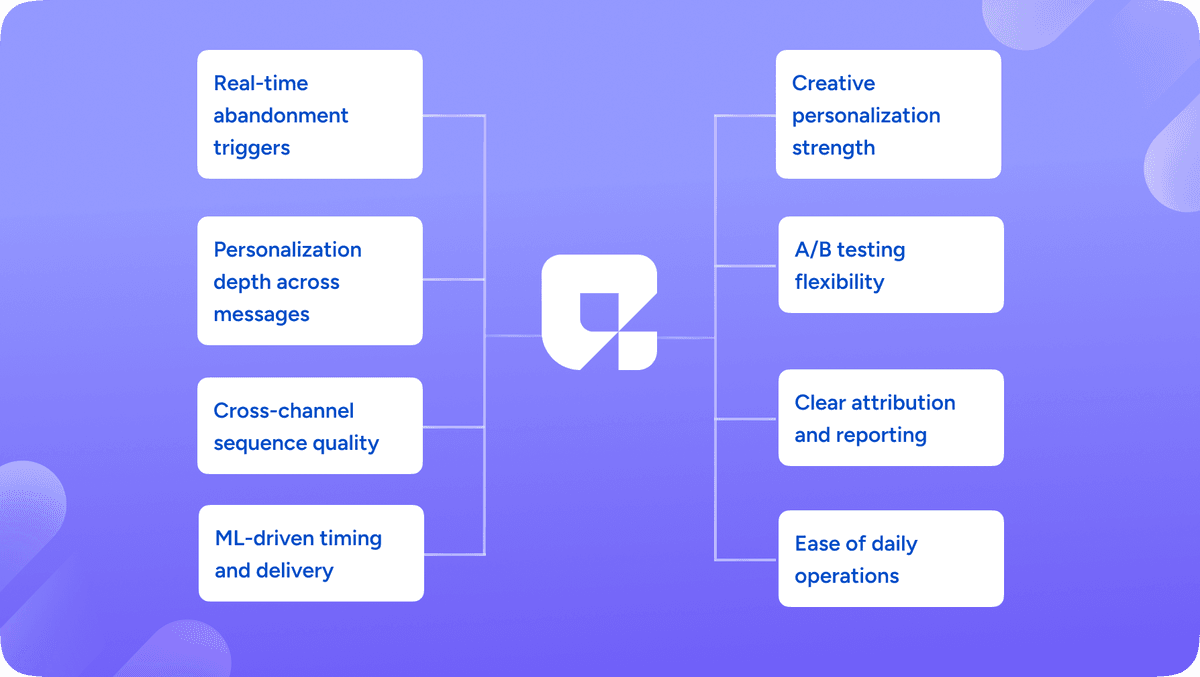
- Real-time abandonment triggers
- Personalization depth across messages
- Cross-channel sequence quality
- ML-driven timing and delivery
- Creative personalization strength
- A/B testing flexibility
- Clear attribution and reporting
- Ease of daily operations
Scoring Rubric
Basic → Advanced → Agentic
This scale helps us compare Questera vs Braze vs Iterable cart abandonment fairly and highlight where each platform stands for brands seeking the best platform for cart abandonment recovery 2025 or weighing Braze vs Iterable vs Questera for eCommerce cart recovery.
Introducing the Platforms
Questera: Agentic Approach Questera feels different from the moment you see how it reads user intent. The platform watches small behavioral signals that many teams miss, and it uses those signals to detect abandonment early. It studies pauses, scroll depth, product revisits, and exit speed to understand what the shopper wants. This makes the cart recovery platform smarter and more helpful in real situations. Questera also uses intent scoring to decide when a user needs a reminder and when they simply need space. Few cart abandonment tools handle this level of sensitivity with such ease.
At the center of Questera’s power, we find ELMA, the agent who manages dynamic email flows. She builds self-updating journeys that adjust as users change their behavior. You never need to manually rebuild your flow because ELMA keeps everything fresh. Many teams treat Questera as their main eCommerce cart abandonment solution because they want something that works without constant edits. ELMA watches behavior events in real time and updates content blocks instantly. This saves hours and supports stronger customer retention automation with very little effort.
Questera also uses a strong cross-channel strategy. The system starts with email, then moves to SMS, then in-app, and finally push for warm leads. This sequence feels natural because the timing changes based on intent. This flexibility makes Questera a reliable cart abandonment software for teams that value simple setups and strong results. Some brands even use the cart recovery platform shopping workflow when they want to handle sales across multiple storefronts.
A typical flow looks like this:
- Detect hesitation during checkout.
- Score intent using recent events.
- Trigger ELMA’s email with soft reassurance.
- Send SMS only when interest stays strong.
- Follow with in-app prompts during the next session.
- Use push for final reminders.
Personalization grows stronger at each step. Questera adds dynamic content, vibe-based tone adjustments, and small nudges based on the shopper’s comfort. This makes it effective for marketing automation for cart recovery at any scale
Strengths: Real-time intelligence, adaptive personalization, self-updating journeys, and gentle cross-channel timing.
Limitations: Works best when product teams share strong behavioral data.
Questera stands ahead in Questera vs Braze vs Iterable cart abandonment, especially for teams seeking the best platform for cart abandonment recovery 2025 or comparing Braze vs Iterable vs Questera for eCommerce cart recovery with complex needs.
Braze: Experience-First Automation
Braze takes a storytelling approach to user engagement. It treats each message like a moment inside a larger experience. When users leave their carts, Braze uses event-driven triggers inside Canvas to respond instantly. These events help the cart recovery platform decide when the shopper is ready for a gentle reminder. Many teams also explore Braze because it connects well with other cart abandonment tools they already use.
Braze leans heavily on personalization through user attributes and content blocks. This works well for brands with clean customer profiles, allowing messages to change based on age, location, or browsing patterns. This makes Braze suitable for many mid-market teams, though personalization requires manual updates and depends heavily on data quality.
Its cross-channel system covers email, push, in-app messaging, and SMS. You can build sequences that move through channels smoothly, though all logic must be set manually. Braze excels when creative teams want full control and don’t mind frequent adjustments. It supports structured customer retention automation, but requires more effort than Agentic systems.
Here’s a typical Braze flow:
- Shopper leaves an item in the cart.
- Event triggers the first email after a short delay.
- If the shopper returns, the flow stops automatically.
- If not, Braze sends a push or SMS based on your rules.
- A discount or offer appears near the final step.
This flow works well for brands that want predictable patterns and clear rules. Many teams use Braze for marketing automation for cart recovery when they want granular control. Braze also works for brands testing multiple storefronts, though its cart recovery platform shopping features need manual tuning.
Strengths: Strong event logic, flexible Canvas builder, reliable cross-channel tools.
Limitations: Heavy manual setup, limited auto-learning, frequent personalization updates.
In the Questera vs Braze vs Iterable comparison, Braze is strong for creative-led teams but needs more human oversight. It's powerful but not always the best platform for cart abandonment recovery 2025 for data-heavy brands.
Iterable: Workflow-Centric Orchestration
Iterable feels comfortable for operations teams that enjoy building structured workflows. It responds to API-driven triggers, giving brands complete control over when and how messages fire. This keeps the cart recovery system accurate across devices and sessions. Many teams pair Iterable with other cart abandonment tools for flexibility.
Iterable relies on segmentation that refreshes frequently. Messages stay updated, though not always instantly. The platform focuses on templates and rule-based personalization, which suits teams that want predictable patterns. While it can act as an eCommerce cart abandonment solution, it requires more manual adjustments than adaptive systems.
Iterable’s cross-channel tools include email, SMS, push, direct mail, and in-app messaging. You can build clear orchestration rules inside Journeys, though timing depends on accurate API events. Many teams choose Iterable for retention automation when they want highly organized flows.
Here’s a typical Iterable flow:
- API confirms that a cart event occurred.
- Workflow triggers and places the user in a segment.
- Email sends after a specified delay.
- If no action occurs, a push or SMS follows.
- Optional discount appears near the end.
This flow works reliably, though it demands regular checks. Many teams choose Iterable for structured marketing automation for cart recovery because they want clarity over automation. Iterable also supports multi-store logic, though the cart recovery platform shopping setup requires more early planning.
Strengths: API flexibility, predictable workflow logic, clear segmentation.
Limitations: Limited real-time intelligence, manual personalization, slower adaptive timing.
Iterable performs well in Questera vs Braze vs Iterable cart abandonment, though it stays workflow-heavy. It remains practical in Braze vs Iterable vs Questera for eCommerce cart recovery, but it rarely becomes the best platform for cart abandonment recovery 2025 for teams seeking adaptive intelligence.
| Feature | Questera | Braze | Iterable |
|---|---|---|---|
| Trigger Sensitivity | Strong events | Deep intent signals | API-dependent |
| Time-to-Send Optimization | Adaptive and real-time | Manual delays | Rule-based timing |
| Personalization Depth | Agentic micro-personalization | Attribute-driven | Template and rules |
| Cross-Channel Handoffs | Auto-adjusted sequences | Flexible but manual | Organized but rigid |
| ML / Predictive Timing | Strong | Moderate | Limited |
| Ease of Setup | Very easy | Moderate | Requires planning |
| Requires planning | Cost Considerations | Efficient for scale | Mid to high |
| Best Use Case | Dynamic brands | Creative-led teams | Workflow-heavy ops |
Common Mistakes & How to Avoid Them
- Sending too many emails without checking intent strength
- Adding discounts too early and lowering overall margins
- Using generic templates instead of clear personalization
- Ignoring users who switch between multiple devices
- Not testing timing windows for different product types
- Overlooking attribution, which confuses campaign results
- Forgetting consent requirements for SMS or push
- Allowing old segments to remain outdated
Conclusion
Cart abandonment always feels like a quiet pause, but the right system turns that pause into real revenue. When we compare Questera vs Braze vs Iterable cart abandonment, we see how each platform handles timing, intent, and user comfort. Questera leads with its adaptive style, while Braze and Iterable support teams that prefer manual control. Every brand can recover more sales with the right cart abandonment software and a reliable cart recovery platform built for growth. If you want the best platform for cart abandonment recovery 2025, Questera offers a calm and intelligent path forward.
FAQs
1. Is email enough for cart recovery?
Email helps, but adding SMS, push, and in-app messages raises recovery rates across different shopper behaviors.
2. When should I add a discount?
Share a discount only near the final step because early offers reduce margins and weaken purchase intent.
3. How much revenue lift can I expect?
Most brands notice steady recovery improvements within a few weeks when triggers and timing are optimized correctly.
4. What about privacy rules?
Always follow consent laws for SMS, push, and email to keep your communication compliant and user-friendly.
5. How often should I test timing?
Test timing every month because user behavior shifts often, and fresh insights improve your overall recovery rates.
6. Which platform is easiest for beginners?
Questera works best for beginners since its agentic workflows update automatically and reduce daily operational effort.
Ready to be a
10x Marketer?
See it in action