






Why "Prompt-to-Product" Is the New SaaS Stack
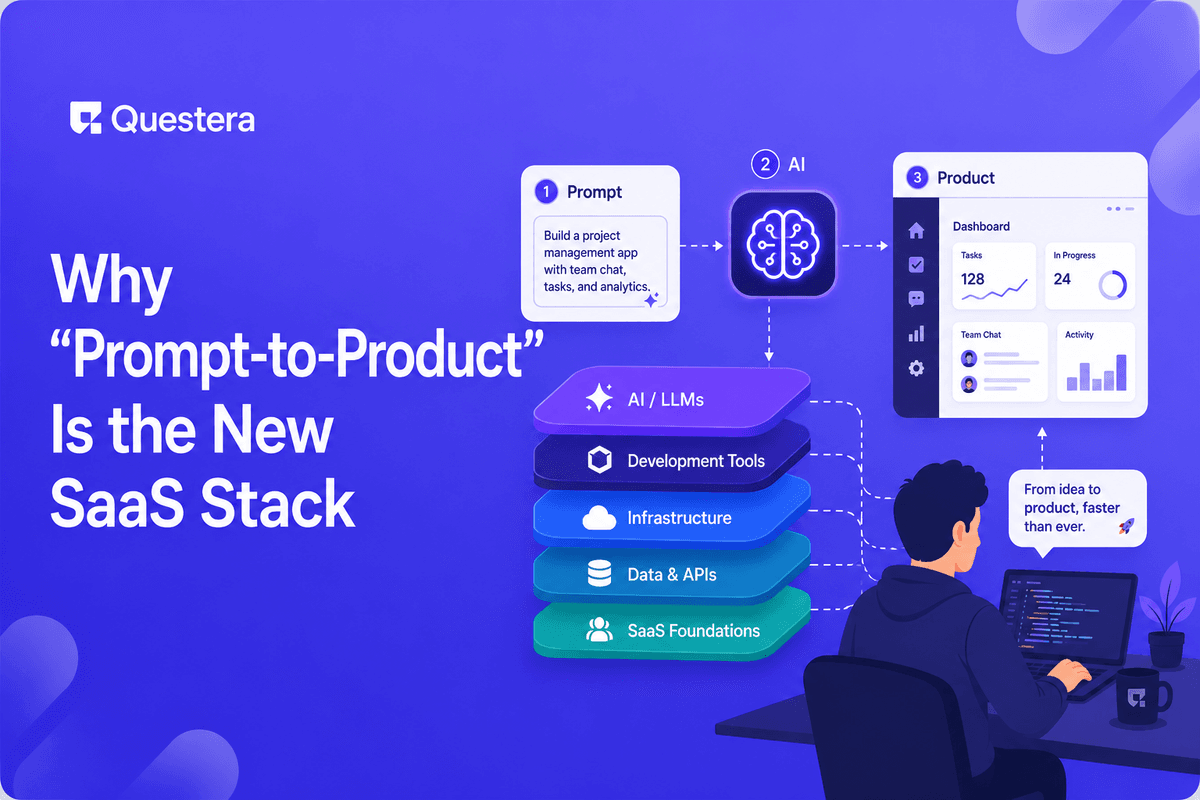
The old SaaS stack — design tools, project management, engineering teams, sprint cycles, QA, deployment pipelines — assumed engineering capacity was scarce and the cost of building wrong was high. The prompt-to-product stack collapses most of those layers. PRD → prompt → AI app builder → review → harden → ship → measure → iterate. The new stack is fewer layers, faster cycles, smaller teams. The era of the heavy SaaS stack is ending; the era of the prompt-driven stack is here.
The traditional SaaS build stack evolved over two decades. Design tools (Figma, Sketch). Project management (Jira, Linear, Asana). Engineering teams. Sprint cycles. QA processes. Deployment pipelines. Monitoring stacks. The structure made sense in an era where engineering capacity was scarce and the cost of building wrong was high. The prompt-to-product stack collapses most of those layers — same week, fewer people, faster cycles.
The Old SaaS Stack: What Each Layer Did
Discovery and Customer Research
- User interviews, surveys, persona development
- PM-driven research synthesized into spec docs
- Often 2–4 weeks of discovery per feature
Spec Writing and Approval
- PMs wrote 10–30 page specifications
- Engineering review with clarifying questions
- Stakeholder review with stakeholder revisions
- Approval gate before engineering started
Design and Design Review
- Designers in Figma/Sketch producing mockups
- Multiple iteration cycles with PMs and engineers
- Design review meetings
- Final designs handed off to engineering
Sprint Planning
- Story point estimation by team
- Sprint backlog construction
- Capacity planning
- Multi-hour planning meetings
Engineering Implementation
- Engineers reading specs, asking questions
- Writing code line by line
- Implementing UI from designs
- Building data models, APIs, backend logic
- Often 2–6 weeks of build time per feature
Code Review, QA, and Deployment
- PRs reviewed by peers
- QA team or QA process testing
- Bug-fix cycle with multiple back-and-forth iterations
- CI/CD setup and maintenance
- Staging deployments and testing before production
The Prompt-to-Product Stack: What Replaced Each Layer
Discovery → Tight Customer Conversation Cadence
- Direct customer conversations weekly (3–5 per week, 30 min each)
- Direct chat with engaged users in Slack/Discord
- Continuous discovery; not batched into 'research phases'
- Founders or PMs synthesize directly into PRDs
Spec Writing → 1-Page PRDs
- Tight 1-page PRDs replace 10–30 page specs
- Goal, target user, acceptance criteria, out of scope, design vibe, technical constraints, success metrics
- Written in 15–30 minutes
- Skip stakeholder approval gate; ship and measure
Design → Design Vibe Specification
- Design vibe specified in prompts (colors, typography, layout patterns)
- AI app builder generates first design pass
- Iteration via additional prompts
- Designers involved for brand identity moments, not every feature
Sprint Planning → Continuous Flow
- No sprint containers; continuous flow of features
- No story point estimation; features take what they take
- Weekly priority alignment instead of multi-hour planning
- Backlog roughly ordered; pulled when ready
Engineering Implementation → Prompt + AI App Builder
- Direct prompting of AI app builder (Greta, Lovable, Bolt) or AI IDE (Cursor)
- Iterative refinement through prompts
- Human engineering for architecture, security, performance decisions
- Build time per feature: hours to days, not weeks
Code Review → AI Output Review + Harden Phase
- Code review focused on AI output (correctness, security, performance)
- Harden phase as deliberate practice (auth, RLS, error handling, performance)
- Less syntax review; more judgment review
- Often single engineer reviews; not multi-reviewer ceremony
Deployment → Direct Deploys with Monitoring
- Direct deploys to production from main branch
- Monitoring catches issues; rapid rollback if needed
- No multi-stage QA gate before production
- Feature flags for risky changes
What the New Stack Looks Like in Tooling Terms
The Minimal Prompt-to-Product Stack
- AI app builder (Greta, Lovable, Bolt, or similar) — Generates the full application
- GitHub — Code and version control (AI app builder integration)
- Vercel or platform-native hosting — Deployment
- Stripe — Payments
- Supabase or platform-native backend — Auth, database, storage
- Resend or similar — Transactional email
- PostHog — Product analytics and feature flags
- Notion — Documentation, PRDs, customer conversations log
- Linear or platform-native task tool — Lightweight task tracking
- Sentry — Error monitoring
The Expanded Stack for Lean Teams
- Above + Cursor or AI IDE — For engineers handling complex logic alongside AI app builder
- v0 by Vercel — Specific UI component generation
- shadcn/ui — Design system foundations
- Slack — Team communication
- Cal.com — Customer interview scheduling
- Plausible or Fathom — Site analytics
- Customer.io or ConvertKit — Marketing email
What Collapsed and What Didn't
Collapsed (Mostly or Entirely)
- Multi-week build cycles
- Detailed spec docs
- Sprint planning ceremonies
- Heavy QA process for everything
- Project management overhead
- Design handoff cycles
- Estimation theater
- Multi-stage approval gates
Didn't Collapse
- Customer research and conversations — Maybe more important than ever
- Architecture and system design decisions
- Security and compliance considerations
- Code review for AI-generated output
- Operational discipline (monitoring, incident response)
- Distribution and customer acquisition
- Brand identity and design strategy
- Strategic technical decisions
Who Wins with the Prompt-to-Product Stack
Solo Founders
- Ship full SaaS without engineering team
- Coordination overhead approaches zero
- Direct customer-to-product loop
Lean Teams (2–5 People)
- Output of teams 3–4× larger in old stack
- Cross-functional roles emerge
- Faster iteration cycles
Niche-Focused Products
- Build economics support smaller markets
- Niches that didn't justify SaaS investment become viable
- Long tail of vertical SaaS opportunities
Established Teams That Adapt
- Same engineers ship 3–5× more output
- Less coordination overhead
- More customer time per engineer
Who Struggles with the Prompt-to-Product Stack
Companies Wedded to Sprint Methodology
- Sprint ceremonies absorb time AI builders saved
- Estimation theater wastes coordination cycles
- Cultural inertia prevents adaptation
Teams with Large Engineering Org Structures
- 20-person teams operating in 2026 likely overstaffed for output level
- Restructuring is hard; politics complicate downsizing
- Competitors with leaner structures pull ahead
Engineers Who Resist AI Tools
- Output gap with AI-using peers grows
- Career advancement depends on absorbing the new workflow
- Resistance compounds over time
Decisions Founders Face When Adopting the New Stack
Which AI App Builder to Use
- Greta — AI-native, prompt-first, broad use cases, strong default brand polish
- Lovable — Prompt-first with design focus
- Bolt — Strong for static and lightweight apps
- Rocket.new — Adjacent player in the category
- Choose based on what you're building and how the platform's defaults match your needs
Backend Stack Choice
- Supabase — Most common for AI-native SaaS; Postgres + auth + storage + edge functions
- Firebase — If Google ecosystem
- Direct Postgres + custom auth — More control, more setup
- AWS-native — Specific scale or compliance requirements
Engineering Team Structure
- Solo until significant revenue ($50K–$200K MRR)
- First engineering hire should be senior with broad foundation
- Avoid hiring as if the old stack still applied
- Lean teams shipping more beats heavy teams shipping less
When to Bring in Specialists
- Designer for brand identity, marketing landing pages
- Security engineer for compliance-regulated industries
- Performance engineer at significant scale (50K+ MAU)
- Infrastructure engineer for custom scaling needs
The Competitive Dynamics Shift
- Lean teams compete with VC-funded incumbents — Build advantage closes gap
- Niche SaaS competes with horizontal incumbents — Cost economics favor niche entry
- Distribution advantage remains — Build economics don't change distribution
- Operational discipline becomes differentiator — Building easier; operating well is moat
- Brand and design polish become differentiators — Generic-looking output is the default; brand identity stands out
- Customer empathy increasingly competitive advantage — Tight feedback loops compound
The Transition Path for Existing Teams
- Month 1: Adopt AI tools across engineering team. Cursor, Greta, or equivalent.
- Month 2: Pilot prompt-to-product workflow on one feature. Measure shipping velocity.
- Month 3: Restructure sprint ceremonies. Cut anything that no longer adds value.
- Month 4–6: Shift PMs to tight PRD format. Tighten customer feedback loops.
- Month 6–12: Lean into output advantage. Resist hiring as if old stack applied.
- Year 2: New stack is default; old stack is legacy. Compete on the new economics.
Common Mistakes in Adopting the Prompt-to-Product Stack
- Keeping sprint ceremonies that no longer fit — Daily standups, retros, planning ceremonies absorb time AI tools saved. Question every ceremony.
- Treating AI as just another tool — It's a structural shift, not an incremental tool. The stack changes around it.
- Hiring as if nothing changed — 20-person teams in 2026 doing what 5-person teams could do is competitive handicap.
- Skipping the harden phase — Build cycles compressed but harden phase isn't optional. AI generates plausible-looking code that needs review.
- Vague PRDs — Tight PRDs work because they translate to clear prompts. Vague PRDs produce vague output.
- Underestimating customer empathy — Compressed build cycles amplify cost of building wrong things. Customer time matters more than ever.
- Over-relying on AI app builder for complex logic — Some features benefit from AI IDE (Cursor) + engineer instead of AI app builder.
- Treating distribution as solved — Build advantage doesn't extend to distribution advantage. Distribution work still required.
- Skipping operational discipline — Monitoring, incident response, cost discipline remain critical.
- Trying to ship the old SaaS UX patterns — AI-native SaaS often benefits from different UX patterns. Don't constrain to old expectations.
Frequently Asked Questions
Is the prompt-to-product stack only for new products?
No. Existing products benefit too. Engineering teams adopting AI workflows on existing codebases ship 3–5× more features. Restructuring sprint ceremonies around the new pace recovers the time AI saved.
What about enterprise SaaS — does it work there too?
Yes, with adjustments. Enterprise SaaS has compliance, security, customization requirements that AI app builders handle well alongside dedicated engineering. The benefit is build velocity; the discipline (security, compliance) doesn't change.
How do I sell this to a sprint-planning organization?
Pilot it. One squad, one quarter, measure outcomes. Show: more features shipped, faster customer feedback, more customer time per team member. Hard to argue with results.
What about teams that need detailed specs for compliance reasons?
Detailed specs still get written when compliance requires. The 1-page PRD format works for most features; compliance-regulated features get the additional documentation they need. Tight PRD + compliance docs as needed, not detailed specs by default.
Does the new stack work for non-SaaS products?
Yes, with adjustments. Marketplaces, internal tools, vertical apps all benefit. Some categories (consumer mobile apps, hardware products) have different stacks; but for web SaaS broadly, prompt-to-product applies.
What about technical debt in the new stack?
Same as any codebase — engineers refactor periodically. AI-generated code can accumulate duplicate patterns, inconsistent abstractions. The discipline of cleanup transfers from old stack to new stack.
How do I hire for the new stack?
Look for AI tool fluency, code review skill, customer empathy, broad foundations. Don't over-weight framework specialism. The new hire should be a director of AI output, not just an implementer of specs.
Prompt-to-product is the new SaaS stack. Fewer layers, faster cycles, smaller teams. The old stack made sense when engineering capacity was scarce; the new stack matches current economics. Layers that collapsed: multi-week build cycles, detailed specs, sprint planning, heavy QA gates, project management overhead. Layers that didn't: customer research, architecture, security, code review, operational discipline. If you're a founder building a new SaaS, start with the prompt-to-product stack from day one. The build advantage is real. If you're at an established company, pilot the new stack on one squad this quarter. The old SaaS stack served its era; the era ended. Adopt accordingly.




© 2026 Questera
Follow in Google