






Pricing Your AI-Built SaaS: Frameworks & Examples
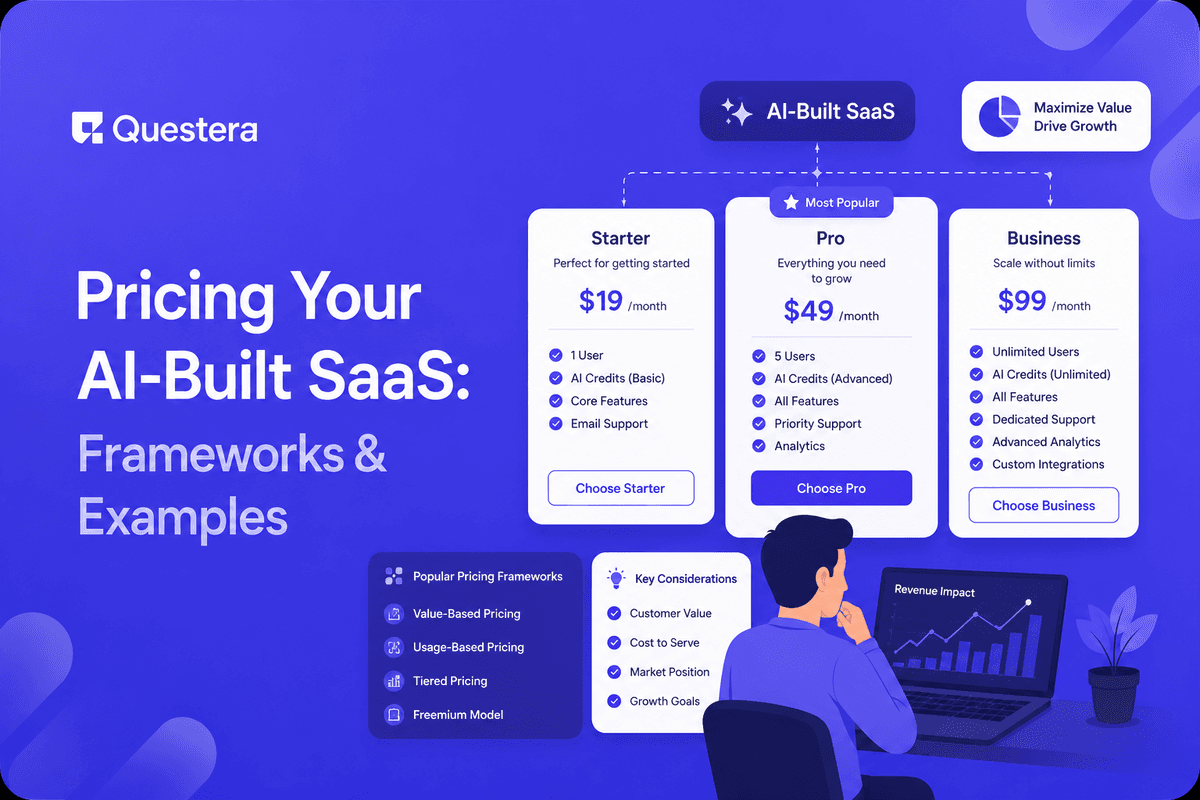
Most indie SaaS founders underprice by 50–80%. Pricing is the single highest-leverage growth lever and the most under-invested in. Three pricing frameworks fit AI-built SaaS in 2026: value-based pricing tied to outcomes (best when you can quantify value), tiered pricing with clear good/better/best (most common, works for most), usage-based pricing for AI-heavy products where customer costs vary. This guide covers the frameworks, real examples from indie SaaS, the AI cost considerations specific to 2026, the price-testing methodology, and the common mistakes that leave money on the table.
Pricing is the single highest-leverage growth lever in SaaS. A 20% price increase often produces 15–18% revenue increase. A 50% price increase often produces 30% revenue increase. The math compounds. Yet most indie SaaS founders pick prices reactively — copying a competitor's price, charging 'what feels right,' or pricing low to avoid scaring customers. The result: chronic underpricing that creates downstream problems — too many customers per dollar of revenue, customers who don't value the product, inability to invest in growth.
Why Most Indie SaaS Underprice
- Imposter syndrome — Founder doesn't feel the product is worth the price
- Customer empathy gone wrong — Pricing low to 'help' customers actually hurts the business
- Competitor copying — Anchoring to existing competitor prices instead of value delivered
- Fear of losing prospects — Few prospects matter more than honest price signal
- Lack of price testing — Picking a price and never validating
- Anchoring to AI costs — Pricing 'just above AI API costs' misses value capture
- Misunderstanding customer value perception — What founder thinks vs what customers actually pay
Framework 1: Value-Based Pricing
Value-based pricing ties your price to the value the customer receives. If your product saves a customer $10K/year in tools or labor, you can confidently charge $1K–$3K/year and customers see strong ROI.
When Value-Based Pricing Works
- B2B SaaS where customer value is quantifiable (time saved, money saved, revenue generated)
- Vertical SaaS for specific industries where the ROI is clear
- Products that replace expensive existing tools or labor
- Higher-priced SaaS ($100+/month per customer typical)
How to Calculate
- Quantify customer's current spend on equivalent solution (tools + labor)
- Estimate savings or revenue lift your product provides
- Price at 10–20% of value delivered (rule of thumb)
- Example: replaces $2K/month consulting → price $200–$400/month
Real Example
An AI-powered legal contract review tool eliminates 3 hours of lawyer time per contract (~$900 savings). For a firm reviewing 20 contracts/month, monthly savings = $18,000. Tool priced at $1,800/month (10% of value) is an easy yes for the firm. Value-based pricing captures the leverage.
Limits
- Requires quantifiable value (harder for productivity tools, consumer products)
- Requires sales conversation in many cases (not pure self-serve)
- Customers must agree with your value calculation
- Doesn't work well for low-stakes consumer SaaS
Framework 2: Tiered Pricing (Good/Better/Best)
Three tiers with clear feature/usage differences. Customers self-select based on needs and willingness to pay. The default framework for most B2B and prosumer SaaS.
Standard Structure
- Starter tier — Limited features, individual or very small team
- Pro tier — Full features, small team
- Team/Business tier — Multi-user, advanced features, priority support
- Optional: Enterprise tier — Custom features, contracts, dedicated support
- Optional: Free tier — Either free-forever with limits or free trial
Pricing Ratios That Work
- Starter : Pro : Business = ~1 : 3 : 8 (e.g., $9 / $29 / $79)
- Each tier feels meaningfully different in price and value
- Avoid: tiers too close in price (customers can't distinguish)
- Avoid: tiers too far apart (no upgrade path)
What Separates Tiers
- Usage limits (e.g., emails sent, AI generations, storage)
- Number of users or team members
- Advanced features (integrations, custom branding, API access)
- Support level (community → email → priority → dedicated)
Framework 3: Usage-Based Pricing
Customer pays based on consumption — API calls, AI generations, data processed, customers served. Increasingly common for AI-heavy SaaS in 2026 because AI usage costs vary significantly across customers.
When Usage-Based Works
- AI-heavy products where customer costs vary dramatically
- API-first products (Stripe charges per transaction, Twilio per message)
- Customer value scales with usage (more usage = more value)
- Predictable customer behavior (volatile usage causes billing anxiety)
Hybrid Pricing (Most Common)
- Base subscription + usage overage
- Example: $29/month includes 1,000 AI generations; $0.05 per additional
- Provides revenue predictability AND captures usage variance
- Customer-friendly: they know minimum cost; can scale up as needed
Limits
- Billing complexity higher than flat subscription
- Customer anxiety about variable bills
- Forecasting MRR harder
- Requires usage metering infrastructure
AI Cost Considerations Specific to 2026
Why AI Costs Change Pricing Math
- Traditional SaaS marginal cost per user ≈ $0 (servers, bandwidth, support)
- AI-heavy SaaS marginal cost per user can be $5–$50/month in API costs
- Pricing must cover AI cost AND deliver margin
- Free tiers carry real cost — can't be unlimited
Margin Protection Patterns
- Track AI cost per active user weekly
- Set usage limits in lower tiers that cover AI costs
- Use cheaper models where appropriate (Haiku for simple tasks; Opus for complex)
- Cache AI responses semantically to reduce repeat costs
- Set hard usage limits to prevent runaway costs
- Track gross margin; should be 60–80% even for AI-heavy SaaS
Pricing Examples by Category
| Category | Typical Pricing | Strategy |
|---|---|---|
| Productivity SaaS for solo users | $9–$15/month Pro tier | Free tier for funnel; affordable pro for individual conversion |
| Team SaaS for small business | $10–$30/user/month | Scale revenue with team size |
| Vertical SaaS for specific industries | $100–$500/month typical | Value-based; replaces expensive existing solutions |
| API/Developer products | Usage-based (per API call) | Low friction trial; revenue scales with customer success |
| AI-powered SaaS | $25–$100/month individual | Hybrid subscription + usage; limits protect margin |
Price-Testing Methodology
Pre-Launch Price Testing
- Run 3–5 price variants on landing page (limited traffic each)
- Measure signups/visitor at each price
- Look for price elasticity — does conversion drop sharply above some price?
- Pick the highest price where conversion stays acceptable
- Caveat: pre-launch conversion isn't post-launch behavior; treat as directional
Post-Launch Price Testing
- Raise prices for new customers (grandfather existing)
- Measure new customer behavior at higher price
- Continue if conversion holds; revert if it drops sharply
- Test in 20–30% price increments; smaller changes are hard to detect
Price Perception Interviews
- Talk to 10–15 customers; ask: what would you pay? what's too expensive? what's so cheap you'd doubt quality?
- Van Westendorp price sensitivity meter is the formal version
- Pay attention to actual purchase behavior, not stated price tolerance (people understate)
When to Raise Prices
- Customer feedback suggests product is undervalued ('I would pay way more for this')
- Conversion at current price is suspiciously high (>30%) — signal of underpricing
- Competitors charge significantly more
- Product capabilities expanded substantially
- Customer success stories suggest high ROI
- Support burden too high for current pricing
- Want to position upmarket
How to Raise Prices Without Losing Customers
- Grandfather existing customers (keep their current price)
- New pricing for new customers only
- Announce price increase 60+ days in advance for clarity
- Add value alongside price increase (new features, better support)
- Communicate the why ('investing in product/team/etc.')
- Most customers care less than founders fear
Common Pricing Mistakes
- Underpricing by 50–80% — Most common mistake. Test higher prices.
- Anchoring to competitor prices — Competitor pricing reflects their constraints, not your value.
- Pricing 'just above AI costs' — Misses entire value-capture opportunity.
- Charging by activity instead of value — 'Per email sent' when customer values 'emails delivered to inbox.'
- Too-cheap free tier — Generous free tier delays paid conversion indefinitely.
- Hidden pricing requiring sales call — Friction unless deal sizes justify (typically $1K+/month).
- Discounting reflexively — Discounts train customers to wait for deals.
- Lifetime deals at low prices — Front-loads revenue but cannibalizes long-term.
- Per-user pricing in solo-friendly products — Forces team buys when single-user is the natural unit.
- No annual discount — Loses customers who want to commit long-term for savings.
- Pricing 'fairly' instead of 'optimally' — Aim for optimal-but-honest, not lowball.
- Skipping price testing — Picking and never validating.
Frequently Asked Questions
How do I know if I'm underpricing?
Three signals: (1) Conversion rate is suspiciously high (>20% of trials convert? You're probably underpricing). (2) Customer feedback suggests value exceeds price ('I'd pay 3x this'). (3) Support burden is high relative to revenue per customer. Any of these = test higher prices.
What about freemium models?
Freemium works when conversion-from-free is mathematically positive. For AI-heavy SaaS, free tier costs real money — set usage limits that approximate $1–$2/month/free user max. Pure freemium without economic discipline destroys margins.
Should I do annual discounts?
Standard 15–25% annual discount captures customers who commit. Annual cash up-front improves cash flow significantly. Most B2B SaaS offer annual at meaningful discount.
What about lifetime deals on platforms like AppSumo?
Lifetime deals (LTDs) generate large upfront revenue but cannibalize long-term ARR. Use sparingly for traffic and validation early; avoid as ongoing strategy. The LTD customer is often the wrong customer.
How often should I revisit pricing?
Quarterly review at minimum. Major changes (re-tiering, fundamental restructure) every 12–18 months. Smaller tweaks (price increases for new customers) every 6 months. Set-and-forget pricing is common and expensive.
Most indie SaaS underprice by 50–80%. Pricing is the highest-leverage growth lever and most under-invested in. Three frameworks fit AI-built SaaS: value-based (when value quantifiable), tiered good/better/best (most common), usage-based (AI-heavy products). AI costs change pricing math — track gross margin (60–80% target). If you're an indie SaaS founder, your current pricing is probably wrong (most likely too low). Test raising new-customer prices 30–50% next month. If it holds, your previous price was leaving real revenue on the table. Make pricing a quarterly habit. Capture the value you're delivering instead of leaving it for someone else.





© 2026 Questera
Follow in Google