






The Lean MVP Playbook for AI-Built Startups
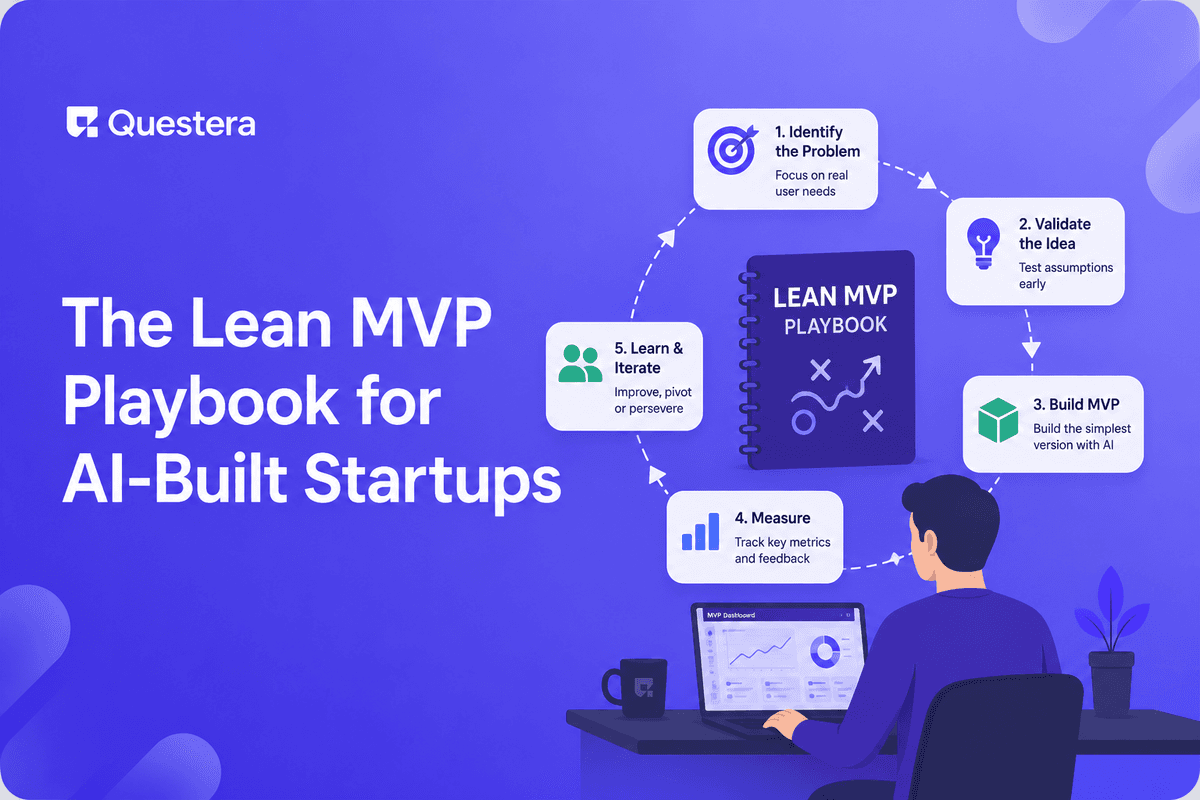
The lean MVP playbook for AI-built startups in 2026 is a 7-day sprint to launch, then 60 days of focused iteration. The traditional Lean Startup framework — build, measure, learn — still applies, but the cycle time has compressed dramatically. The discipline that separates shippers from stallers is scope ruthlessness: one user, one core action, one pricing tier, one distribution channel. AI builders make the building fast; the founder still has to do the harder work of picking the right niche and finding the first 50 paying customers.
Introduction
The Lean Startup framework was written when MVPs took months. In 2026, the framework still applies — build, measure, learn — but the cycle time has compressed roughly 10×. What used to be a 6-month iteration is now a 30-day iteration. The principles haven't changed; the cadence has.
This guide is the 2026-era lean MVP playbook. Not "Lean Startup, but with AI features bolted on," but the genuine playbook for founders building real businesses on AI app builders like Greta, Lovable, and Bolt. By the end, you'll have a 90-day plan to take an idea from zero to product-market signal.
What "Lean" Means in the AI Builder Era
The original Lean Startup definition of "lean" was about minimizing wasted engineering. In 2026, with AI handling the build, "lean" has shifted meaning meaningfully.
- Minimize wasted scope, not wasted engineering — Engineering effort isn't the scarce resource anymore. Founder attention is. Skip features that don't help you learn.
- Charge from week one — Lean now includes 'avoid free-forever startups that never validate willingness to pay.'
- Talk to users daily — Lean means cycle time, not feature count. The fastest learners win.
- Pick one distribution channel — Lean means resisting the temptation to try five marketing channels.
- Stay solo until you can't — Lean means avoiding premature team-building. Most AI-built startups don't need a team for the first 12 months.
The 7-Day MVP Build Phase
A focused solo founder can ship a viable v1 SaaS MVP in 7 days using modern AI builders. The discipline that makes this work — one core feature, one pricing tier, one distribution channel.
- Day 1: Write the one-page PRD and scaffold the app
- Day 2: Build the data model with realistic seed data
- Day 3: Add authentication and protected routes
- Days 4–5: Build the single core feature (one feature per prompt, in dependency order)
- Day 6: Integrate Stripe Subscriptions with one paid tier
- Day 7: Polish, security audit, and launch to first 10 users
By end of day 7, you have a working SaaS at a real domain, taking real payments, with users signing up. Total spend: $50–$200. This is the foundational build phase; everything that follows is iteration.
Days 8–14: First User Conversations
Week 2 of the playbook is the most important week of the 90 days. The first 5–10 customers shape the next two months of work.
- Reach out personally to every signup from week 1 — Email, DM, or Loom them. Schedule a 20-minute conversation.
- Run 5–10 user conversations — Watch them use the app live if possible. Ask three questions: what made them sign up, what they expected to happen, what almost made them not sign up.
- Take notes obsessively — Record sessions if users allow. Direct quotes matter more than your interpretation.
- Identify the top 3 friction points — Where users hesitate, get confused, or quit. Fix these in priority order before adding any new features.
- Confirm willingness to pay — If your free trial users won't pay, no amount of feature additions will fix that.
Days 15–45: The Iteration Cycle
Weeks 3–6 are the iteration phase. The cadence: ship, measure, talk to users, learn, repeat. Aim for one meaningful iteration cycle per week.
What One Iteration Cycle Actually Looks Like
- Monday: Review user conversations from last week. Pick one specific change to test.
- Tuesday–Wednesday: Ship the change. One focused build using your AI app builder.
- Thursday: Notify existing users. Reach out to 5 new potential users.
- Friday: Have user conversations. Note what worked and what didn't.
- Weekend: Reflect. What's worth keeping vs reverting? What's the next test?
What to Test (in Priority Order)
- Onboarding friction — Are users completing the core action on day 1?
- Activation rate — What percentage of signups become paying users?
- Pricing — Is the price too low (no signal) or too high (no conversions)?
- Core feature quality — Does the main action actually solve the problem users describe?
- Messaging — Does the landing page describe the product the same way users describe it?
- Retention — Are paying users still active after 14 days?
Resist the urge to add new features in this phase. The job is to make the existing features land, not to expand surface area. Most MVPs stall because founders add features instead of validating the ones already shipped.
Days 46–60: Distribution Discipline
By day 45, you should have product-market signal. Days 46–60 shift focus to distribution. The build is the easy part; finding the audience is the actual work.
Pick One Channel
- X (Twitter) — Strong for B2B SaaS founders shipping in public.
- LinkedIn — Strong for B2B SaaS targeting professionals.
- Niche subreddits — Strong for consumer or pro-sumer products where the community is concentrated.
- Cold outbound — Strong for B2B with $99+ pricing.
- Content SEO — Slowest ramp; longest payoff. Worth investing in only if you can publish consistently for 3–6 months.
- Communities you're already part of — Often the highest-converting channel for solo founders. Use this first.
What "Going Deep" on a Channel Means
- Daily activity on the channel for 60+ days minimum
- Specific content for that channel (not cross-posted everywhere identically)
- Direct engagement with the audience (replying, joining conversations, building relationships)
- Tracking conversion from channel to signup to paid customer
- Adjusting messaging and content based on what works on that specific channel
Days 61–75: Pricing and Conversion Optimization
Once distribution is producing reliable signups, weeks 9–10 are about converting more of them. Most AI-built MVPs underprice severely; raising prices is usually the highest-leverage change in this phase.
- Test price increases — Most MVPs are priced 30–50% below what the market would bear.
- Add an annual plan — Annual pricing (typically 16–20% discount vs monthly) materially lifts LTV.
- Tune the onboarding — The single biggest conversion lever in week 9 is usually onboarding.
- Add social proof — Testimonials from paying users. Real quotes outperform manufactured ones.
- Test free trial vs. freemium — Free trials with credit card upfront usually convert better for B2B.
- Add a high-tier plan — Often the easiest revenue lift. Even small adoption meaningfully lifts ARPU.
Days 76–90: Decision Time
Days 76–90 are the decision phase. The question: scale the working motion, or pivot meaningfully. Don't keep iterating ambiguously past day 90 without a clear yes-or-no on product-market fit.
Signals That Suggest "Scale"
- MRR growing 15%+ month-over-month
- Paid retention above 80% at 30 days
- Organic signups (people you didn't ask) starting to appear
- Word-of-mouth — at least some signups citing referrals
- You're learning roughly the same things in user conversations now as 2 weeks ago (signal of pattern stability)
Signals That Suggest "Pivot"
- MRR flat or declining despite consistent distribution effort
- Paid retention below 50% at 30 days
- Free users not converting even at lower price points
- Every user conversation reveals a different unmet need (signal of no consistent pattern)
- Customer acquisition cost exceeds first-year LTV by 2× or more
What This Playbook Doesn't Promise
- Most lean AI-built MVPs don't hit $10k MRR in 90 days. The median outcome is $0–5k MRR.
- Niche selection still matters more than execution. If you pick a niche with no willingness to pay, no amount of iteration will fix it.
- Distribution discipline is the bottleneck for most founders. The build is fast; finding the audience is slow.
- Solo execution has limits. By day 90, some founders need to hire (customer support, content marketing, sales).
How AI Builders Enable This Playbook Specifically
- The 7-day build phase is real — Traditional engineering builds took 4–8 weeks for the same v1 output. AI builders compress this to days.
- Weekly iteration cycles are realistic — Adding a focused change in 1–2 days vs 1–2 weeks means the iteration cadence can be weekly, not quarterly.
- Bundled growth tooling removes context-switching — Platforms like Greta bundle domain, SEO, analytics, content management. Founders don't lose hours switching between tools.
Common Mistakes That Kill Lean MVPs
- Building for everyone — A SaaS 'for everyone' will never ship in 7 days or find product-market fit in 90.
- Free-forever pricing — Charging from week one teaches you willingness to pay.
- Adding features instead of fixing onboarding — Most MVPs need better onboarding more than new features.
- Trying multiple distribution channels — Pick one. Master it. Add others only after success.
- Skipping customer conversations — Building blind from analytics is the most common reason MVPs stall.
- Ignoring signals — Both 'scale' and 'pivot' signals deserve action. Drifting past day 90 without a decision wastes another 90 days.
- Hiring too early — Solo execution scales further than founders expect.
- Confusing activity with progress — Shipping new features feels productive. The job is learning, not shipping.
Frequently Asked Questions
How is this different from the original Lean Startup framework?
The principles (build, measure, learn) are the same. The cycle time has compressed roughly 10× because AI builders made the build phase 5–10× faster. The 2011 6-month MVP iteration is now a 30-day iteration.
Can a complete beginner actually run this 90-day playbook?
Yes, with the right niche choice. The build is no longer the bottleneck; it's clarity of niche, discipline around v1 scope, and post-launch distribution.
What's a realistic outcome by day 90?
Median outcome is $0–5k MRR. Top quartile (founders executing with discipline) is $5–20k MRR. Top 10% reach $20k+ MRR by day 90. Outcomes depend heavily on niche selection and distribution execution.
Which AI app builder works best for the lean MVP playbook?
Greta, Lovable, Bolt, v0, and Replit all work. Greta is often the fastest path for solo founders specifically because bundled growth tooling reduces context-switching during the iteration phase.
What if I don't hit product-market signal by day 90?
Pivot. Sticking with a non-working niche past day 90 wastes another 90 days. The playbook is designed to surface yes-or-no signals within 90 days. Pivoting at day 90 is success, not failure.
How do I know if I'm building the right thing?
Talk to users weekly. The pattern in your first 50 user conversations tells you whether the niche has real demand. If you hear different unmet needs from every user, the niche is too broad.
Is this playbook just for AI-built startups?
Mostly — the 90-day cadence depends on the build phase being short. Traditional engineering builds can't compress the build phase to 7 days, so the iteration cadence has to be longer.
Key Takeaways
- The lean MVP playbook for AI-built startups is a 90-day sequence — 7 days to build, 60 days to iterate, 30 days to decide. The cycle time has compressed roughly 10× from the original Lean Startup framework.
- The discipline that matters: ruthless scope, weekly iteration cycles, charging from week one, and treating distribution as the actual work.
- By day 90, you should have a clear yes-or-no on product-market fit. Drifting past day 90 without a decision wastes another 90 days.
- AI builders enable this playbook by collapsing the build phase. They don't make the rest easier — niche selection, customer conversations, and distribution are still slow work.





© 2026 Questera
Follow in Google