






The History of Vibe Coding: From Karpathy's Tweet to an Industry
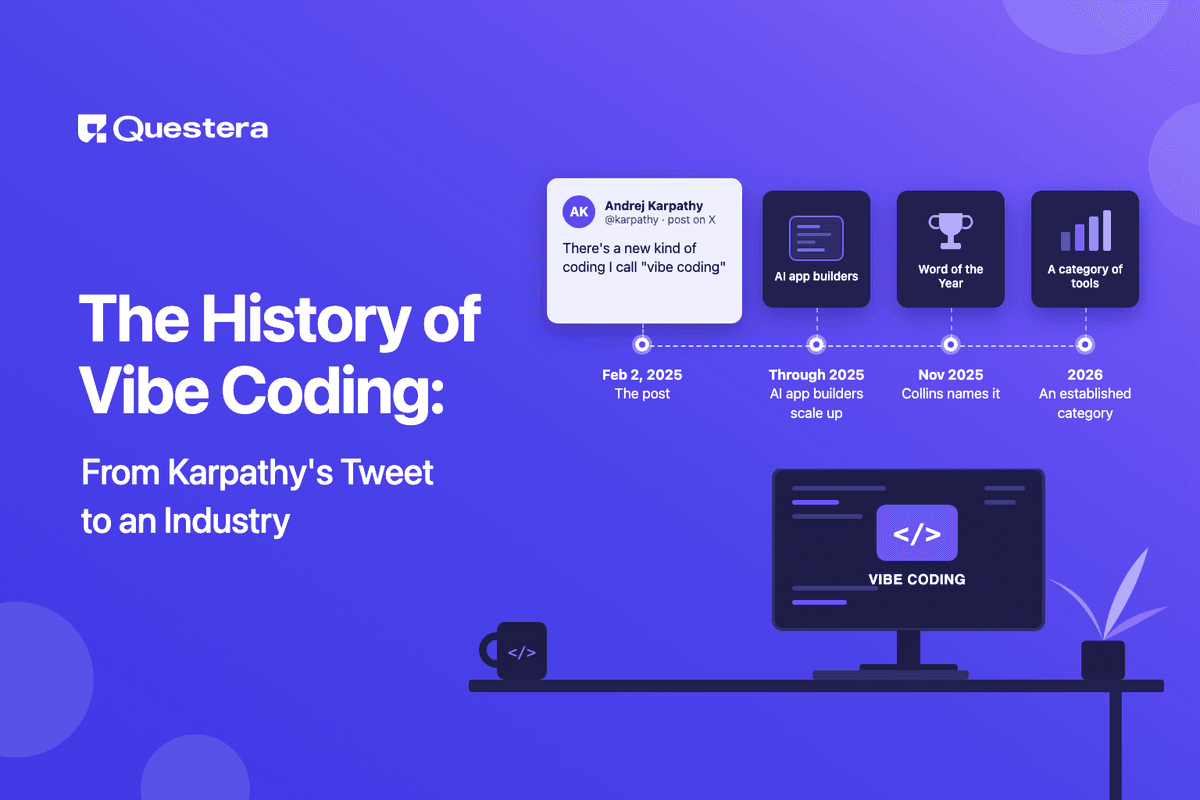
Vibe coding's history fits a single sharp arc. On February 2, 2025, Andrej Karpathy posted a tweet describing a new way of building software where you "fully give in to the vibes" and let AI write the code. Within 12 months it became Collins Dictionary's Word of the Year 2025, and by 2026 it named a whole category of AI coding tools.
Introduction
Most industries take decades to form. Vibe coding took under two years. From a single February 2025 tweet to an established software category by 2026 — the speed of this formation is itself part of the story.
The Pre-History: AI-Assisted Coding Before the Term Existed
GitHub Copilot arrived as a technical preview in June 2021 and became generally available in June 2022. Replit launched its AI coding assistant, Ghostwriter, in October 2022. OpenAI released GPT-4 in March 2023, and Anthropic released Claude 3 in March 2024 and Claude 3.5 Sonnet in June 2024; Sonnet is the model line Karpathy later named in his post. The practice he described was already underway before it had a name.
February 2, 2025: The Tweet That Named It
In a post on X, Andrej Karpathy wrote: "There's a new kind of coding I call 'vibe coding'." He described giving in to the vibes and forgetting the code exists, credited LLMs getting very good (naming Cursor Composer with Sonnet), and said he talked to Composer through SuperWhisper, accepted changes without reading the diffs and pasted error messages back. He judged it good enough for throwaway weekend projects.
The exact phrase "vibe coding" became a shorthand, then a category.
Why the Term Stuck
- It named the experience accurately — 'giving in to the vibes' captured the feeling of treating code as a steerable draft rather than something requiring line-by-line authorship.
- It came from a credible source — Karpathy isn't a hype-merchant; he's a serious researcher with a long track record.
- It was findable — short, memorable, and unique enough to search.
2024–2025: The Platform Wave
- Cursor — Karpathy named it in his post. Cursor said it had passed $100M in recurring revenue in its Series B announcement (16 January 2025).
- Bolt.new — about $40M ARR five months after launch, according to StackBlitz CEO Eric Simons on Lenny's Podcast (13 March 2025).
- Lovable — European AI app builder; CEO Anton Osika said on 23 July 2025 that it had crossed $100M ARR in eight months.
- v0 by Vercel — generally available since 2024, according to Vercel.
- Replit Agent — Replit's autonomous agent inside its cloud IDE, launched in September 2024.
March–November 2025: The Term Outgrows Its Original Meaning
By March 2025 the term was already being stretched: on 19 March, Simon Willison wrote that people were applying "vibe coding" to all forms of code written with AI assistance, and argued that not all AI-assisted programming is vibe coding. In May 2025, at LangChain's Interrupt conference, Andrew Ng called the name "unfortunate", saying coding with AI is "a deeply intellectual exercise" (Business Insider, June 2025).
Collins Word of the Year 2025
On 6 November 2025, Collins Dictionary named "vibe coding" its Word of the Year for 2025, ahead of shortlisted words such as "aura farming" and "taskmasking."
2026: The Category Matures
- Usage-based pricing — Lovable, Emergent and Greta sell monthly credits, and Bolt.new sells tokens (pricing pages, September 2026).
- Specialization — AI-first IDEs (Cursor, Devin Desktop, formerly Windsurf), AI app builders (Lovable, Bolt.new, Greta, v0, Replit) and agent platforms (Emergent).
- Growth tooling alongside the builder — Greta's paid plans include custom domain setup and web analytics (greta.sh pricing, September 2026).
- Enterprise features — Cursor, Lovable, v0 and Bolt.new all list SSO on a team, business or enterprise plan (pricing pages, September 2026).
The Financial Scale of Vibe Coding by 2026
- Cursor: over $100M in recurring revenue by January 2025 and over $1B in annualized revenue by November 2025, according to its Series B (16 January 2025) and Series D (13 November 2025) announcements.
- Lovable: crossed $100M ARR in July 2025, eight months after launch, according to CEO Anton Osika (post on X, 23 July 2025).
- Bolt.new: about $40M ARR by March 2025, according to CEO Eric Simons (Lenny's Podcast, 13 March 2025).
- Windsurf: Cognition agreed to acquire it in July 2025 (announced 14 July 2025), and it has since been renamed Devin Desktop. Its site says it is trusted by over a million developers (September 2026).
- v0: more than 4 million people had used it by February 2026, according to Vercel (3 February 2026).
- Greta: publishes rates rather than totals. Its State of Vibe Coding 2026 report (August 2026) puts the lifetime deploy rate for apps built on Greta at about 39%.
What Vibe Coding Has Actually Changed
- The build is no longer the bottleneck — Solo founders ship working SaaS in days, not months.
- Non-developers can ship real software — Designers, marketers, product managers, and operators can now build production-grade apps.
- Early-career hiring is most exposed — Stanford Digital Economy Lab researchers found employment of 22–25-year-olds in AI-exposed occupations 19% below trend, mainly through reduced hiring (August 2026).
- Vertical SaaS is exploding — Niche, specific-industry apps that wouldn't have been economically viable are now profitable indie projects.
- The cost of starting a software business dropped — A working MVP no longer needs a funded engineering team.
- The cultural status of coding shifted — From 'specialized profession' toward 'expressive medium accessible to anyone.'
What's Next for Vibe Coding
- Convergence on agentic workflows — more autonomous, less prompt-by-prompt.
- Better debugging and observability — tools catching AI errors before they reach production.
- Mobile-first AI builders — dedicated platforms for building native mobile apps via prompts.
- Vertical specialization — builders purpose-built for healthcare, legal, finance, education.
- Better economics on infrastructure — falling AI inference costs make more generous plans possible.
- Karpathy's original meaning may reclaim some territory as the tooling matures.
Common Misconceptions to Avoid
- 'Vibe coding replaces all software engineers' — it removes boilerplate and lowers the bar, not the ceiling.
- 'The category is a hype bubble that'll burst' — the underlying model quality improvements are structural, not cyclical.
- 'Karpathy invented AI-assisted coding' — he named a practice already underway.
- 'You need to know how to code to vibe code' — this was never true; the whole point is that you don't.
- 'Vibe-coded apps can't reach scale' — multiple vibe-coded apps are now at millions of users and real revenue.
Frequently Asked Questions
Want to try one of these? Start on Greta.sh — no setup, no boilerplate — just a prompt.Who coined the term vibe coding?
Andrej Karpathy, in a post on X on February 2, 2025.
What did Karpathy originally mean by vibe coding?
You describe what you want to an AI, accept the suggestions without carefully reviewing the code, paste back error messages when things break, and let the codebase grow without fully understanding every line. The "vibes" refer to trusting the AI rather than auditing its work line by line.
When did vibe coding become a serious industry trend?
Within weeks. By 19 March 2025, Simon Willison noted coverage in the New York Times, Ars Technica and the Guardian. Collins Dictionary named it Word of the Year for 2025 in November 2025.
Has the meaning of vibe coding changed since 2025?
Yes. Karpathy's original post described accepting AI output without reading the diffs. By March 2025, Simon Willison observed people applying the term to all AI-assisted coding.
What are the major vibe coding platforms in 2026?
AI-first IDEs: Cursor and Devin Desktop (formerly Windsurf). AI app builders and agent platforms: Lovable, Bolt.new, Greta, v0 by Vercel, Replit and Emergent.
Will vibe coding still matter in 5 years?
The structural shift — AI as primary author of software with humans as directors — is here to stay. The interfaces, business models, and player lineup will change. The fundamental change in how software gets built will not.
Key Takeaways
- Vibe coding began with a single tweet from Andrej Karpathy on February 2, 2025.
- Within months, it became a category — Cursor, Bolt, Lovable, v0, Greta, Emergent, Windsurf.
- The term outgrew Karpathy's original meaning. By 2026, it broadly refers to any AI-assisted software development.
- The deeper shift is structural. Starting a software business costs far less, non-developers can ship production apps, and the bottleneck has moved from engineering to distribution and pricing.





© 2026 Questera
Follow in Google