






The Growth Engineer's Toolkit: 50 Tools That Replace a Marketing Team
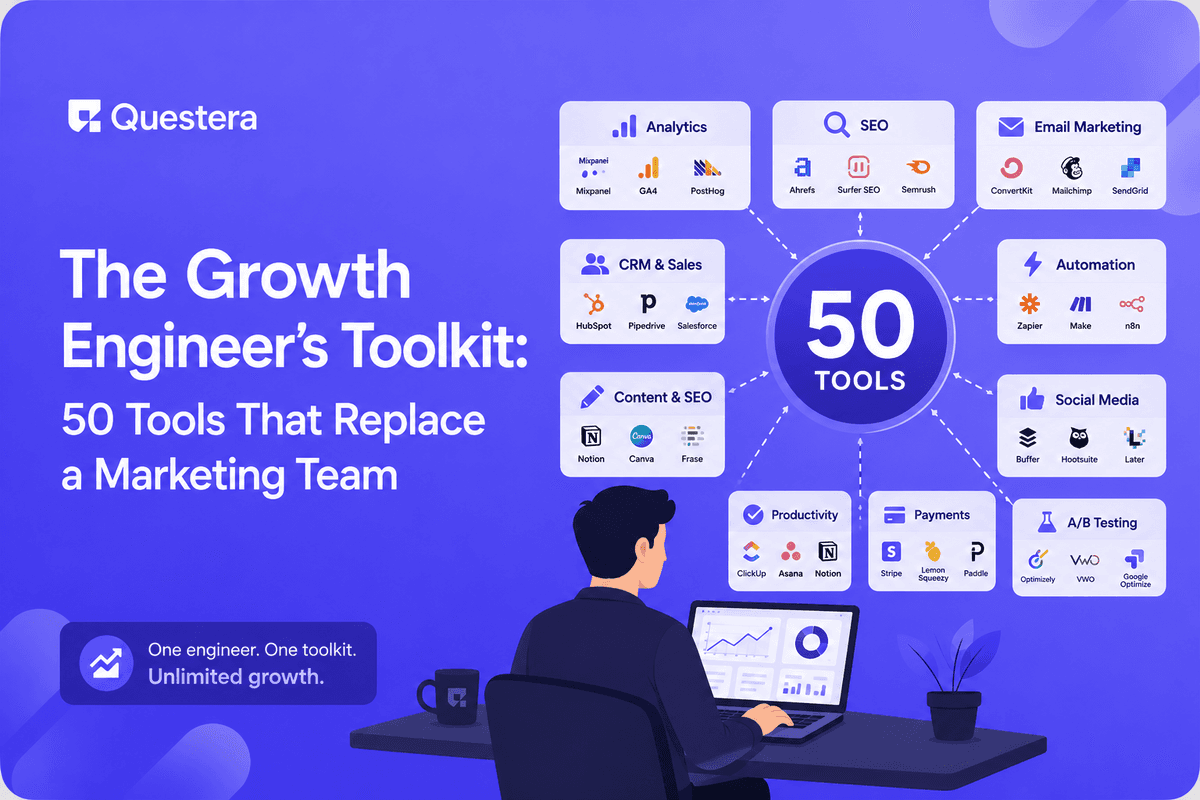
Solo founders and growth engineers in 2026 don't hire marketing teams — they assemble toolkits. The modern stack spans analytics, SEO, content production, email, conversion rate optimization, social media, paid acquisition, and AI-augmented workflows. 50 tools (free and paid) cover the full marketing function for indie SaaS at $0–$100K MRR. Not every tool fits every business — but the right combination of 8–12 tools from this list outperforms a full-time marketing hire for most indie SaaS in 2026.
This guide organizes 50 tools by job-to-be-done. Analytics. SEO. Content production. Email and outreach. Conversion rate optimization. Social media. Paid acquisition. AI-augmented workflows. Customer feedback and research. Operations and infrastructure. By the end, you'll have a concrete shortlist for your specific business shape — solo founder vs lean team vs growth-stage SaaS.
Got an idea? Build it now!
Just start with a simple Prompt
Get Started Today


Category 1: Analytics (Knowing What's Working)
- PostHog — Product analytics, session replay, feature flags, A/B testing. Open-source-friendly, generous free tier. The strongest single tool for indie SaaS analytics.
- Plausible — Privacy-friendly site analytics. No cookies, GDPR-friendly. $9/month start.
- Fathom Analytics — Similar to Plausible. Privacy-first, simple dashboard. $14/month start.
- Google Analytics 4 — Free; comprehensive; complexity overhead. Standard but not always best fit for indie.
- Mixpanel — Product analytics; strong funnel and cohort analysis. Free tier; paid tiers scale with events.
Recommendations
- Solo founder: PostHog (free tier) + Plausible for site analytics
- Lean team: PostHog + Plausible/Fathom
- Growth-stage: PostHog Cloud or Mixpanel + Plausible/GA4
Category 2: SEO (Organic Growth Foundation)
- Ahrefs — Mature SEO suite. Backlink analysis, keyword research, competitor analysis. $99/month entry; pricier scales.
- Semrush — Similar to Ahrefs. Slightly different strengths in PPC and content. $139/month entry.
- Moz — Older SEO tool. Domain Authority metric. $99/month entry.
- Mangools — Budget alternative covering keyword research, SERP analysis, backlinks. $29/month entry.
- Ubersuggest — Neil Patel's tool. Free tier; paid from $29/month.
- Surfer SEO — Content optimization specifically. SERP-based optimization recommendations.
- Google Search Console — Free; essential. Search performance, indexing status, technical issues.
Recommendations
- Solo founder: Google Search Console (free) + Mangools
- Lean team: Ahrefs or Semrush at entry tier
- Growth-stage: Full Ahrefs/Semrush + Surfer for content
Got an idea? Build it now!
Just start with a simple Prompt
Get Started Today
Category 3: Content Production (The Durable Channel)
- Notion — Content planning, calendar, drafts, team collaboration
- Google Docs — Content drafting; collaborative editing
- Hemingway Editor — Readability check during editing
- Grammarly — Grammar and clarity check; both free and paid tiers
- Canva — Visual content (social graphics, blog hero images)
- Figma — Design for marketing assets and landing pages
- Loom — Screen recordings for tutorials, walkthroughs, sales demos
Recommendations
- Solo founder: Notion + Google Docs + Canva + Loom
- Lean team: Add Figma for design-heavy work
- Growth-stage: Add Hemingway/Grammarly for quality consistency at scale
Category 4: Email and Outreach
- Resend — Transactional email infrastructure. Developer-friendly, reasonable pricing.
- Postmark — Reliable transactional email. Slightly pricier than Resend; mature.
- Beehiiv — Newsletter platform. Strong for content marketing.
- ConvertKit (now Kit) — Creator-focused email marketing. Automation, broadcasts, paid newsletters.
- MailerLite — Email marketing automation. Generous free tier.
- Customer.io — Behavior-triggered email. More expensive; powerful for product-led growth.
- Lemlist — Cold outreach with personalization. For sales-driven motion.
- Apollo — Sales prospecting + outreach. Database + email sequencing.
Recommendations
- Solo founder: Resend for transactional + MailerLite for marketing
- Lean team: Resend + ConvertKit or Beehiiv
- Growth-stage: Resend/Postmark + Customer.io for behavior-triggered
Got an idea? Build it now!
Just start with a simple Prompt
Get Started Today
Category 5: Conversion Rate Optimization
- Hotjar — Heatmaps, session recordings, surveys
- FullStory — Session replay, behavior analytics
- VWO — A/B testing and personalization (VWO and AB Tasty merged and now operate as Wingify; vwo.com redirects to wingify.com)
- Optimizely — Enterprise-grade A/B testing
- Microsoft Clarity — Free heatmaps and session replay (surprisingly capable)
- PostHog — Built-in feature flags and A/B testing (covered in analytics)
Recommendations
- Solo founder: Microsoft Clarity (free) + PostHog for A/B testing
- Lean team: Hotjar + PostHog
- Growth-stage: FullStory + dedicated A/B testing (VWO or PostHog)
Category 6: Social Media
- Buffer — Multi-platform scheduling, basic analytics
- Hypefury — Twitter/X-specific; threading, auto-engagement
- Typefully — Twitter/X-specific; clean writing experience
- Hootsuite — Mature social media management; enterprise-leaning
- Sprout Social — Similar to Hootsuite; pricier
- Tweet Hunter — Twitter/X with content research and AI assistance
Recommendations
- Solo founder (Twitter-focused): Typefully or Hypefury
- Lean team: Buffer for multi-platform
- Growth-stage: Buffer or Sprout depending on team size
Got an idea? Build it now!
Just start with a simple Prompt
Get Started Today
Category 7: Paid Acquisition
- Google Ads — Search and display ads. Largest paid channel.
- Meta Ads (Facebook/Instagram) — Detailed audience targeting.
- LinkedIn Ads — B2B targeting. Expensive but precise.
- Reddit Ads — Niche subreddit targeting.
- Twitter/X Ads — Promoted tweets in niches.
- Sparkloop — Cross-promotional newsletter ad network.
- Ezoic — Programmatic ad management for content sites.
Recommendations
- Solo founder: Skip paid for v1; validate organic first
- Lean team: Google Search + niche channel (Reddit, LinkedIn) at small scale
- Growth-stage: Multi-channel with dedicated paid analyst
Honest framing: most indie SaaS at $0–$10K MRR shouldn't run paid acquisition. Unit economics rarely work at this stage. Validate organic first.
Category 8: AI-Augmented Workflows
- ChatGPT or Claude — Drafting, editing, brainstorming, analysis
- Jasper — AI marketing copywriting specifically
- Copy.ai — Marketing copy generation
- Descript — AI-powered audio/video editing
- Synthesia — AI video generation from text
- ElevenLabs — AI voice generation for narration
- Midjourney / DALL-E / Imagen — AI image generation for marketing assets
- Otter.ai — Meeting transcription and summary
- Rytr — Lower-cost AI writing
Recommendations
- Solo founder: ChatGPT/Claude + Midjourney/DALL-E + Descript or Otter
- Lean team: Same plus Synthesia/ElevenLabs for video/audio at scale
- Growth-stage: Add specialized tools (Jasper for copy, etc.) based on need
Got an idea? Build it now!
Just start with a simple Prompt
Get Started Today
Category 9: Customer Feedback and Research
- Typeform — Beautiful forms and surveys
- Tally — Free Typeform alternative
- Calendly / Cal.com — Customer interview scheduling
- Maze — User testing with prototypes
- UserTesting — Recorded user testing sessions
- Sprig (formerly UserLeap) — In-app micro-surveys
Recommendations
- Solo founder: Tally (free) + Cal.com (free) + Sprig free tier
- Lean team: Typeform + Calendly + Sprig
- Growth-stage: Add Maze or UserTesting for usability work
Category 10: Operations and Infrastructure
- Slack — Team communication (works for distribution coordination)
- Linear — Issue and project tracking
- Notion — Documentation, content planning, knowledge base
- Figma — Design and prototyping
- GitHub — Code and version control
- Vercel / Netlify — Hosting with preview deployments
- Stripe — Payments and subscriptions
- Crisp / Intercom — Customer support chat
- Webflow / Framer — Marketing site builders
Got an idea? Build it now!
Just start with a simple Prompt
Get Started Today
Building the Right Stack for Your Business
Solo Founder Shipping V1 SaaS (8 Tool Stack)
- Analytics: PostHog + Plausible
- SEO: Google Search Console + Mangools
- Content: Notion + Canva
- Email: Resend + MailerLite
- Social: Typefully
- AI: ChatGPT/Claude
- Feedback: Tally + Cal.com
- Operations: GitHub + Vercel + Stripe (already in product stack)
Lean Team at $5K–$50K MRR (12 Tool Stack)
- Add Ahrefs or Semrush
- Add Hotjar for conversion optimization
- Add Buffer or Hypefury
- Add ConvertKit or Beehiiv for newsletter
- Add Linear for project tracking
- Add Crisp for support chat
Growth-Stage SaaS at $50K+ MRR (15+ Tool Stack)
- Add Mixpanel for product analytics depth
- Add VWO or Optimizely for A/B testing
- Add Customer.io for behavior-triggered email
- Add UserTesting for usability research
- Add dedicated paid acquisition tools
- Add Sprout Social if multi-platform social at scale
What This Stack Actually Costs
| Stage | Monthly Stack Cost | Equivalent Hire |
|---|---|---|
| Solo founder | $50–$200/month | Saved $5K–$10K/month vs marketing hire |
| Lean team | $300–$800/month | Saved $8K–$15K/month vs hiring |
| Growth-stage | $1,500–$5,000/month | Saved or complemented a small team |
| Enterprise | $10K+/month | Augments a real marketing team |
The math compounds. At every stage, the toolkit costs are a fraction of the equivalent hire. The leverage comes from operating the toolkit well — not from owning every tool, but from picking the right 8–12 and using them with discipline.
Got an idea? Build it now!
Just start with a simple Prompt
Get Started Today
Operational Discipline That Determines Outcomes
- Weekly review of metrics across tools — Set aside 1 hour every Friday to review analytics, SEO, email performance, conversion rates
- Quarterly tool audit — Are you using everything you pay for? Drop tools that aren't earning their keep.
- One tool per job — Don't have two analytics tools, two email tools, two SEO tools. Pick one; master it.
- Integration over fragmentation — Tools that pass data between each other are more valuable than isolated tools
- Document workflows — Solo founders eventually hire help. Documented workflows in tools transfer cleanly.
- Track ROI on each tool — Tools that don't drive measurable revenue or growth should be cut.
- Patience with compounding tools — SEO and content take 6–18 months to compound. Don't quit at month 3.
What This Stack Doesn't Replace
Honest framing: tools augment but don't replace certain skills. Strategy — tools don't decide which markets, products, or positioning. Storytelling — tools draft copy; brand voice and narrative come from humans. Customer empathy — tools count; humans interpret what counts means. Creative execution — tools generate; humans curate and refine. Relationships — tools measure; humans build the relationships measurement reveals. The toolkit doesn't replace the marketer; it replaces the marketing team.
Common Mistakes Building Marketing Stacks
- Over-tooling — Buying 15 tools for an MVP business. Pick 8 and use them well.
- Tool-shopping instead of execution — Spending hours researching tools instead of doing the work the tools enable.
- Skipping analytics setup — Without analytics from day one, you have no signal on what's working.
- Trying to use every tool's every feature — Pick the 20% of each tool's features that matter and master those.
- Comparing tools by feature count — More features = more complexity. Pick tools that match what you actually need.
- Ignoring free tiers — Many indie-friendly tools have generous free tiers. Don't pay for things you don't need yet.
- Cancelling tools too quickly — Some tools (especially SEO) take months to demonstrate value.
- Not integrating tools — Tools that don't share data create siloed insights. Pick tools that integrate.
- Letting tool sprawl creep — Adding tools is easy; removing is harder. Quarterly audit forces discipline.
- Buying enterprise tools at the wrong stage — Salesforce, HubSpot Enterprise, Adobe stack are wrong for indie SaaS.
Got an idea? Build it now!
Just start with a simple Prompt
Get Started Today
Frequently Asked Questions
Can solo founders really do marketing without a team?
Yes, with discipline. The toolkit + 15–30 hours/week of operator time produces marketing output that would have required a 5-person team in 2018. The catch: it requires the founder to actually do the work, not just buy the tools.
How much should I budget for the marketing stack?
For solo founders shipping early-stage SaaS: $50–$200/month. For lean teams at $5K–$50K MRR: $300–$800/month. For growth-stage at $50K+: $1,500–$5,000/month. Scale stack cost with revenue, not before.
What about AI tools — are they replacing more of the team?
AI augments productivity meaningfully. ChatGPT/Claude for drafting, Midjourney for visuals, Descript for video editing, Otter for transcription — solo founders ship 3–5x more content with AI assistance. AI doesn't replace strategy, taste, or relationships.
Which one tool gives me the most leverage?
PostHog. Analytics + session replay + A/B testing + feature flags in one platform. Free tier covers most indie SaaS until significant scale. Single tool that covers what would have taken 3–4 separate tools previously.
Should I use Google Analytics or alternatives?
Privacy-friendly alternatives (Plausible, Fathom) are easier to use, smaller learning curve, no cookie banners. GA4 is more comprehensive but complex. For indie SaaS, Plausible or Fathom is often better fit. PostHog complements either for product analytics.
How do I track ROI across all these tools?
Track revenue attribution where possible (which channels drove which customers). For tools without direct attribution (content, social, brand), track activity → traffic → conversion → revenue funnel and look for correlation over time.
When should I stop and hire a marketer?
When operating the stack consumes more time than the highest-value work you could be doing instead. Typically around $30K–$100K MRR depending on business shape. The first hire is usually content/SEO; second is conversion/paid; third is brand/positioning.
Solo founders and lean teams in 2026 assemble toolkits instead of hiring marketing teams. The right 8–12 tools cover analytics, SEO, content, email, conversion, social, AI, and operations for indie SaaS at $0–$100K MRR. Stack cost scales with revenue — always a fraction of the equivalent hire. Tools augment but don't replace strategy, storytelling, customer empathy, and creative execution. Pick your business stage, map the 8–12 tools that match, set them up this week, and run them with weekly metric reviews. By month 6, the marketing function compounds. By month 12, you'll have a marketing stack that outperforms what marketing teams of 5–10 people delivered in 2018 — at a fraction of the cost.
Got an idea? Build it now!
Just start with a simple Prompt
Get Started Today
Ready to be a
10x Marketer?
See it in action



© 2026 Questera
Follow in Google