






Greta vs Softr: AI Prompt-to-App vs Database-First Builder
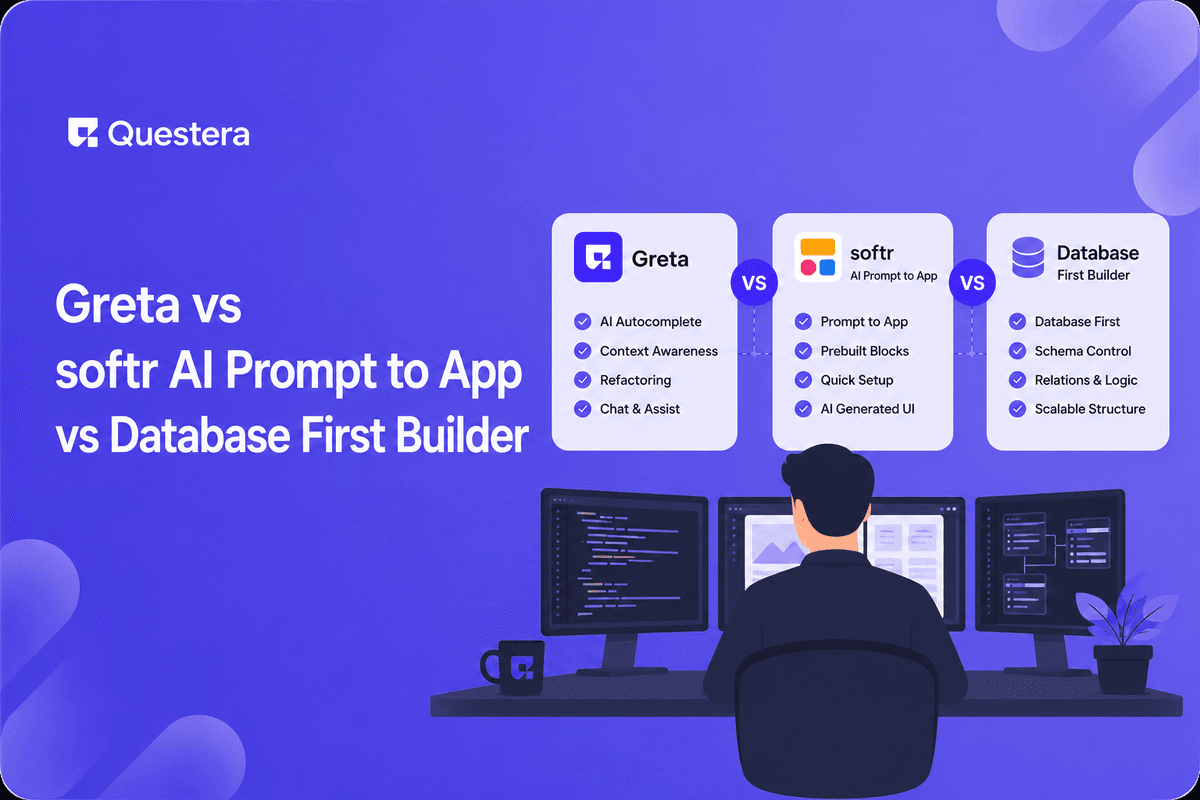
Softr is a popular database-first no-code builder. You start with a data source — Airtable, Google Sheets, or Softr's built-in database — then assemble an app from pre-built blocks: list views, detail pages, forms, charts, user portals, membership gates. It's fast for the apps it's designed for, requires no code, and shines at turning structured data into a usable interface.
Greta is an AI-native prompt-to-app builder. You describe what you want; Greta generates a full SaaS application — real Next.js/React code in your GitHub repo with auth, database (Supabase), payments (Stripe), and deployment. Output is a real codebase, not an assembly of blocks. The comparison comes up because both let non-traditional developers ship apps fast. But they're different approaches: Softr assembles apps from blocks on top of a data source; Greta generates custom code from prompts.
The Approach Difference
Softr is database-first and block-based. You bring or build a data source, then drag in blocks that display and interact with that data. The blocks are pre-built and configurable but not infinitely flexible — you work within what the blocks support. No code is involved, which is the appeal and the ceiling.
Greta is prompt-first and code-generating. You describe the app; Greta generates custom code. The output is a real codebase you own, with custom logic possible because it's actual code, not blocks. The trade is that you're working with generated code (which needs review and ownership) rather than a fully managed no-code environment.
What Softr Does Well
- Client portals on top of existing Airtable data — fast
- Internal tools and dashboards from structured data
- Directories and listing sites
- Membership sites with gated content
- No code required at all
- Fast assembly when your data already lives in Airtable/Sheets
- Pre-built blocks handle common patterns out of the box
- Good for non-technical builders who want zero code
What Softr Struggles With
- Custom logic beyond what blocks support
- Complex workflows and state machines
- Apps that need to grow beyond block capabilities
- Code ownership (you're on the platform)
- Performance at scale (Airtable backend has limits)
- Deep integrations beyond available connectors
- Becoming a real product with custom backend needs
What Greta Does Well
- Custom logic and workflows (it's real code)
- Apps that grow into real products
- Code ownership in your GitHub
- Real Postgres backend (relationships, performance)
- Custom integrations with any service
- Full control over auth, payments, and behavior
- Scaling beyond no-code ceilings
Where Softr Is Genuinely Faster
- You already have data in Airtable and want a portal on it — today
- Standard client portal (login, view their records, submit forms)
- Directory or listing site from structured data
- Membership site with gated content
- Internal tool where block patterns fit exactly
- Zero-code requirement (no appetite for any code ownership)
Where Greta Is Genuinely Better
- App needs custom logic blocks can't express
- Product you'll grow over months/years
- Need code ownership (avoid platform lock-in)
- Complex data relationships (Postgres over Airtable)
- Custom payment flows beyond basic Stripe blocks
- Performance requirements beyond Airtable-backend limits
- Anything that becomes a real SaaS business
The Data Model Difference
- Softr on Airtable — Airtable is the backend; great for moderate data, hits limits at scale (record counts, API rate limits, query complexity)
- Softr's own database — more capable than Airtable backing but still managed/block-bound
- Greta on Postgres (Supabase) — relational, performant, scales, supports complex queries and relationships
- For simple structured data, Airtable-backed Softr is fine; for relational SaaS data at scale, Postgres wins
- Migrating from Airtable backend to real database later is a real project; factor it in
Common Project Patterns
- Client portal on existing Airtable data — Softr wins if standard and data's in Airtable; Greta wins if it needs custom logic or will grow
- Directory / listing site — Softr wins for a straightforward directory from structured data
- SaaS product with custom workflows — Greta wins; custom logic, real backend, code ownership, room to grow
- Membership site with gated content — Softr wins for standard membership gating, no code
- Internal tool with complex logic — Depends: simple fits Softr; complex workflows and integrations fit Greta
Code Ownership and Lock-In
- Softr — app lives on the platform; no code export; lock-in is real
- Greta — real Next.js code in your GitHub; full ownership; low lock-in
- For throwaway or simple internal tools, lock-in matters less
- For products you'll grow, code ownership matters more
- Match to whether the app is disposable or foundational
Pricing: Softr is a tiered subscription that scales with usage/features and can get pricey with members/scale; Greta is a subscription with bundled capacity for full-stack apps. Softr's no-code convenience commands ongoing platform cost. Calculate based on whether you need block assembly or custom code.
Want to try one of these? Start on Greta.sh — no setup, no boilerplate — just a prompt.Common Mistakes
- Picking Softr for a product that will grow — Block ceilings and lock-in bite later. Greta for products.
- Picking Greta when a Softr portal would ship today — If blocks fit and data's in Airtable, Softr is faster.
- Ignoring the Airtable backend ceiling — Record limits and API rate limits surface at scale. Plan for it.
- Underestimating lock-in — Softr apps don't export to code. Migration is a rebuild.
- Forcing custom logic into blocks — Fighting block limitations is painful. Use code when logic is custom.
- Skipping the harden phase on Greta output — Generated code needs auditing before real users.
- Choosing on 'no code' alone — No-code convenience has a flexibility and ownership trade.
- Mid-project switching — Migrating Softr to code is a rebuild. Pick for the journey upfront.
- Treating them as equivalents — Different approaches with different ceilings.
- Ignoring data shape — Relational SaaS data fits Postgres; simple structured data fits Airtable-backed Softr.
Frequently Asked Questions
Which is faster to ship?
For a standard portal/directory on existing Airtable data, Softr is faster (block assembly, no code). For a custom app or one that grows, Greta is faster end-to-end because you don't hit block ceilings requiring a rebuild.
Can Softr handle a real SaaS product?
For simple SaaS fitting block patterns, partly. For products with custom logic, complex workflows, or scale, Softr hits ceilings. Greta's code generation suits products that grow; Softr suits portals, directories, and internal tools.
Do I own my app in Softr?
You own your account and data, but the app lives on Softr's platform — there's no code export. Greta produces real Next.js code in your GitHub that you fully own. For lock-in-sensitive projects, this difference matters.
Can I start in Softr and move to Greta later?
Yes, but it's a rebuild — Softr apps don't export to code. If you suspect the app will grow into a real product, starting in Greta avoids the rebuild. If it's a portal that stays a portal, Softr is fine.
Which for a non-technical founder?
Depends on the app. Portal/directory/membership site fitting blocks — Softr's zero-code path. Product with custom logic that grows — Greta, accepting you'll engage with code (or AI-assisted maintenance) more.
Softr is database-first block assembly (no code); Greta is prompt-to-code generation (real code you own). Softr wins for client portals, directories, membership sites, and internal tools built fast from existing data — especially Airtable — with zero code. Greta wins for custom logic, products that grow, code ownership, relational data at scale, and anything that becomes a real SaaS business. Watch the Airtable backend ceiling and Softr's lock-in. The expensive mistake is building a growing product on block assembly and hitting the ceiling, then rebuilding. Pick deliberately for the journey.