






Greta vs Retool: AI App Builder vs Internal Tool Platform
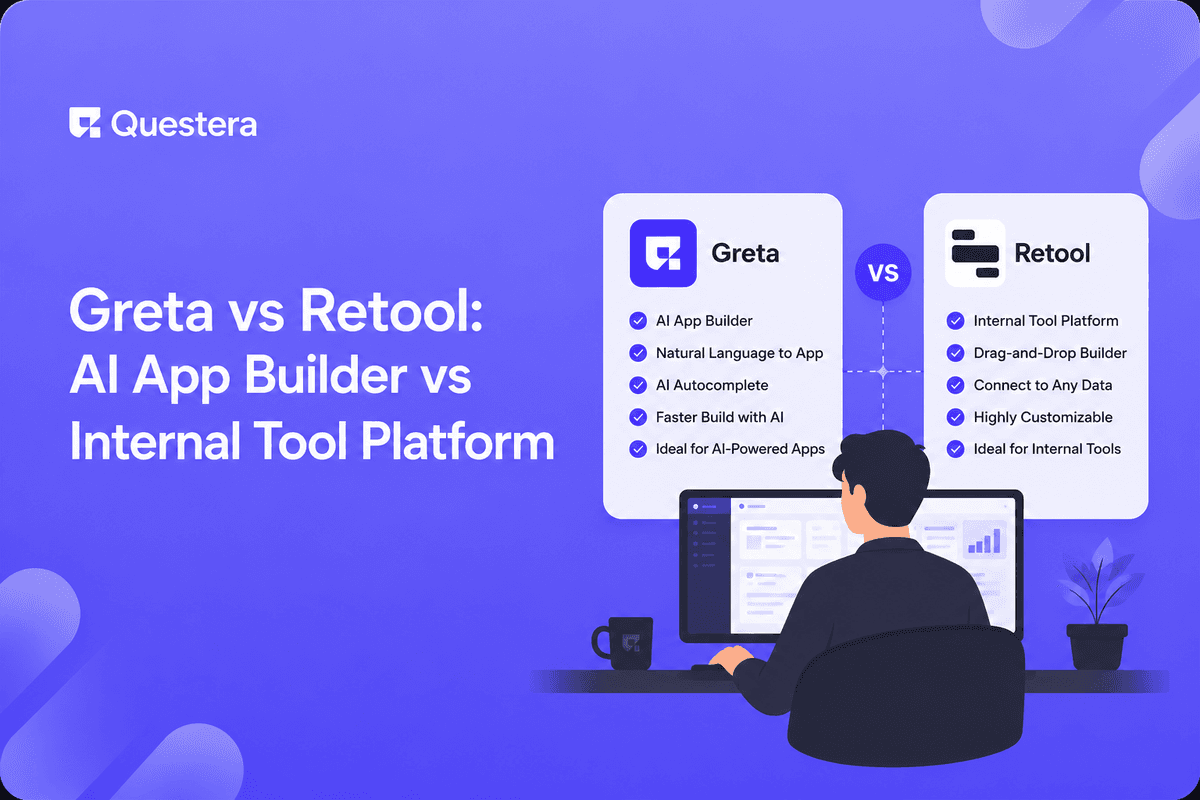
Greta vs Retool comes down to audience: Retool builds internal tools by wiring UI components to your databases and APIs, while Greta builds full, ownable web apps from natural-language prompts. Retool suits internal dashboards; Greta suits customer-facing products you intend to own and scale.
Internal tooling and product building look similar from a distance — both produce software — but the right platform for each differs sharply. That's the heart of the Greta vs Retool decision in 2026. This guide compares the two across purpose, data model, ownership, audience, and scale, so you choose the tool that matches what you're actually shipping.
What Is Retool?
Retool is a low-code platform for building internal tools by dragging UI components onto a canvas and connecting them to databases, APIs, and queries. It's optimized for ops, support, and admin dashboards.
Its strength is fast internal UIs over existing data sources. It's not designed to be the customer-facing product itself, and apps generally live inside Retool's environment.
What Is Greta?
Greta is an AI vibe-coding platform that builds full web applications from natural-language prompts, generating a real frontend, backend, and database you can own and export.
Rather than wiring components to a query, you describe the product and Greta generates it — making it suited to customer-facing apps, not just internal panels.
Build this with a prompt on Greta.sh — describe the app, Greta writes and deploys it.Greta vs Retool: Feature Comparison
The table maps the core differences teams weigh when choosing between them.
| Factor | Retool | Greta |
|---|---|---|
| Primary purpose | Internal tools & admin UIs | Customer-facing web apps |
| Build method | Drag components + queries | Natural-language prompts |
| Data model | Connect existing DBs/APIs | Generated native backend |
| Audience | Internal teams | End users / customers |
| Code ownership | Platform-hosted | Own & export codebase |
| Best for | Ops, support, dashboards | SaaS, marketplaces, products |
When Should You Choose Retool Over Greta?
Choose Retool when you need an internal dashboard fast over data that already lives in your databases and APIs. For ops teams approving refunds or support agents looking up accounts, it's purpose-built.
Retool shines where the audience is internal and the goal is a control panel, not a product you sell.
When Should You Choose Greta Over Retool?
Choose Greta when the software is the product — something customers sign up for, pay for, and use directly. Greta generates the full stack and lets you own the code.
If you expect to scale to many external users, ownership and architecture matter. The realities are covered in our guide on whether AI-built apps can scale to 10k, 100k, and 1M users. For a database-first contrast, see Greta vs Softr.
Key Benefits at a Glance
- Retool is the fastest route to internal dashboards over existing data.
- Greta produces ownable, exportable code for customer-facing products.
- Retool excels at admin panels; Greta excels at full applications.
- Greta scales toward production SaaS; Retool stays internal by design.
- Both remove the need for a full dev team to start.
Common Mistakes to Avoid
- Using an internal-tools platform to ship your customer-facing product.
- Assuming a dashboard builder will scale as an external SaaS.
- Ignoring code ownership until you're locked into a hosting model.
- Picking on price alone instead of audience and use case.
- Skipping a security review before exposing any app to customers.
Frequently Asked Questions
Want to try one of these? Start on Greta.sh — no setup, no boilerplate — just a prompt.Is Greta a Retool alternative?
For customer-facing products, yes. For purely internal dashboards over existing databases, Retool remains the more specialized fit.
Can Retool build a product I sell to customers?
It's not designed for that. Retool targets internal tools; customer-facing SaaS is better served by a full app builder like Greta.
Do I own my code with Retool?
Retool apps largely live in its hosted environment. Greta is built so you own and can export your codebase.
Which is faster for an internal admin panel?
Retool, when your data already sits in connected databases and APIs. It's optimized for that exact job.
Can Greta connect to my existing database?
Greta generates a native backend, and you own the code to integrate as needed. Confirm your specific integration before committing.
Key Takeaways
- Retool builds internal tools; Greta builds ownable customer products.
- Match the platform to your audience — internal team vs paying users.
- Code ownership and scale are the dividing lines in Greta vs Retool.
- For products you sell and scale, Greta is the more future-proof choice.
Building something customers will actually use? Describe it to Greta and see a working, ownable version before you commit.