






Greta vs Replit: Full-Stack AI Builder Showdown
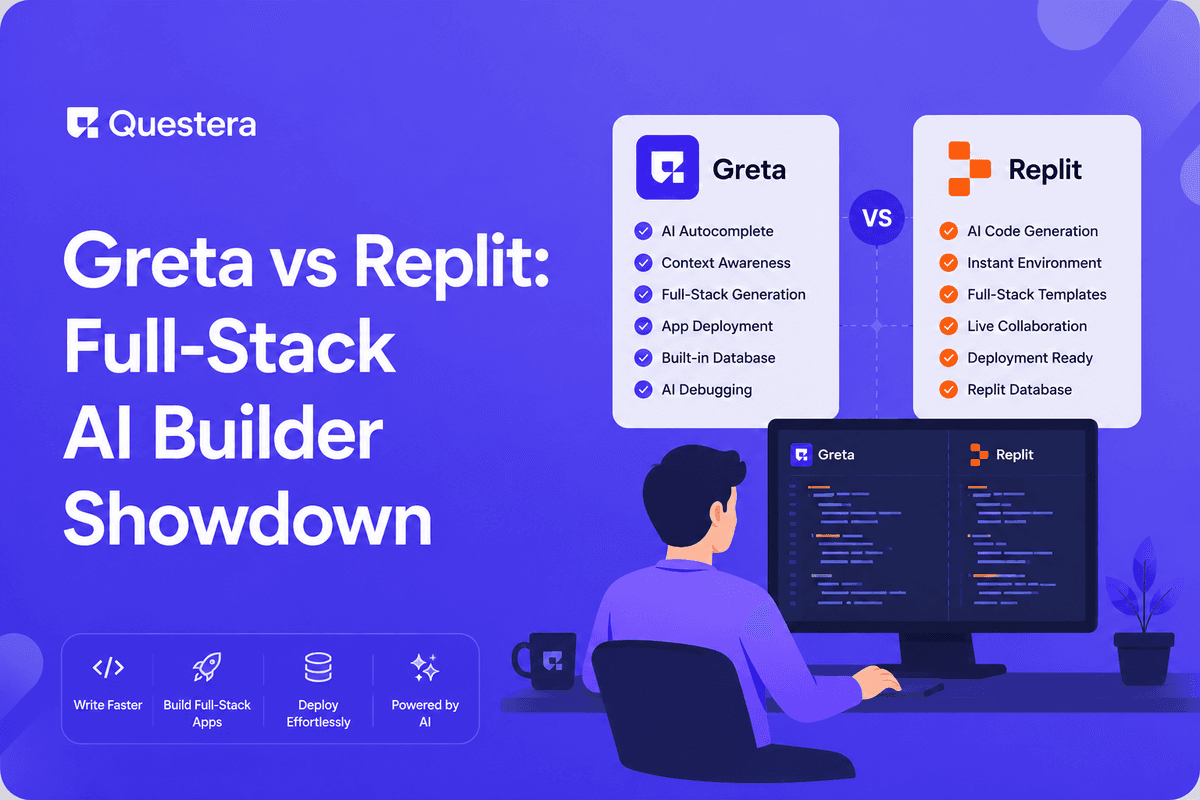
Greta vs Replit comes down to two different bets on what "full-stack AI builder" means. Replit pairs a cloud IDE with Replit Agent for autonomous building, deployment, and database hosting — best for builders who want full code visibility and a Linux-backed development environment. Greta is a unified vibe coding platform with bundled growth tooling — best for solo non-developer founders shipping a SaaS plus its marketing stack. Both ship working production apps. Pick Replit if you want a real cloud IDE you can SSH into; pick Greta if you want one workspace for app + domain + SEO + analytics + content.
Introduction
Replit and Greta both call themselves full-stack AI builders, and both produce working apps from prompts. But they're really betting on different things. Replit is a cloud IDE with an AI agent layered on top — you get a real Linux environment, an actual code editor, and Replit Agent that can plan and build autonomously. Greta is a unified vibe coding platform where the code is abstracted away and the surrounding marketing tooling (domain, SEO, analytics, content) is bundled in. Picking the wrong one for your workflow means fighting the tool every prompt.
What Is Replit and What Does Replit Agent Do?
Replit is a browser-based cloud development environment that's been around since 2016. Each project (a "Repl") runs in an isolated Linux container with real terminal access, package managers, and git. The 2024–2025 Replit Agent feature added autonomous AI building on top — describe what you want, Agent plans the steps, writes the code, runs it, debugs, and deploys.
Replit's full-stack stack is broad: any language, any framework, with built-in database hosting (Replit DB or attached Postgres), authentication, and deployment via Replit Deployments. Pricing in 2026 runs a free tier (limited resources, public repls) and Core at $20/month with Agent access, private repls, and more compute.
What Is Greta and How Does It Differ?
Greta runs as a unified vibe coding platform with bundled growth tooling. The app builder is one part of a larger workspace that also handles domain setup, basic SEO infrastructure, analytics, and content management. The mental model is "ship a complete SaaS business from one workspace" rather than "ship a working app and assemble the marketing surface separately."
Pricing is subscription-based with bundled capacity, which means non-coders don't watch credit consumption during heavy iteration. Multi-backend support (Supabase, MongoDB, AWS) gives stack flexibility for projects with non-standard architectural needs.
Greta vs Replit: Feature-by-Feature Comparison
| Feature | Greta | Replit |
|---|---|---|
| Type | Unified vibe coding platform | Cloud IDE + AI Agent |
| Best For | Solo non-dev founders, SaaS + marketing | Builders who want code visibility + Linux env |
| Code Access | Abstracted (export available) | Full — real cloud IDE |
| Stack Flexibility | Multi-backend (Supabase, MongoDB, AWS) | Any language/framework (Linux container) |
| Standout Feature | Bundled growth tooling | Real cloud IDE with terminal access |
| Pricing Model | Subscription with capacity | $20/mo Core; free tier available |
| Deployment | Built-in, multi-host | Built-in via Replit Deployments |
| Database | Multi-backend bundled | Replit DB or attached Postgres |
| Growth Tooling | Built-in (domain, SEO, analytics) | Not bundled |
| Content Management | Built-in | Not included |
| Learning Curve | Lowest in category | Steeper (cloud IDE familiarity helps) |
Which One Ships Projects Fastest?
Replit Ships Fastest When...
- You want full code visibility and a real Linux environment
- Your stack is non-standard — niche frameworks, custom infrastructure, Python ML services
- You're already comfortable in a cloud IDE and prefer staying close to code
- Your project needs unusual server-side capabilities (cron jobs, custom binaries, system-level access)
- You want one tool that handles dev environment + AI agent + hosting end-to-end
- Education or experimentation — Replit's free tier and broad language support are unmatched
Greta Ships Fastest When...
- You're a solo non-developer founder shipping your first SaaS plus its marketing site
- You want predictable pricing without watching credits during heavy iteration
- Your build needs a landing page, blog, or content surface alongside the app
- You'd rather describe what you want than navigate a cloud IDE
- Content marketing or SEO matters to your launch strategy
- You're shipping a standard SaaS where a Supabase/MongoDB/AWS backend is enough
Pricing: What Each Actually Costs
- Replit Core — $20/month with Agent access, private repls, and additional compute. The free tier lets you prototype and host small public projects without paying.
- Greta — Subscription with bundled capacity. Growth tooling (domain, SEO, analytics, content management) included.
- Hidden Replit costs — Domain ($1/month), separate analytics ($9–$20/month), SEO tools (separate), content management (adds $10–$30/month).
- Hidden Greta costs — Mostly bundled. Platform subscription is typically higher than Replit Core sticker price but lower than the assembled equivalent stack.
Code Control: Who Owns What?
Replit gives you total code visibility from day one. The cloud IDE shows every file, every commit, every dependency. Replit Agent's autonomous changes are immediately visible as code diffs you can review.
Greta abstracts code intentionally during the build. Code export to GitHub is fully supported, but the workflow is AI-first rather than code-first. Most non-developer founders shipping on Greta export the code only when bringing engineers in for hardening — they don't open it during the build itself.
The trade-off is direction. Replit is code-first with AI assistance. Greta is AI-first with code as an output. Pick based on whether reading code helps you ship faster or slows you down.
Agent Capability: How the AI Actually Works
Replit Agent
Replit Agent runs inside the cloud IDE. It can read your existing code, write new files, run terminal commands, and iterate on errors autonomously. The advantage: full development environment access — Agent can install packages, run tests, check logs, and use any tooling available in the container. The trade-off: the workflow assumes you can read what Agent did and reason about whether it was correct.
Greta's Unified Flow
Greta's agent is the platform itself rather than a feature inside an IDE. You describe a product; the platform generates UI, database, auth, payments, and deployment together as one cohesive build. You see the running app, not the underlying code. The advantage: zero context-switching between tools and no code-reading required. The trade-off: less visibility into individual implementation choices.
For developers who think in code, Replit Agent is more powerful because it respects how they already work. For non-developers, Greta's abstraction is the point — they don't want to see code, they want to ship a product.
Who Should Pick Which?
- Pick Replit if you read code or want to learn to read code as part of building.
- Pick Replit if your stack is non-standard (Python ML, Go services, Rust, embedded systems) or you need a real Linux environment.
- Pick Replit if education or experimentation is the priority — the free tier and language breadth are unmatched.
- Pick Replit if you want one tool handling dev + AI + hosting end-to-end with full code visibility.
- Pick Greta if you're a solo non-developer founder shipping a SaaS plus its marketing stack.
- Pick Greta if you want predictable pricing without credit anxiety during heavy iteration.
- Pick Greta if content marketing or SEO matters to your launch — bundled tooling saves real time.
- Pick Greta if you'd rather describe products than navigate a code editor.
How They Compare to Other Full-Stack AI Builders
- Replit vs Bolt.new — Bolt's WebContainers run in the browser; Replit runs full Linux containers in the cloud. Bolt is faster for React-first prototypes; Replit is more flexible for unusual stacks.
- Replit vs Cursor — Both are developer-friendly, but Cursor is a local IDE while Replit is cloud-based. Cursor wins on offline work; Replit wins on instant collaboration and zero local setup.
- Greta vs Lovable — Lovable competes more directly with Greta as a no-code app builder with a fixed React + Tailwind + Supabase stack.
- Greta vs v0 — v0 produces best-in-class React/Next.js UI with tight Vercel deploy. Frontend-heavy compared to Greta or Replit.
Common Mistakes to Avoid
- Picking Replit if you can't read code — The cloud IDE will feel overwhelming, and Agent's output will be hard to validate.
- Picking Greta if you want full code visibility throughout — Greta abstracts intentionally; Replit or Cursor fit better for code-first workflows.
- Comparing on sticker price alone — Replit's $20/month + a separate hosting/analytics/SEO/content stack often costs more than Greta's bundled subscription.
- Underestimating Replit's free tier — For experimentation and learning, Replit's free tier is genuinely useful.
- Treating cloud IDE familiarity as a deciding factor — If you don't already use cloud IDEs, the learning curve adds time.
- Switching platforms mid-project — Migration costs more than starting fresh.
Frequently Asked Questions
Is Greta or Replit better for non-developers?
Greta. The unified flow has the lowest learning curve, growth tooling is bundled, and pricing is predictable. Replit's cloud IDE assumes some technical comfort that non-developers usually lack.
Can both Greta and Replit build production-grade apps?
Yes. Both produce apps that take real customer payments and run on real domains. Replit's code visibility makes engineering review easier; Greta's abstraction makes the build faster for non-developers. Both export real code if you grow past their natural scale.
Which is better for experimenting with multiple ideas?
Replit, by a wide margin. The free tier lets you prototype dozens of ideas without paying. Greta is better for committing to one focused build with full marketing surface, but less suited to throwaway experiments.
Does Replit's cloud IDE matter for non-coders?
It can be intimidating. Replit Agent does the building, but the IDE around it (file tree, terminal, code editor) still surrounds you. Non-coders who try Replit usually adapt eventually, but the first few hours feel more technical than Greta.
Which has the better deployment workflow?
Roughly equivalent. Replit Deployments handle SSL, scaling, and database hosting in one click. Greta bundles deployment with the rest of the workflow. The difference is more about which surrounding tools you also need.
Can I use both Replit and Greta for the same project?
Possible but rarely worth it. Pick one for the v1; bring engineering in for the hardening phase. The exit paths on both platforms are genuine.
Are these tools going to replace developers entirely?
Not in the near term. They automate boilerplate and shrink the on-ramp for non-developers, but senior engineering, complex systems, and production hardening still need human expertise.
Key Takeaways
- Greta vs Replit isn't about which is better — it's about which fits how you work. Replit is the strongest cloud IDE with autonomous agent for code-comfortable builders; Greta is the strongest unified platform for solo non-developer founders.
- Replit wins on stack flexibility, code visibility, and Linux environment access. Greta wins on bundled growth tooling, lowest learning curve, and pricing predictability.
- Both export real working code. Both produce apps that take real customer payments. Neither locks you in long-term.
- Replit's free tier is unmatched for experimentation. Greta's bundled tooling is unmatched for shipping complete SaaS businesses solo.





© 2026 Questera
Follow in Google