






Greta vs Lovable vs Bolt vs v0: The Ultimate 2026 AI Builder Comparison
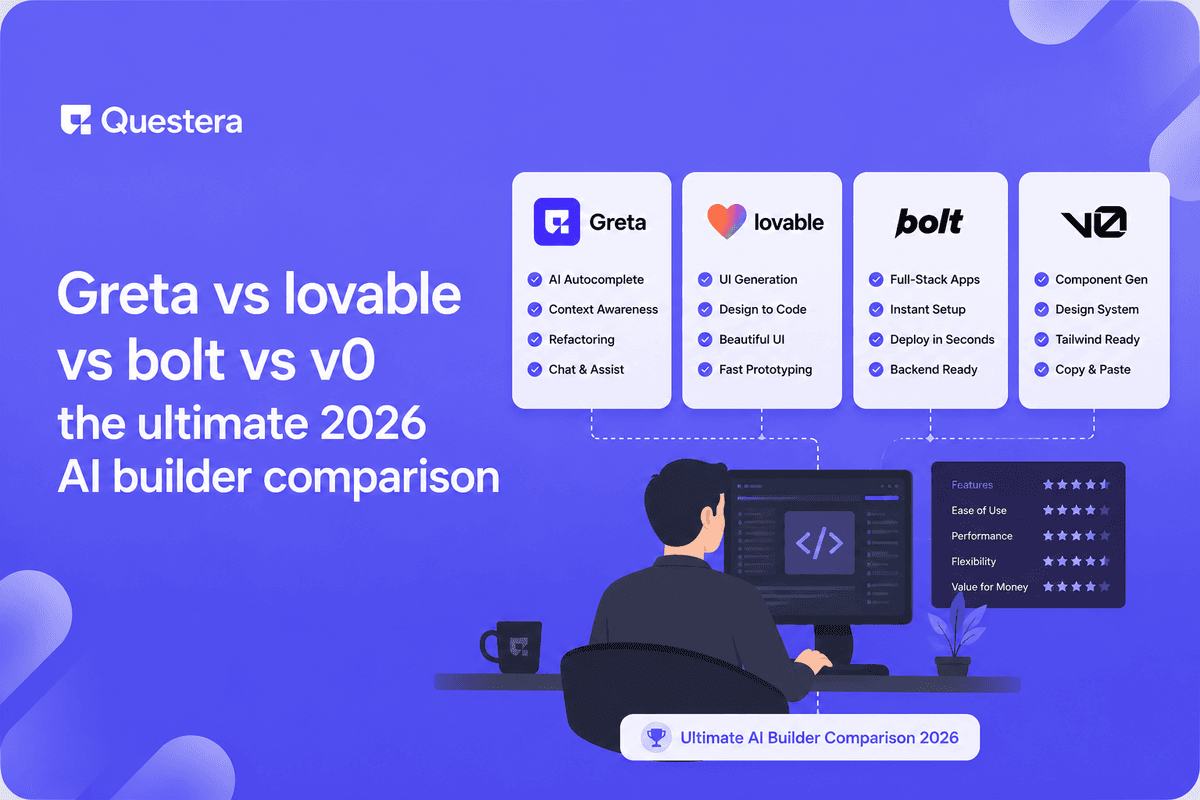
By 2026, the AI app builder category has matured from toy demos into tools that ship real products. Among entrepreneurs and developers, a handful of names dominate the conversation. v0 by Vercel, Bolt.new, and Lovable have become the most discussed AI app builders, and Greta sits in the same conversation as an AI-native full-stack builder emphasizing code ownership and production-readiness.
The 'which is best' question has no universal answer — each tool wins for a specific user and use case. The differences that matter aren't the demo wow-factor (they all have it) but what happens after the MVP: backend depth, code ownership, who maintains it, and whether it becomes a real product. One thread runs through every honest comparison: AI-generated code, regardless of which tool produces it, needs a security review before it ships to real users. This guide compares all four across the dimensions that actually decide outcomes.
The Four at a Glance
| Tool | Primary Audience | Backend Story |
|---|---|---|
| Greta | Founders wanting full-stack output + code ownership | Real Next.js code, Supabase, Stripe — production-ready |
| Lovable | Non-technical founders, designers, indie makers | Full-stack React + TypeScript + Tailwind, Supabase |
| Bolt.new | Developers wanting framework flexibility | Wide framework support; Bolt Cloud for hosting/auth/DB |
| v0 | Frontend developers in the Vercel ecosystem | Frontend-leaning; Next.js + Shadcn UI; weaker backend |
Lovable: The Non-Technical Founder's Choice
Lovable is a chat-first app builder that produces full-stack React + TypeScript + Tailwind apps with Supabase as the default backend. Its defining strength is the iteration loop. Where other tools break older changes when you make new ones, Lovable maintains context across many rounds, letting you build a non-trivial app by chatting over an afternoon.
- Best fit: non-technical founders, designers, indie makers shipping MVPs
- Full-stack React + TypeScript + Tailwind with Supabase backend
- Strong conversational iteration that preserves context
- Reported among the fastest-growing builders by revenue
- Trade-off noted in comparisons: connecting and configuring Supabase can be friction for true non-coders
Bolt.new: The Developer's Flexible Environment
Bolt.new is a browser-based AI development environment built by StackBlitz that runs an in-browser dev runtime and supports a wide range of frameworks. It added Bolt Cloud for hosting, auth, and databases in 2026.
- Best fit: developers who want framework flexibility and a real coding environment
- Supports more frameworks than the other two combined, per comparisons
- Generous free tier noted across reviews
- All-in-one browser environment; type a description, see it running
- Trade-off noted in comparisons: code quality is more variable than competitors
v0: The UI Quality Leader
v0 by Vercel generates production-quality React components and full-stack Next.js apps from prompts, deeply integrated with Vercel hosting and Shadcn UI. Its strength is design output — the interfaces it generates look professional without further work.
- Best fit: frontend developers in the Vercel ecosystem who prioritize UI quality
- Cleanest, most polished React UIs in the category per multiple reviews
- Tight Next.js and Vercel integration
- Strong complement to other tools for the frontend layer
- Trade-off noted in comparisons: weaker backend story; frontend-leaning
Greta: Code Ownership and Production-Readiness
Greta is an AI-native full-stack builder generating real Next.js/React code in your GitHub repo with auth, database (Supabase), payments (Stripe), and deployment. Its emphasis is code ownership from day one and a path from MVP to real product without re-platforming.
- Best fit: founders who want full-stack output AND code ownership in their GitHub
- Real Next.js code you own, not platform-locked
- Auth, database, and Stripe payments as part of the default scaffold
- Deployment to Vercel or anywhere Next.js runs
- Emphasis on production-readiness and the harden phase, not just the demo
The Dimension That Matters Most: After the MVP
A prototype that runs in a browser is not automatically a product. Once real users, customer data, payments, roles, compliance, and maintenance are involved, the tool choice is only part of the decision. The demo is easy across all four; the path to a maintained, secure, scaling product is where they differ.
- Code ownership — Greta and Bolt/Lovable (with export) give you code; platform-locked tools constrain growth
- Backend depth — Greta, Lovable, Bolt strong; v0 frontend-leaning
- Maintainability — depends on code quality and your ability to own the codebase
- Security — all need review (see below)
- Re-platforming risk — tools that don't carry to production cost a rebuild
The Security Reality (Read This)
Independent research is blunt about AI-generated code. Veracode's 2026 research says 45% of AI-generated code ships with vulnerabilities, and Stanford puts the number at 80% of AI-generated applications containing at least one exploitable flaw. This applies across the category. Budget for a security review regardless of which you pick.
- No matter which builder you choose, audit before shipping to real users
- RLS (data isolation) is the most common and most dangerous issue
- Secrets handling, input validation, auth bypasses need review
- The security work is on you regardless of tool
- This is non-negotiable for apps with real user data or payments
How to Choose
Choose Greta If
- You want full-stack output AND real code ownership in your GitHub
- Payments (Stripe) and production-readiness matter from the start
- You want a path from MVP to product without re-platforming
- You value owning the codebase over staying on a platform
Choose Lovable If
- You're a non-technical founder shipping an MVP fast
- You want the strongest context-preserving conversational iteration
- Supabase-backed full-stack out of the box suits you
- You're comfortable with its Supabase connection step
Choose Bolt.new If
- You're a developer wanting framework flexibility
- You value a generous free tier and a real coding environment
- You want the widest framework support
- You can tolerate more variable code quality for the flexibility
Choose v0 If
- You're a frontend developer in the Vercel ecosystem
- UI quality is your top priority
- You'll handle the backend yourself or with another tool
- You want the cleanest React components in the category
The Combination Strategy
- Some builders use v0 for UI components + another tool for full-stack
- Greta or Lovable for the full-stack app; v0's components dropped in for polish
- Bolt.new for rapid framework experimentation; production build elsewhere
- The tools aren't mutually exclusive for different layers
- Pick a primary for the product; supplement where another excels
Common Mistakes
- Choosing on demo wow-factor — All four demo well. Decide on post-MVP reality.
- Skipping the security review — 40-80% vulnerability rates across the category. Audit before shipping.
- Picking v0 for a backend-heavy app — It's frontend-leaning. Pair it or pick a full-stack tool.
- Picking a platform-locked tool for a product you'll grow — Re-platforming costs a rebuild.
- Non-technical founder picking a developer-oriented tool — Match the tool to your skill level.
- Ignoring code ownership — For products, owning the code avoids future lock-in.
- Assuming code quality is uniform — It varies (Bolt noted as more variable). Review output.
- Treating them as interchangeable — Each wins for a specific user. Pick deliberately.
- Forgetting the after-MVP work — Maintenance, security, scaling are on you regardless of tool.
- Comparing only pricing — Total cost includes security work, re-platforming risk, and maintenance.
- Not testing on your actual use case — Build the same small app in your finalists before committing.
- Skipping RLS verification — The most common AI-generated app vulnerability. Test data isolation.
Frequently Asked Questions
Which is the best AI app builder in 2026?
There's no universal winner — each wins for a specific user. Lovable for non-technical founders, Bolt.new for developers wanting flexibility, v0 for frontend/UI quality in the Vercel ecosystem, Greta for full-stack output with code ownership and production-readiness. Match to your situation.
Is AI-generated code from these tools secure?
Not by default. Independent research (Veracode, Stanford) reports high vulnerability rates across AI-generated code. Budget for a security review regardless of which tool you pick. RLS, secrets, input validation, and auth need verification before real users.
Which has the best UI output?
Multiple 2026 comparisons name v0 as producing the cleanest, most polished React UIs in the category, owing to its Shadcn UI and Vercel integration. Greta, Lovable, and Bolt all produce strong UIs; v0 is most often singled out for pure UI quality.
Can I use more than one?
Yes — many builders combine tools. v0 for UI components, a full-stack tool for the app. Pick a primary builder for the product and supplement where another excels. They're not mutually exclusive across different layers of a project.
How should I actually decide?
Build the same small app in your two or three finalists. Evaluate the output quality, how it handles your backend needs, whether you own the code, and how it feels to iterate. Then run a security review on the output. The hands-on test beats any comparison article — including this one.
No universal winner. Lovable for non-technical founders, Bolt.new for developers wanting flexibility and a generous free tier, v0 for frontend/UI quality in the Vercel ecosystem, Greta for full-stack output with code ownership and production-readiness. The differences that matter appear after the MVP — backend depth, code ownership, maintainability, re-platforming risk — not in the demo, which all four nail. Security is non-negotiable across the category: budget for a review regardless of tool. Decide by building the same small app in your finalists, evaluating output and ownership, then auditing security. Pick deliberately. Audit always. Build for after the MVP, not just the demo.