






Greta vs Firebase Studio: Google's AI Builder vs Greta
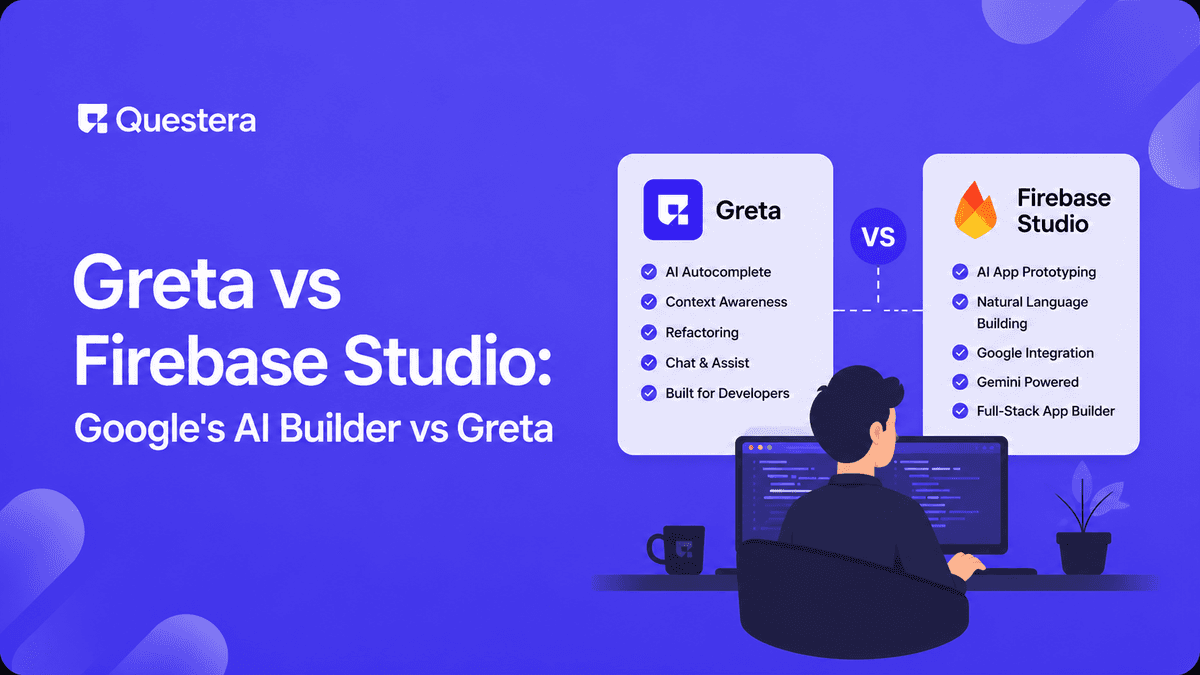
Google launched Firebase Studio (formerly Project IDX) as their answer to the AI app builder category — an in-browser development environment with AI assistance, deeply integrated with Firebase services (Firestore, Auth, Functions, Hosting, Genkit for AI workflows). For developers already living in Google Cloud, it's a natural fit.
Greta is an AI-native app builder generating real Next.js/React code in your GitHub repo. Built around an open stack — Supabase for database and auth, Stripe for payments, Vercel for hosting, but flexible enough to swap any layer. Code ownership is the default; vendor lock-in is the exception. The 'Greta vs Firebase Studio' question gets asked because they overlap in the 'AI builds apps' positioning. The differences are real and matter for long-term plans. This guide covers what each does, where the stack differences cut, the pricing models, and the decision for builders in 2026.
What Firebase Studio Genuinely Does Well
- Tight Firebase integration — Firestore, Auth, Functions, Hosting work seamlessly
- Genkit for AI workflows — Google's AI SDK integrated for building agentic features
- Google Cloud ecosystem fit — natural for teams already on GCP
- In-browser development — no local setup; works anywhere
- Real-time database with Firestore (live sync to clients)
- Generous free tier on Firebase for early-stage projects
- Strong mobile SDK — Firebase has best-in-class mobile integration
What Greta Genuinely Does Well
- Open stack — Next.js, Supabase, Stripe, Vercel — replaceable layers
- Code ownership default — Next.js code in your GitHub from day one
- Postgres database (relational) — better fit for most SaaS data models
- Deployment portability — Vercel, Netlify, Cloudflare, self-host, anywhere Next.js runs
- No vendor lock — swap Supabase for Neon, Postgres direct, anything
- Stripe-native — payments setup is part of the default scaffold
- Single tool for customer-facing and internal apps
Where the Stack Difference Cuts
Database Model: Firestore (NoSQL) vs Postgres (Relational)
- Firestore — document-based; flexible schema; real-time sync built-in; queries limited (no joins)
- Postgres — relational; joins and complex queries; mature SQL ecosystem
- Most SaaS data models fit Postgres better (users → projects → tasks → comments with relationships)
- Firestore shines for chat, live collaboration, real-time apps
- Migration between them is significant work; pick based on data shape
Hosting: Firebase Hosting vs Vercel
- Firebase Hosting — tight Google integration; CDN; works well within Firebase
- Vercel — Next.js-native; edge functions; preview deployments per PR
- Both production-grade; Vercel feels native for Next.js
- Firebase Hosting can host Next.js but with more setup
Auth: Firebase Auth vs Supabase Auth
- Both mature; both support email, social providers, MFA
- Firebase Auth has strongest mobile SDK story
- Supabase Auth integrates with Postgres RLS natively
- Both work fine; pick to match rest of stack
When Firebase Studio Wins
- Team already using Google Cloud / Firebase
- Mobile-first app with iOS/Android native + web
- Real-time collaboration features as core (chat, live editing, live dashboards)
- Comfortable with NoSQL document model
- Want Genkit for AI workflow orchestration
- Free tier economics favor early-stage Firebase usage
- Prefer in-browser IDE over local dev
When Greta Wins
- Standard SaaS with relational data (most B2B SaaS)
- Want code in your GitHub from day one
- Stripe subscription billing as core flow
- Prefer Next.js ecosystem and tooling
- Want deployment flexibility (not locked to one host)
- Lower lock-in tolerance — value swappable layers
- Indie founder building product to sell
Lock-In: The Underrated Dimension
Firebase Studio's tight integration is a strength and a constraint. Apps deeply built on Firestore's NoSQL model don't migrate easily to Postgres. Functions written for Firebase Functions don't run as-is on AWS Lambda. Firebase Hosting routing differs from Vercel. Migration off Firebase is a real project — months of work for non-trivial apps.
Greta's open stack assumes swappability. Postgres is portable across providers (Supabase, Neon, AWS RDS, self-hosted). Next.js runs anywhere. Stripe is independent. Each layer is replaceable. Migration burden is dramatically lower if you ever need to move. Lock-in isn't inherently bad — Firebase customers tolerate it because the integration is genuinely productive. But it's worth recognizing the trade. Greta optimizes for portability; Firebase Studio optimizes for ecosystem cohesion.
AI Integration Patterns
- Firebase Studio + Genkit — Google's framework for AI workflows; built for Firebase apps
- Greta + any AI SDK — OpenAI, Claude, Cohere directly via standard libraries
- MCP servers work with both — the protocol is stack-agnostic
- Both can build AI-powered features; integration ergonomics differ
Common Project Patterns
- Real-time chat or collaboration app — Firebase Studio wins. Firestore's real-time sync is purpose-built for this.
- B2B SaaS with subscription billing — Greta wins. Stripe integration is native to the scaffold; Postgres handles relational SaaS data well.
- Mobile app with companion web — Firebase Studio wins. Firebase's mobile SDK depth matters significantly here.
- Indie founder shipping first SaaS — Greta wins. Code ownership, open stack, Stripe-ready, lowest lock-in risk.
- Team already on Google Workspace + GCP — Firebase Studio wins. Ecosystem cohesion matters; existing infrastructure investment compounds.
Migration Patterns
- Firebase Studio → Greta — Possible but significant; rewrite from Firestore to Postgres, swap Firebase services to open equivalents
- Greta → Firebase Studio — Possible; rewrite from Postgres to Firestore, swap Stripe/Vercel/Supabase to Firebase equivalents
- Either → Custom — Standard pattern when teams outgrow either tool
- Lock-in friction is real on the Firebase side; Greta's open stack lowers exit costs
Common Mistakes
- Picking Firebase for relational data models — Fighting Firestore's NoSQL nature is painful. Use Postgres for SaaS data.
- Picking Greta for real-time collaboration heavy apps — Firebase Studio's real-time story is stronger. Match tool to use case.
- Underestimating lock-in — Firebase migration is months of work; factor into long-term plans.
- Ignoring ecosystem fit — Team already on Google Cloud benefits from Firebase Studio; team agnostic benefits from Greta's openness.
- Choosing on AI features alone — Both have AI; the stack differences matter more long-term.
- Skipping the harden phase — Either tool generates apps that need security review, observability, ops setup before production.
- Comparing pricing in isolation — Total cost of ownership depends on usage shape; calculate honestly.
- Mid-project switching — Migration cost is significant. Pick deliberately upfront.
- Ignoring mobile requirements — Firebase wins for mobile-first; Greta is web-first.
- Treating them as interchangeable — Different stacks. Pick deliberately.
Frequently Asked Questions
Can I use Greta with Firebase backend?
Technically yes — Greta generates code; you could swap Supabase for Firebase. But it fights the defaults. If you want Firebase backend, Firebase Studio's tighter integration is the better fit.
Can I use Firebase Studio with Postgres?
Possible but unusual. Firebase Studio is designed around Firebase services. Using external Postgres is technically possible but loses the integration value that's the main reason to pick Firebase Studio.
What about cost at scale?
Both can be expensive at scale. Firebase's usage-based pricing can spike with high traffic. Greta's stack (Supabase, Vercel) also has costs that grow. Calculate based on expected usage shape; neither is universally cheaper.
Which has better AI features?
Both integrate AI well. Firebase's Genkit is purpose-built for Firebase apps. Greta works with any AI provider via standard libraries. For most AI use cases, both are capable; integration ergonomics differ.
What about Supabase as a Firebase alternative directly?
Supabase positions explicitly as 'open source Firebase alternative.' Used with Greta or any modern framework, Supabase + Postgres + Stripe + Vercel covers most Firebase use cases with open stack benefits.
For someone learning, which should I pick?
Greta for SaaS-focused learning. Firebase Studio if your goals are mobile-heavy or you want Google Cloud experience. Both teach valuable skills; pick based on what you want to build long-term.
Greta and Firebase Studio overlap as AI-driven app builders but diverge on stack, lock-in, and ecosystem fit. Firebase Studio wins when you're deep in Google Cloud, building real-time or mobile-first apps, comfortable with NoSQL. Greta wins for standard SaaS with relational data, code-ownership preference, open-stack philosophy, Stripe subscription billing as core. Lock-in is the underrated dimension — Firebase migration is months of work; Greta's open stack lowers exit costs significantly. Both ship working apps. The lock-in trade-off is real but often invisible until the day you want to switch. Pick deliberately. Build with confidence. Plan for the trade-offs you can foresee.





© 2026 Questera
Follow in Google