






Greta vs Claude Artifacts: Can Claude Build Real Apps in 2026?
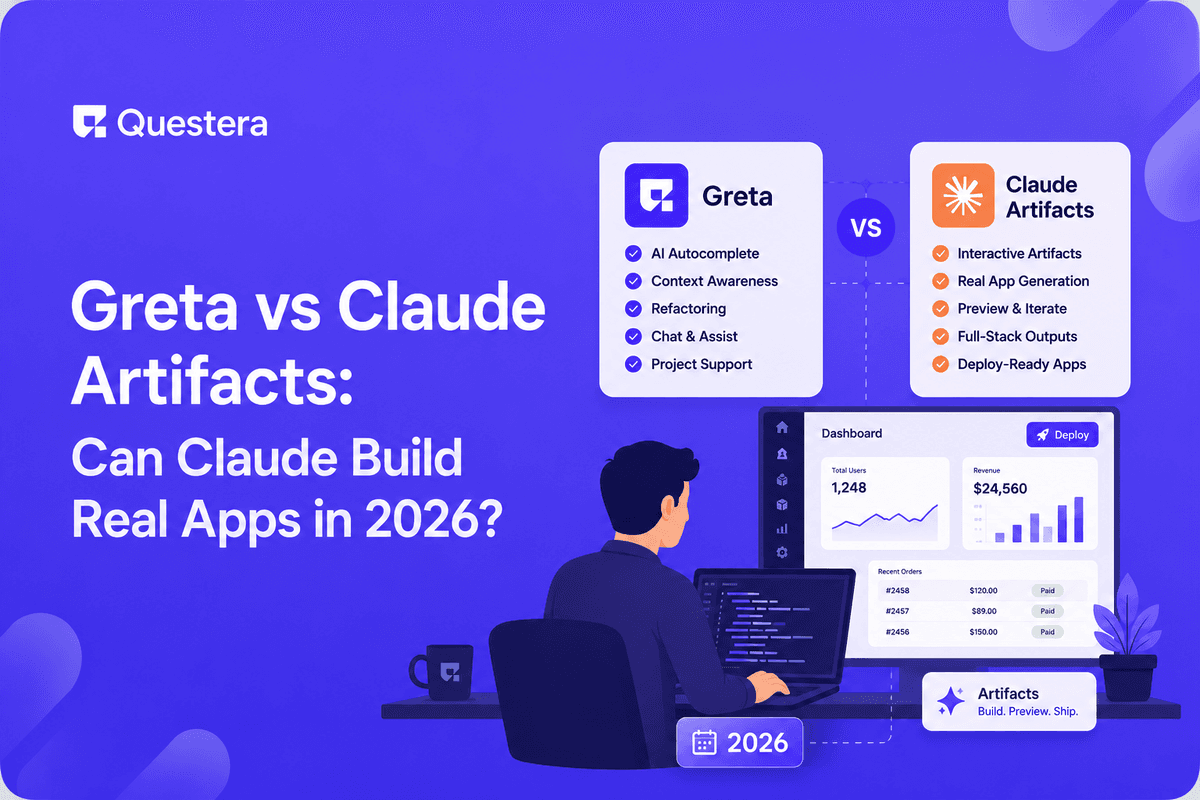
Claude Artifacts and Greta are in different categories despite both being 'build apps with AI.' Artifacts is in-chat prototyping — single-file React/HTML that runs in Claude's chat interface. No persistent backend, no deployment, no auth, no payments. Greta is a full SaaS application builder generating real Next.js/React code in a GitHub repo with auth, database, payments, and deployment. Artifacts wins for ideation, prototypes, single-file tools, learning. Greta wins for actual SaaS products you ship to customers. This guide breaks down what each does, when each fits, and the honest answer to 'can Claude build real apps.'
Claude Artifacts launched in 2024 as a way to render generated code directly in Claude's chat interface — interactive React components, HTML pages, SVG graphics, all rendered live alongside the conversation. By 2026, Artifacts handles increasingly sophisticated single-file apps. Greta is an AI-native app builder for full SaaS applications — prompt-driven creation generating Next.js/React code with authentication, database integration, payment processing, and deployment to production. Mistaking one for the other produces frustration; this guide covers what each genuinely does and when each fits.
The Category Difference
Claude Artifacts is an in-chat code rendering capability. When Claude generates HTML, React components, SVG, or similar, the output renders in a panel alongside the conversation. Users can interact with the artifact in real-time. The artifact lives inside the Claude conversation; no persistent backend; no deployment; no user authentication; no database that survives the session. It's a sandbox for code that demonstrates ideas.
Greta is a full SaaS application builder. Users describe what they want; Greta generates Next.js/React code with auth, database (typically Supabase), payments (Stripe), and deployment. The output is real production code in the user's GitHub repository, deployable to real URLs, supporting real users with persistent accounts and data. Artifacts is the rapid prototyping layer; Greta is the production build layer. Different jobs.
Side-by-Side Comparison
| Dimension | Greta | Claude Artifacts |
|---|---|---|
| Primary Use | Build production SaaS apps | Prototype, demo, learn, single-file tools |
| Output | Next.js/React code in GitHub | Single-file React/HTML in chat |
| Persistence | Real database (Supabase) | Browser session only |
| Authentication | Multi-provider built-in | None |
| Payments | Stripe integration | None |
| Deployment | Real URL, production hosting | Lives in Claude chat |
| Users | Real users with accounts | Single-session interaction |
| Code Ownership | User owns code in GitHub | Can copy code from chat |
| Complexity Ceiling | Production SaaS | Single-feature demo |
| Pricing | Subscription with bundled capacity | Free with Claude.ai; included in Pro |
What Claude Artifacts Genuinely Does Well
- Prototypes that demonstrate an idea in seconds
- Single-file React components for testing concepts
- Interactive demos (calculators, games, visualizers)
- Data visualizations from pasted data
- Custom calculators (mortgage, ROI, conversion)
- Interactive learning aids and educational tools
- Survey forms and quick polls (single-session)
- Game prototypes
- Single-file dashboards from pasted CSV data
- Quick utility tools you use a few times
What Claude Artifacts Can't Do
- Persist data across sessions (no backend)
- Authenticate real users (no auth)
- Process payments (no Stripe or equivalent)
- Send emails (no email service integration)
- Deploy to a real URL accessible to others
- Run scheduled tasks or background jobs
- Handle file uploads from real users
- Support multiple users with different permissions
- Be the foundation of a real SaaS business
What Greta Does That Artifacts Doesn't
- Generates complete SaaS applications, not single files
- Includes authentication (signup, login, password reset, social auth)
- Includes database with persistent storage
- Integrates payment processing for subscriptions or one-time payments
- Deploys to real URLs accessible by real customers
- Supports user accounts with permissions and data isolation
- Integrates with external services (email, SMS, analytics, AI APIs)
- Outputs code to GitHub for ongoing development and team collaboration
- Supports the harden phase — security review, performance optimization, production readiness
- Scales to real SaaS businesses with real revenue
When Claude Artifacts Wins
- Testing an idea before committing to a real build
- Building single-file tools you use temporarily
- Learning to code by experimenting interactively
- Quick demos for stakeholders or interviews
- Creating custom calculators or interactive widgets for personal use
- Generating visualizations from data on the fly
- Prototyping a UI before building it for production
- Educational tools and learning aids
- Brainstorming what an app might look like
When Greta Wins
- Building a SaaS product to sell to customers
- Internal tools your team will use daily
- Customer-facing apps requiring auth and data persistence
- Marketplaces with payment processing
- B2B applications with user accounts and team permissions
- Any app you'll deploy to real users on a real URL
- Applications you'll evolve over months and years
- Apps that integrate with external services and APIs
- Products you want to build as a business
The Realistic Workflow Combining Both
Many builders use both. Claude Artifacts for ideation and prototyping; Greta for the production build.
Step 1: Prototype with Artifacts
- Ask Claude to build a quick prototype of your idea as an Artifact
- Iterate on the UI and interaction in chat
- Test the concept with a few people via screen-share
- Validate that the idea is worth building further
- Cost: free with Claude.ai; time: minutes to hours
Step 2: Build Production in Greta
- Take the prototype direction into Greta
- Describe the full app including auth, database, payments, deployment
- Greta generates the production codebase
- Iterate on features in Greta
- Deploy to a real URL with real users
Step 3: Maintain and Evolve
- Use Greta for ongoing feature additions
- Use AI IDEs (Cursor) for complex modifications
- Use Artifacts again for quick component prototyping that informs Greta builds
- Cycle repeats as product evolves
Common Project Patterns
- Personal calculator or utility — Artifacts wins. Single file; ephemeral use; no need for accounts or persistence.
- Internal tool for your team — Greta wins. Multiple team members need access; data persistence required.
- SaaS product to sell — Greta wins. Payment processing, user accounts, customer support workflows, ongoing development.
- Educational interactive demo — Artifacts wins for chat-based education; export code for production embedding.
- Quick prototype to test an idea — Artifacts wins for the first 1-2 days of validation. Then move to Greta if the idea proves out.
- Custom dashboard from pasted data — Artifacts wins for one-time analysis. Greta wins if it becomes an ongoing multi-user tool.
Can Claude Build Real Apps?
The literal answer: through Artifacts alone, no — Artifacts produces single-file demos, not production SaaS. Through Claude integrated into AI app builders (which use Claude or similar models under the hood), yes — but the app builder is doing the heavy lifting of producing multi-file structured projects with backend integration.
The honest framing: 'Claude' is the model; what you build with it depends on the tool wrapping it. Artifacts is one wrapper (rapid prototyping). Greta is another (full app builder). Cursor is another (AI IDE). Each wrapper unlocks different categories of capability. Claude the model is powerful; what you produce with Claude depends on the tool you use to direct it.
Common Mistakes
- Trying to build a real SaaS in Artifacts — Hits the persistent backend wall immediately. Use Greta or similar.
- Dismissing Artifacts as 'not real' — It's genuinely useful for prototyping and single-file tools.
- Comparing them as equivalents — They're different categories. Comparing pricing or features misses the point.
- Skipping prototyping entirely — Artifacts is a fast way to validate ideas. Don't skip the validation step.
- Overinvesting in Artifacts when the project should be in Greta — Wasting time on a prototype that needs to be rebuilt anyway.
- Treating Greta output as Artifacts — Greta apps need real production discipline (security, monitoring, ops).
- Choosing 'Claude' as if it's a tool choice — Claude is the model; the tool wrapping it determines what you can build.
- Using Artifacts for client deliverables — Clients usually need apps they can access independently; Artifacts can't deliver that.
Frequently Asked Questions
Will Claude Artifacts ever support persistent backends?
Anthropic continues to evolve Artifacts. Some persistence features (like saved state) are being added in 2026. Full SaaS-grade backend integration would put Artifacts in Greta's category — possible but not the current direction. Bet on Artifacts staying focused on rapid prototyping and Greta-like tools handling production SaaS.
Can I export an Artifact and turn it into a real app?
Yes, with significant work. The Artifact code can be copied and used as a starting point. But you'd need to add auth, database, deployment, multi-file structure — essentially rebuild as a production app. For a new project, it's faster to start in Greta directly.
Does Greta use Claude?
Greta uses leading models (which may include Claude) for code generation. Specifics evolve as models improve. Users don't typically need to know which model is running; they care about output quality.
For someone learning to code, which is better?
Artifacts for early learning and experimentation. Greta when ready to build real projects. Many learners use Artifacts to experiment with concepts, then move to Greta for portfolio projects and actual apps.
For a hackathon, which would I use?
Depends on the goal. Artifacts for a quick demo to win a judging round; Greta if the hackathon expects a deployed app users can sign up for. Some hackathons specifically require deployed apps; check requirements.
Greta and Claude Artifacts are in different categories despite both being 'build apps with AI.' Artifacts is in-chat prototyping with no persistent backend; Greta is full SaaS app generation with real code in GitHub. The realistic workflow uses both — Artifacts for ideation and prototyping; Greta for production build. The 'can Claude build real apps' question is answered: yes, with the right tool wrapping it. Artifacts alone won't ship a SaaS business; Greta (using Claude or similar models under the hood) will. Match the tool to the job. Both have their place; neither replaces the other.





© 2026 Questera
Follow in Google