






Greta vs Base44: Best No-Code App Builder for Non-Developers
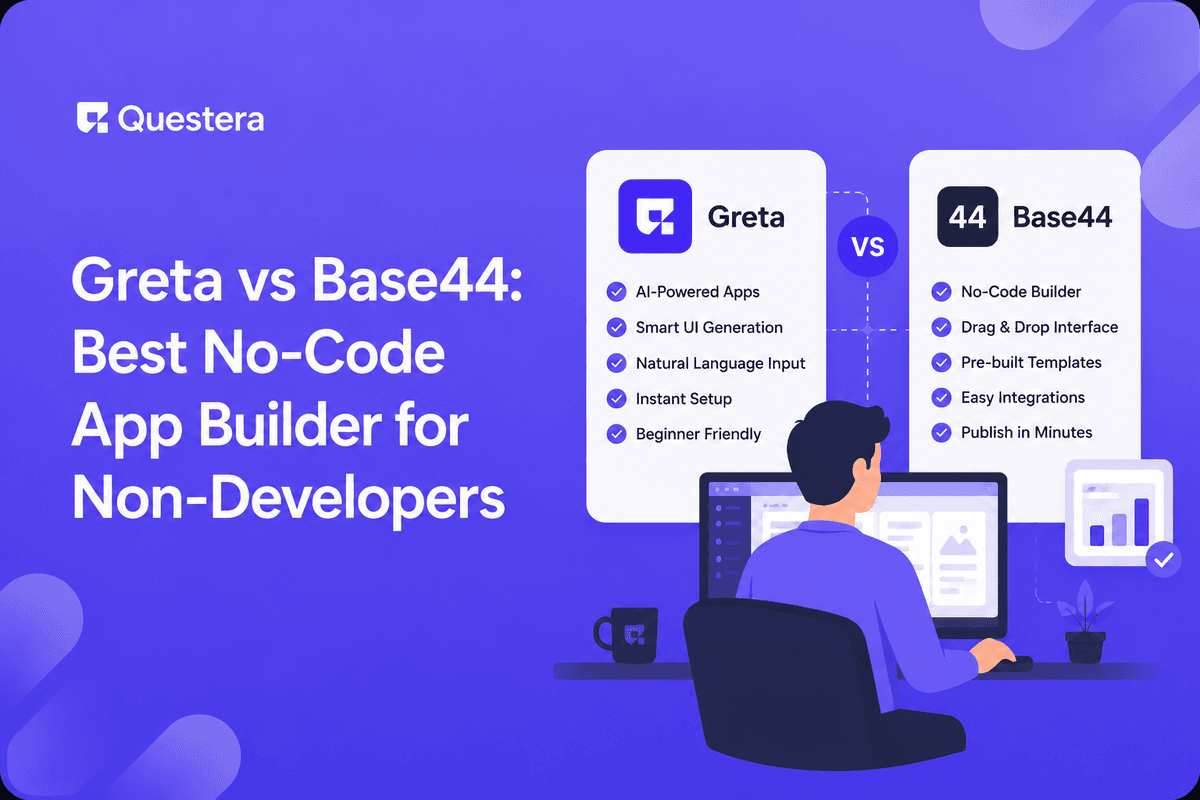
Greta and Base44 are two of the strongest no-code AI app builders for non-developers in 2026. Base44 (acquired by Wix in 2025 for ~$80M) is an all-in-one platform with integrated database, auth, and AI agents — strong on first-impression UI quality and a visual click-to-tweak editor. Greta is a unified vibe coding platform with bundled growth tooling — domain, SEO, analytics, and content management built into the same workspace. Both ship working production apps from prompts. Pick Base44 if you want the fastest prototype-to-pretty-app loop; pick Greta if you're shipping a complete SaaS business including its marketing surface.
Introduction
Greta and Base44 both target the same audience: non-developers who want to ship real software without learning to code. Both produce working full-stack apps from natural language prompts. But they make different bets about what "no-code AI app builder" actually means. Base44 is an all-in-one platform with strong first-impression UI and a visual click-to-tweak editor; Greta is a unified workspace that bundles app building with the growth tooling needed to run a SaaS business.
What Is Base44 and How Does It Work?
Base44 launched as an AI app builder and was acquired by Wix in 2025 for roughly $80M. By 2026, the platform reports 2M+ users and around $100M ARR. The defining bets: integrated database, authentication, AI agents, and a visual click-to-tweak editor that lets non-developers adjust copy, colors, and layout post-generation without re-prompting.
Pricing in 2026 runs five tiers: a free plan, then paid tiers from roughly $16/month (annual) to $160/month at the top. Pricing is credit-based — message credits for building and integration credits for API calls. Unused credits don't roll over. The dual-credit system can be confusing for new users; planning for credit usage matters more than on flat-fee platforms.
What Is Greta and How Does It Differ?
Greta is a unified vibe coding platform with bundled growth tooling. The app builder is one part of a larger workspace handling domain setup, basic SEO infrastructure, analytics, and content management. The mental model is "ship a complete SaaS business from one workspace" rather than "ship a working app and assemble the marketing surface separately."
Pricing is subscription-based with bundled capacity, which means non-developers don't watch credit consumption during heavy iteration. Multi-backend support (Supabase, MongoDB, AWS) gives stack flexibility for projects with non-standard architectural needs.
Greta vs Base44: Feature-by-Feature Comparison
| Feature | Greta | Base44 |
|---|---|---|
| Type | Unified vibe coding platform | All-in-one AI app builder |
| Best For | Solo founders, SaaS + marketing | Non-devs wanting fastest pretty-app loop |
| Pricing Model | Subscription with bundled capacity | Credit-based, $16–$160/mo |
| Backend | Multi-backend (Supabase, MongoDB, AWS) | Integrated DB (less flexible) |
| Standout Feature | Bundled growth tooling | Visual click-to-tweak editor |
| Growth Tooling | Built-in (domain, SEO, analytics) | Custom domain on Builder tier+ |
| Content Management | Built-in | Limited |
| Code Export | Yes, to GitHub | Yes, on Builder tier+ (GitHub sync) |
| Learning Curve | Lowest in category | Low; credit anxiety mid-build |
| Owner | Independent | Owned by Wix |
Which One Ships Projects Fastest?
Base44 Ships Fastest When...
- You want a polished-looking prototype in 5–10 minutes for stakeholder feedback
- Your project is a focused standalone app without much surrounding marketing
- You value click-to-tweak visual editing over re-prompting for cosmetic changes
- You're comfortable monitoring credit usage and planning for top-ups
- Your stack is standard — Base44's integrated database fits your needs
- You're already in the Wix ecosystem
Greta Ships Fastest When...
- You're a solo non-developer founder shipping a SaaS plus its marketing site
- You want predictable monthly costs without watching credits during heavy iteration
- Content marketing or SEO matters to your launch strategy
- Your project needs a non-standard backend (MongoDB, AWS) or stack flexibility
- You want one workspace for app + domain + SEO + analytics + content
- You'd rather describe the entire SaaS once than maintain a tool stack
Credit-Based vs Subscription: The Real-World Impact
This is the biggest practical difference between the two platforms and the one most often underestimated by first-time builders.
Base44 uses a dual-credit system. Building consumes message credits; running the app's AI features consumes integration credits. A chatbot getting 100 users making 10 queries each burns 1,000 integration credits — half the monthly allowance on the Starter plan. Unused credits don't roll over. Heavy iteration during the build phase can burn credits faster than expected, and the anxiety of watching the counter affects how people prompt.
Greta's subscription with bundled capacity removes credit anxiety. You iterate as much as you need without watching the counter. For non-developers specifically — who often need 20–50 prompts to refine v1 — the predictability matters meaningfully. Neither model is universally better. For light usage and prototyping, Base44's credit model is fine. For heavy iteration during real builds, Greta's predictability wins.
Full-Stack Capability: What Each Handles Automatically
What Base44 Handles
- Frontend (React-based) with strong default styling
- Integrated database (managed by Base44)
- Authentication built into the platform
- AI agents and LLM integration
- Custom domain on Builder tier and above
- GitHub sync on Builder tier and above
What Greta Handles
- Everything Base44 does, plus:
- Bundled domain setup and SSL across all tiers
- Basic SEO infrastructure (meta tags, sitemap, structured data)
- Built-in analytics tracking
- Content management for blog and marketing pages
- Multi-backend flexibility for unusual architectures
UI Quality and Visual Editing
Both platforms produce strong first-pass UI. Base44's standout advantage is post-generation: the visual click-to-tweak editor lets non-developers adjust copy, colors, padding, and small layout details without writing prompts. For non-developers who think visually, this matters.
Greta's approach is prompt-driven throughout. Cosmetic adjustments come from focused prompts rather than direct manipulation. Non-developers who prefer describing what they want benefit from Greta; non-developers who prefer pointing-and-clicking benefit from Base44's visual editor.
For founders specifically, the post-generation visual editor matters less than it does for designers or marketers. Founders iterating on a real product spend most of their time on functionality, not cosmetics.
Data Ownership and Platform Lock-In
Base44's integrated database is convenient but creates a future migration burden. If you grow past Base44 or want to switch platforms, the data sitting in Base44's database has to be migrated. GitHub sync (Builder tier and above) helps with code portability, but the data layer is harder to extract.
Greta exports both code and supports standard backend choices (Supabase, MongoDB, AWS). The exit path is fundamentally cleaner — your code lives in GitHub, your data lives in standard databases. For founders thinking past their first 12 months, this difference compounds.
Pricing Analysis: What Each Actually Costs
- Base44 Free — Useful for evaluation; credits disappear quickly.
- Base44 Starter — Around $16/month annual. Limited credits; fine for prototypes.
- Base44 Builder — Around $40/month annual. Includes custom domain and GitHub sync. Sweet spot for serious solo builders.
- Base44 Pro — $80/month annual. Double Builder credits, suitable for small teams.
- Base44 Elite — $160/month annual. Heavy commercial use; priority support.
- Greta — Subscription with bundled capacity. Growth tooling (domain, SEO, analytics) included rather than billed separately.
On sticker price alone, Base44 Starter ($16/mo) is the cheapest entry point. Once you factor in separate hosting, analytics, SEO tools, and content management that Base44 doesn't bundle even at higher tiers, Greta is often cheaper for total stack.
Who Should Pick Which?
- Pick Base44 if you want the fastest prototype-to-pretty-app loop, especially for stakeholder demos.
- Pick Base44 if visual click-to-tweak editing matters more to you than predictable pricing.
- Pick Base44 if you're already in the Wix ecosystem and want one vendor.
- Pick Base44 if your project is a focused standalone app without much surrounding marketing.
- Pick Greta if you're shipping a complete SaaS business with marketing surface included.
- Pick Greta if predictable subscription pricing matters more than sticker price.
- Pick Greta if content marketing or SEO is part of your launch strategy.
- Pick Greta if your project needs unusual backend architecture or stack flexibility.
- Pick Greta if data portability and clean exit paths matter to you.
How They Compare to Other No-Code AI Options
- Base44 vs Lovable — Lovable's standout is two-way GitHub sync; Base44's standout is the visual editor. Lovable is more developer-friendly; Base44 is more non-developer-friendly for visual iteration.
- Base44 vs Bolt.new — Bolt's WebContainers offer faster preview; Base44 is more all-in-one; Bolt assumes more technical curiosity.
- Greta vs v0 — v0 produces best-in-class React UI with tight Vercel deployment. Greta is more workflow-bundled.
- Greta vs Replit — Replit offers full cloud IDE access; Greta abstracts code.
Common Mistakes Picking Between Them
- Picking on first-impression demos — Both platforms have impressive demos. Production-ready output depends on your prompt discipline as much as the platform's defaults.
- Underestimating credit burn on Base44 — Heavy debugging cycles can burn through credits faster than expected.
- Skipping the marketing surface math — A Base44 Builder subscription plus a separate hosting/analytics/SEO/content stack can cost more than Greta's bundled subscription.
- Treating visual editing as the only deciding factor — You'll spend most of your build time on functionality, not cosmetics.
- Ignoring data portability — Base44's integrated database creates migration burden later.
- Switching platforms mid-project — Migration costs more than starting fresh. Pick one, ship the v1, then evaluate.
Frequently Asked Questions
Is Greta or Base44 easier for complete non-developers?
Roughly tied at the low end. Greta's unified flow has the lowest learning curve when you account for marketing surface needs. Base44's visual editor adds an intuitive editing model but the dual-credit system adds cognitive overhead for new users.
Can both build real production-grade SaaS?
Yes. Both produce apps that take real customer payments and run on real domains. The differences are about workflow and what's bundled, not code quality at the output.
Does Base44's Wix acquisition change anything?
The product remains independently usable, but it now sits inside Wix's ecosystem. For builders who care about platform independence, this is worth considering. For builders who don't, it's largely neutral.
Which has better real customer pricing in practice?
Depends on what's included. Base44 Starter ($16/mo) is cheaper sticker; Base44 Builder ($40/mo) approaches Greta. Once you factor in separate hosting, analytics, SEO tools, and content management Base44 doesn't bundle, Greta usually wins on total stack cost.
What about data portability?
Greta exports cleanly — code to GitHub, data on standard backends (Supabase, MongoDB, AWS). Base44's integrated database creates more migration burden, though GitHub sync on Builder tier helps with code portability.
Will my AI-built SaaS scale?
For 1k–50k users, both platforms handle comfortably. Beyond that, you'll need engineering review. Both platforms export real code engineers can extend rather than rebuild.
Key Takeaways
- Greta and Base44 are two of the strongest no-code AI app builders for non-developers in 2026. The decision is about workflow fit, not which one is universally 'better.'
- Base44 wins on visual click-to-tweak editing post-generation, all-in-one workspace simplicity, and Wix ecosystem integration.
- Greta wins on bundled growth tooling, predictable pricing without credit anxiety, stack flexibility, and cleaner data portability.
- Both export real working code. Both produce apps that take real customer payments. Pick the platform that matches what you're actually shipping.





© 2026 Questera
Follow in Google