






The Future of Software Engineering in the Age of AI
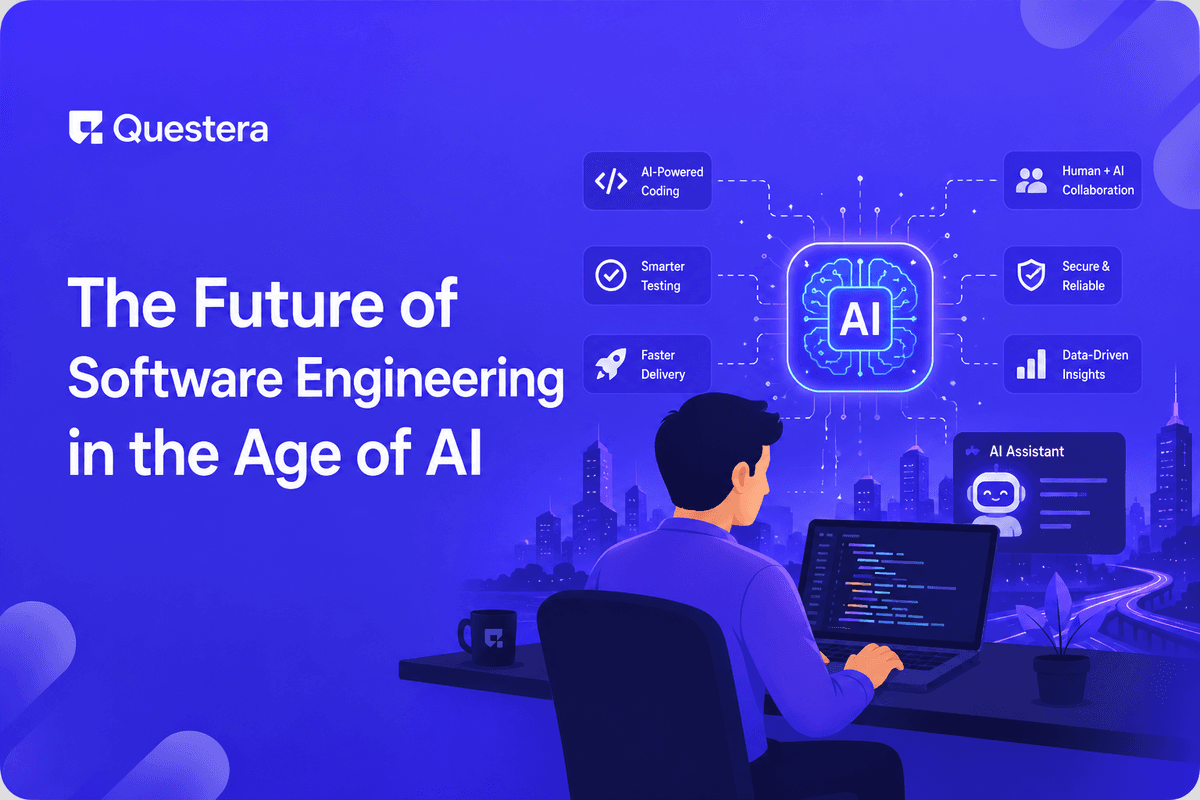
Software engineering in 2026 has changed structurally — not in what's built but in how. AI generates most greenfield code; engineers shift from typing to directing, architecting, reviewing, and hardening. Build cycles compressed 10–20×. The role didn't disappear; it concentrated on the parts AI can't do well — judgment, design, edge cases, security, system architecture, customer empathy. Engineers who absorb the shift become higher-leverage than ever. Engineers who stay in line-by-line implementation mode get bypassed.
Software engineering as a profession spent decades stabilizing around the same shape — engineers write code by hand, in IDEs, building features over sprints. The tools evolved but the underlying activity stayed recognizably the same. From 1995 to 2022, an engineer from any year would recognize the daily work of any other year. By 2026, the daily work shifted structurally.
Got an idea? Build it now!
Just start with a simple Prompt
Get Started Today


What Changed Structurally
Build Cycles Compressed 10–20×
- Greenfield features that took 2–4 weeks in 2020 now ship in hours–days
- API endpoints, CRUD UIs, basic auth flows — generated in minutes, not days
- Engineering review and harden phase moved to the bottleneck
- Sprint planning theater no longer matches the pace of work
Code Quantity per Engineer Increased Dramatically
- Single engineer outputs that previously took 3–5 engineers
- Solo founders ship full SaaS without engineering hires
- Lean teams of 2–5 engineers operate at the output scale of 10–20-person teams
- Code quality maintained or improved (when properly reviewed)
Tool Category Fragmentation
- AI app builders (Greta, Lovable, Bolt) generate full applications from prompts
- AI IDEs (Cursor, Windsurf) augment engineers in existing codebases
- Component generators (v0) produce specific UI pieces
- Visual no-code (Bubble, Webflow, Framer) added AI features
- Each category optimizes for different workflows
Boilerplate Vanished
- Auth scaffolding, CRUD APIs, form validation, basic UI components — AI generates
- Framework starters lose relevance as AI generates equivalent
- Engineers no longer write Stripe integrations from scratch — they prompt and review
- Testing scaffolds generated; engineers focus on test quality, not boilerplate setup
What Didn't Change
- Software still needs to work — Bugs are still bugs; users still notice failures
- Architecture still matters — Trade-offs, scalability, system design remain human judgment
- Security is still hard — AI generates plausible-looking but sometimes insecure code; engineers verify
- Code review still essential — AI-generated code needs review for correctness, performance, security
- Engineering culture still matters — Quality bars, code standards, mentorship
- Customer empathy still drives outcomes — Building the right thing matters more than ever
- Operational discipline still required — Monitoring, incident response, on-call
- Trade-offs still require judgment — Time vs quality vs cost trade-offs aren't automatable
Got an idea? Build it now!
Just start with a simple Prompt
Get Started Today
The New Engineer's Role
Director, Not Typist
- Engineers describe what to build; AI generates the implementation
- Engineers review, refine, harden
- Less time on syntax; more time on system design and trade-offs
- More cognitive work per hour; less mechanical work
Architect, Then Assemble
- System architecture decisions remain human — service boundaries, data models, integration patterns
- AI assembles components within the architecture
- Engineers focus on the parts AI doesn't handle well: edge cases, performance, security, observability
Reviewer and Hardener
- Most engineering time now spent on review, harden phase, and operational work
- Auth checks, RLS verification, error handling, performance optimization
- Production incident response and post-mortem analysis
- Security audits and compliance reviews
Customer-Empath
- Build cycle compression makes 'building the right thing' more important than ever
- Engineers increasingly in direct customer conversations
- Customer empathy informs every PRD and every prompt
Skills That Compound in 2026 (and Beyond)
Prompt Design
- Writing prompts that produce desired output efficiently
- Iterative refinement — knowing when to re-prompt vs edit directly
- Constraint specification — telling AI what NOT to do
- Layered prompts — building up complex features through iteration
Code Review Skill
- Reading AI-generated code critically
- Spotting subtle correctness, security, and performance issues
- Knowing what 'good' looks like across domains AI may not handle well
- Reviewing at the right level of abstraction (not nitpicking syntax; finding real issues)
System Architecture
- Designing systems AI can build into
- Service boundaries, data models, integration patterns
- Trade-off analysis between approaches
- Long-term implications of structural decisions
Security and Compliance Judgment
- Auth patterns and RLS design
- OWASP top-10 awareness
- Compliance framework familiarity (GDPR, SOC 2, HIPAA, others)
- Threat modeling for AI-built systems
Domain Expertise and Customer Empathy
- Deep knowledge of specific verticals (fintech, healthcare, real estate, etc.)
- Industry-specific patterns, regulations, integrations
- AI handles the generic; engineers handle the domain-specific
- Direct customer conversations and synthesizing insights into PRDs and prompts
Operational Discipline
- Monitoring and observability design
- Incident response and post-mortem
- On-call engineering culture
- Cost monitoring (especially AI cost discipline)
Got an idea? Build it now!
Just start with a simple Prompt
Get Started Today
Skills That Depreciate
- Pure syntax mastery — AI handles syntax across languages
- Boilerplate code production — Auth, CRUD, forms generated by AI
- Framework-specific knowledge as the only skill — AI handles framework patterns
- Implementation-only work without judgment — Engineering value is increasingly in the judgment, not the implementation
- Defensive complexity — Adding abstractions 'just in case' less valuable when rewrites are cheap
- Premature optimization — Time spent on micro-optimization rarely pays off when features ship in hours
Team Structure Shifts
- Smaller teams ship more — 5-person teams now do what 20-person teams did
- PM-to-engineer ratios tightened — Less translation overhead means closer collaboration
- Engineering management role evolved — More technical leadership; less project tracking
- Specialists still matter — Security engineers, performance engineers, infrastructure engineers retain value
- Generalist engineers thrive — Breadth across stack increasingly valuable with AI handling depth
- Hybrid roles emerge — PM+engineer, designer+engineer, growth+engineer
What This Means for Early-Career Engineers
- Junior roles compress — Some traditional junior tasks (boilerplate code, simple CRUD) automated
- But engineers who skill up faster than peers thrive — AI is leverage; juniors can punch above their level with good direction
- Code review is teachable; learn it fast — Reviewing AI-generated code is a core junior skill now
- Build broad foundations — Single-language depth less valuable; cross-stack competence more so
- Domain expertise + AI proficiency is the new high-value combination
What This Means for Senior Engineers
- Higher leverage than ever — Same engineer outputs 3–5× more code, builds bigger systems
- Mentorship still critical — Junior engineers need senior judgment in AI-built systems
- Architecture skills appreciate — System design becomes the highest-leverage senior skill
- Code review skills become primary value — Catching subtle issues in AI-generated code
- Operational discipline transfers — Senior engineers' instincts around production, security, scale remain
Got an idea? Build it now!
Just start with a simple Prompt
Get Started Today
What This Means for Engineering Managers
- Project management overhead reduces — Sprint planning theater no longer makes sense
- Team output per engineer increases dramatically
- Focus shifts to technical leadership, quality bars, mentorship
- Hiring decisions matter more — Each engineer is higher-leverage; wrong hires cost more
- Culture and process tuned for compressed cycles — Continuous flow vs sprint structure
- Strategic technical decisions rise in importance — Architecture, security, scale judgment
What This Means for Solo Founders and Indie Hackers
- Ship full SaaS as solo operator — Genuine possibility now
- Don't need to hire engineers until significant scale — $50K–$200K MRR achievable solo
- But still need engineering judgment — Architecture, security, operational decisions matter
- Domain expertise + AI proficiency wins — Pick a niche you understand deeply; build for it
- Community of indie founders grew — Mutual support, shared patterns, distribution channels
The New Engineering Workflow
Old Workflow
- Sprint planning (2–4 hours) → estimation → ticket assignment
- Engineer reads ticket → asks clarifying questions → writes code → tests → opens PR
- PR review by peers → discussion → merge
- QA cycle → bug fixes → deploy
- Total time per feature: days to weeks
New Workflow
- PRD written (15–30 min) → tight, focused, design-vibe specified
- Engineer prompts AI app builder or AI IDE → reviews output → iterates
- Harden phase (auth, RLS, error handling, performance) — engineer-driven
- PR review focused on judgment, not syntax → merge
- Direct deploy with monitoring → fast feedback loop
- Total time per feature: hours to days
What Ceremonies Stayed and What Dropped
- Stayed: code review, customer conversations, architecture discussions, post-mortems
- Dropped or compressed: sprint planning, story point estimation, daily standups, retrospectives
- New: prompt iteration sessions, AI cost reviews, AI output quality reviews
Got an idea? Build it now!
Just start with a simple Prompt
Get Started Today
Emerging Engineering Specializations
- AI cost engineering — Optimizing AI usage costs at scale, model selection, caching strategy
- Prompt engineering at production — Crafting prompts that produce consistent quality output for AI features
- AI safety engineering — Ensuring AI features behave correctly and don't harm users
- Evaluation engineering — Building evals for AI features, measuring quality over time
- Multi-modal engineering — Audio, vision, document processing alongside text
- Agent engineering — Building AI agents that use tools, plan tasks, execute autonomously
- MCP (Model Context Protocol) integration — Connecting AI to external tools and data
What's Emerging in 2026 and Beyond
Agent-Driven Workflows
- AI agents handle multi-step tasks autonomously
- Engineering work shifts toward designing, monitoring, and improving agents
- Agents handle routine operational tasks (deploys, incident triage, monitoring)
- Human engineering attention reserved for novel problems and judgment calls
Continuous AI-Generated Tests
- Tests generated alongside code automatically
- Edge cases discovered by AI exploration
- Test maintenance burden reduced significantly
What Stays Human (Probably Forever)
- Architectural trade-off decisions in novel domains
- Customer relationships and empathy
- Strategic technical decisions
- Ethics and judgment calls
- Cross-functional negotiation and influence
- Mentorship and culture-building
- Crisis judgment under ambiguity
- Domain-specific creativity in novel problems
Common Mistakes Engineers Make in the Transition
- Resisting AI tools — Engineers who don't use AI builders/IDEs ship 5× less than those who do. The competitive gap is real.
- Treating AI output as final — AI generates plausible-looking code; engineers must still review for correctness, security, performance.
- Skipping the harden phase — AI generates features; engineers harden them. Skipping = prototypes shipping to production.
- Over-relying on AI for judgment calls — AI is a code generator. Architecture, trade-offs, design decisions remain human.
- Failing to develop prompt skill — Prompt design is now core engineering skill. Investment in learning it compounds.
- Continuing sprint ceremonies for inertia — Build cycle compression made many ceremonies disproportionate. Question every one.
- Underestimating customer empathy — Building right things matters more than ever with build cycles compressed.
- Specializing too narrowly — Broad foundations across stack increasingly valuable; pure framework-specialists get bypassed.
- Ignoring AI cost discipline — Production AI features can run up significant API bills. Engineers need cost awareness.
Got an idea? Build it now!
Just start with a simple Prompt
Get Started Today
Frequently Asked Questions
Is software engineering still a good career?
Yes. The role evolved; the value remained or increased. Engineers who absorb the new workflow are higher-leverage than ever. Engineers who don't get bypassed. The job didn't disappear; it changed.
Should engineers learn AI/ML deeply?
Familiarity yes; deep ML expertise optional. Most production AI engineering is API integration, prompt design, cost optimization, evaluation — not ML model training. ML specialists remain valuable for specific roles; most engineers benefit from API-level fluency.
What about CS fundamentals — still relevant?
Increasingly relevant. Algorithm and data structure understanding helps in code review, performance work, architectural decisions. AI generates code; humans judge whether the code is correct and well-structured. CS fundamentals enable that judgment.
How do junior engineers compete with senior engineers using AI?
By skilling up faster than peers. AI is leverage; juniors using it well punch above their level. The career risk isn't AI; it's complacency. Juniors who learn prompt design, code review, system thinking quickly become competitive faster than ever before.
What about hiring trends?
Smaller teams shipping more = fewer engineering hires per dollar of revenue. But engineering quality matters more — each hire is higher-leverage. The bar rose; the volume dropped. Top engineers compensated better; commodity engineering work compresses.
Are bootcamps still worth it?
Mixed. Bootcamps that teach pure syntax and framework usage in 2020 style produce graduates who struggle in 2026's market. Bootcamps that teach AI-augmented workflows, prompt design, code review, and modern stacks produce graduates well-prepared for current roles.
What's the trajectory for the next 5 years?
Continuing compression of routine work, growing importance of judgment-heavy work. Agents handling more multi-step tasks. AI getting better at edge cases and security; humans remaining critical for novel problems and strategic decisions. Engineering becomes more like designing systems and less like writing them by hand.
Software engineering changed structurally in 2026. AI generates most greenfield code; engineers shift from typing to directing, architecting, reviewing, hardening. Skills that compound: prompt design, code review, system architecture, security judgment, domain expertise, customer empathy, operational discipline. Team structures shifted. Smaller teams ship more. Solo founders ship full SaaS. The trajectory continues — agents handle more autonomously, routine work compresses further, judgment-heavy work remains human. Engineers who skill up — broadly, deeply, in modern workflows — thrive. The future of software engineering isn't disappearing; it's concentrating on the work that matters most.
Got an idea? Build it now!
Just start with a simple Prompt
Get Started Today
Ready to be a
10x Marketer?
See it in action



© 2026 Questera
Follow in Google