






How to Get Your First 1,000 Users (For AI-Built SaaS)
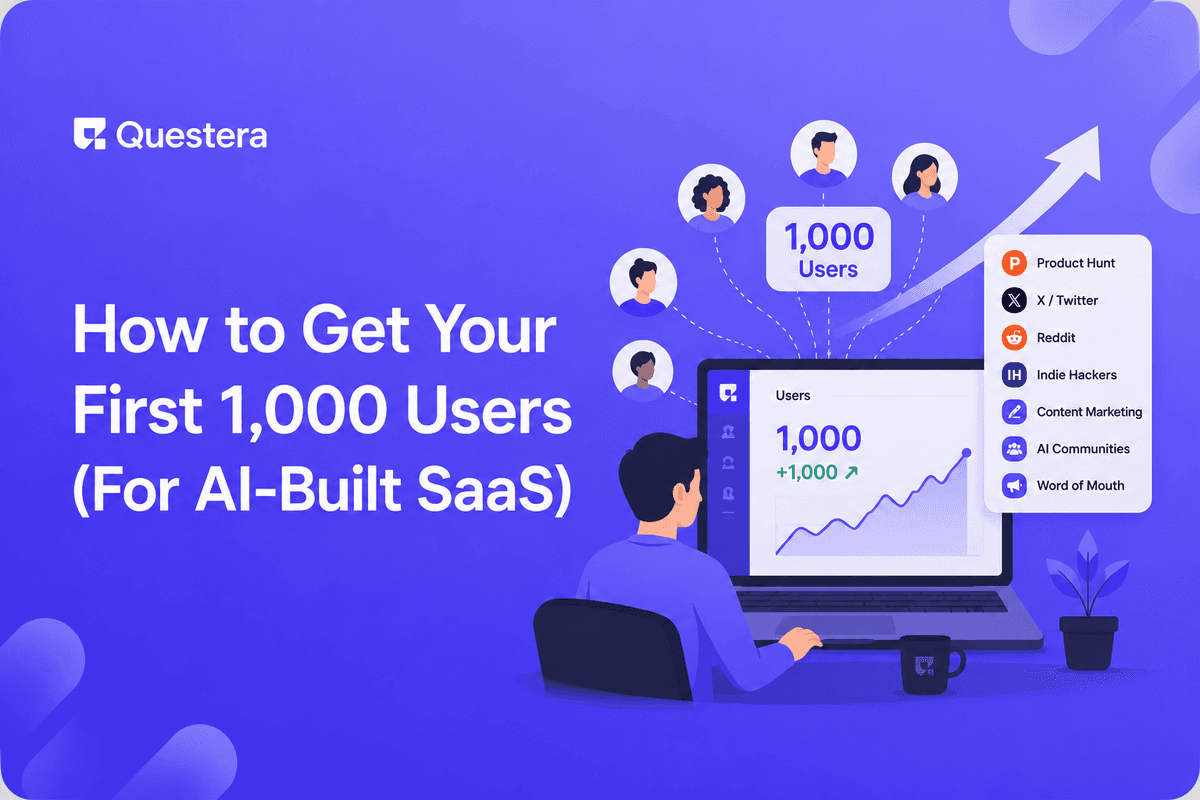
Getting your first 1,000 users for an AI-built SaaS in 2026 looks different from 2018. Generic "launch on Twitter" is shallow; the channels that actually move the needle are niche communities, Product Hunt with proper setup, comparison content for SEO, direct outreach to your ICP, niche newsletters, and 1-to-1 founder-led sales. This guide covers the realistic path from 0 to 1,000 users, the channels worth investing in, the conversion math that matters, and the operational discipline that separates the SaaS that grows from the SaaS that launches and disappears.
Introduction
AI app builders made shipping fast. The build that took 3 months now takes 3 days. The bottleneck moved from building to distribution. Most AI-built SaaS in 2026 ship a working v1 in a week and then sit there for 6 months with under 50 users because the founder treats distribution as someone else's problem.
The honest reality: distribution is the hard part. Getting the first 1,000 users isn't a single tactic; it's a portfolio of channels, each contributing some compounding share of growth, executed with discipline for 6–18 months. Founders who treat distribution as seriously as they treated the build hit 1,000 users in months. Founders who ship and pray hit 50 users in years.
The Conversion Math You Need to Plan Around
| Funnel Stage | Typical Conversion | Implication |
|---|---|---|
| Awareness → Visitor | ~1–5% of audience | Need to reach 20,000–100,000 people to get 1,000 visitors |
| Visitor → Signup | 2–10% | 1,000 visitors → 20–100 signups |
| Signup → Active Use | 30–60% | 100 signups → 30–60 active users |
| Active → Paid (if monetized) | 5–25% | 60 active → 3–15 paid |
| Paid Retention 6 months | 60–85% | Most paid users stay if product fits |
Math working backward from 1,000 users: ~5,000–10,000 signups → ~50,000–100,000 visitors → ~1,000,000–10,000,000 awareness impressions. This is the scale needed for horizontal SaaS. Niche SaaS targets less awareness reach but converts harder.
Channel 1: Niche Communities
The highest-leverage channel for indie SaaS. Specific Reddit subreddits, niche Slacks, niche Discords, Indie Hackers, niche Facebook groups. Where your audience already hangs out and discusses problems your product solves.
How to Use Niche Communities (Without Getting Banned)
- Participate for weeks before promoting — Be a member, help others, build standing
- Respond to questions your product solves — Mention your product naturally when relevant
- Share your build journey, not just product launches — Indie hackers love behind-the-scenes content
- Respect community rules — Self-promotion subreddits exist; general subs have strict rules
- Provide value first; ask for usage second
Communities Worth Participating In
- Reddit — r/SideProject, r/SaaS, r/Entrepreneur, r/IndieHackers, niche-specific subs
- Indie Hackers — Active community of indie SaaS founders; revenue transparency culture
- Hacker News — Show HN posts can drive significant traffic for technical products
- Niche Slacks/Discords — Industry-specific communities
- Twitter/X communities — Lists, niches, conversations around specific topics
Channel 2: Product Hunt Launch
Product Hunt remains a meaningful launch channel in 2026. A well-executed launch drives 2,000–10,000 visitors in the first 48 hours and meaningful long-tail SEO.
Build this with a prompt on Greta.sh — describe the app, Greta writes and deploys it.What Makes a Product Hunt Launch Work
- Pre-launch warm-up — Build an audience for weeks before launch
- Hunter selection — A well-connected hunter increases visibility on launch day
- Visual quality — Hero image, gallery, demo video all need polish
- Founder presence — Active in comments throughout launch day
- Tagline that explains the value in 60 characters
- Launch on Tuesday/Wednesday — typically highest engagement
Channel 3: SEO + Comparison Content
SEO is slow but compounds. For most indie SaaS, the path that works is comparison content — "[Your Product] vs [Competitor]" posts that capture buyers in active evaluation mode.
Why Comparison Content Works
- Buyer intent is high — 'X vs Y' searches happen during active purchase consideration
- Less crowded than head terms — Easier to rank for than 'best SaaS'
- Honest comparisons build trust — Acknowledge competitor strengths; explain where you fit better
- Cumulative growth — 20+ comparison pieces compound into significant organic traffic
Channel 4: Direct Outreach to ICP
Underrated for indie SaaS. 1-to-1 outreach to people who match your ICP. Not cold email blasts; thoughtful, personalized messages that mention specific signals you observed.
Who to Reach Out To
- People who tweeted about the problem you solve
- People who posted in niche communities asking for tools like yours
- Customers of your competitors who've publicly expressed dissatisfaction
- Specific roles you target found on LinkedIn
Outreach Pattern That Works
- Specific opening that shows you actually researched them (no 'Hey {first_name}')
- Reference the signal you observed (their tweet, their question, their use case)
- Brief explanation of what you built and why it might help them
- Offer free use for early users in exchange for feedback
- No hard sell; the goal is conversation, not conversion in the first message
Realistic numbers: 100 personalized outreaches → 20–40 responses → 5–15 sign-ups → 2–5 paid customers. Time-intensive but high-conversion. Most successful indie SaaS founders ran 1,000+ personalized outreaches in the first year.
Channel 5: Niche Newsletters and Podcasts
Audience-rich, trust-rich, but harder to access at scale. The right newsletter or podcast appearance can drive 100–500 qualified signups.
- Identify 10–20 niche newsletters your ICP reads; subscribe and engage with the author
- Sponsorship is sometimes available for $200–$5,000 per send
- Have a specific angle the podcast host can frame to their audience
- Smaller niche podcasts are easier to land and often have more engaged audiences
Channel 6: Content + Organic Social
- Twitter/X — Frequent posts, replies, engagement with niche community. Long-haul; results in 6–12 months
- LinkedIn — Posts about lessons learned, ICP-relevant content. Higher trust per impression than Twitter.
- YouTube — Demos, tutorials, behind-the-scenes. Slower but highest trust signal.
- Building in public — Revenue transparency, build journey, lessons learned. Indie hacker audiences love this
Channel 7: Affiliate and Referral Programs
Once you have customers who love the product, turn them into a growth channel.
- Referral program — Existing users invite friends; both get credit or discount
- Affiliate program — Bloggers, YouTubers, course creators get commission for new customers
- Friction-light referrals — Email signature 'Get $X off,' in-app referral prompts at success moments
- Don't launch affiliate too early — Wait until product fit is proven and you have at least 100 happy customers
Channel 8: Paid Acquisition (Use Carefully)
Paid ads can work but rarely for v1 indie SaaS. Wait until you have ICP clarity, message-market fit, and unit economics that support it.
- Google Search Ads — Best for bottom-of-funnel intent (specific tool searches)
- Reddit Ads — Hyper-niche targeting via specific subreddits
- Newsletter sponsorships — Often best ROI for B2B SaaS
- Skip Facebook/Instagram ads early — Audiences too broad for niche SaaS
Honest framing: most indie SaaS at $0–$10K MRR shouldn't run paid acquisition. Unit economics rarely work at this stage. Wait until you understand customer LTV before spending to acquire.
Operational Discipline That Separates Winners
- Daily distribution work — Even 30 min/day compounds. Posting in communities, sending outreach, writing content.
- Weekly metric review — Visitors, signups, conversion, paid customers. Track week-over-week trends.
- Customer interviews — Talk to 1–3 customers/week. Learn what's working, what's not.
- Content production cadence — At least 1 blog post or piece per week. Compounds over months.
- Outreach quota — 5–10 personalized outreaches/day. Volume + quality.
- Patience with timelines — 1,000 users typically takes 6–18 months for indie SaaS.
- Focus on one channel at a time — Two channels done well beat five done poorly.
Common Mistakes Getting First 1,000 Users
- Treating distribution as 'will figure it out later' — The build is the easy part. Plan distribution before launching.
- One big launch and nothing else — Launches give a spike; sustained distribution is what gets to 1,000 users.
- Trying everything at once — Focus on 1–2 channels until you understand them; then expand.
- Generic outreach blasts — High-volume cold email rarely works. Personalized, specific outreach does.
- Skipping niche communities — They're the highest-leverage channel for indie SaaS.
- Spending on paid acquisition too early — Wait until you understand customer LTV.
- Ignoring SEO until it's too late — SEO compounds over 6–18 months. Start in month 1, not month 12.
- Quitting at the dip — Most products see a slow ramp followed by acceleration. The slow ramp tests your patience; the acceleration rewards it.
Frequently Asked Questions
How long does it really take to get 1,000 users?
For indie SaaS with disciplined distribution, 6–18 months. Faster than that requires either a viral hit (rare) or significant existing audience. Most successful indie SaaS founders look back and see the long ramp before the acceleration.
What if I have no audience?
Most indie founders start with no audience. The path is building one alongside the product. Post in niche communities, write content, do outreach. By the time you have 1,000 users, you'll have a meaningful audience too.
Should I focus on paid or organic?
Mostly organic for v1. Paid acquisition rarely works at $0–$10K MRR. Organic channels (communities, SEO, content, outreach) build durable audience. Once unit economics are clear and you have $5K+ MRR, evaluate paid.
What's the right launch sequence?
Soft launch to 10–30 friendly users first. Iterate based on feedback for 2–4 weeks. Then formal Product Hunt or community launch when product is genuinely ready. Skip the "big bang" launch for an unfinished product.
Key Takeaways
- Getting to 1,000 users for indie SaaS takes 6–18 months of disciplined distribution. The build is the easy part; distribution is the hard part.
- Top channels: niche communities, Product Hunt launches, SEO + comparison content, direct outreach to ICP, niche newsletters/podcasts.
- Conversion math matters. Plan backward from 1,000 users through realistic funnel conversion rates.
- Focus on 1–2 channels at a time; master them before expanding. Most channels won't work for your product; find the ones that do and double down.



© 2026 Questera
Follow in Google