






How to Get Your AI-Built App Featured on Product Hunt
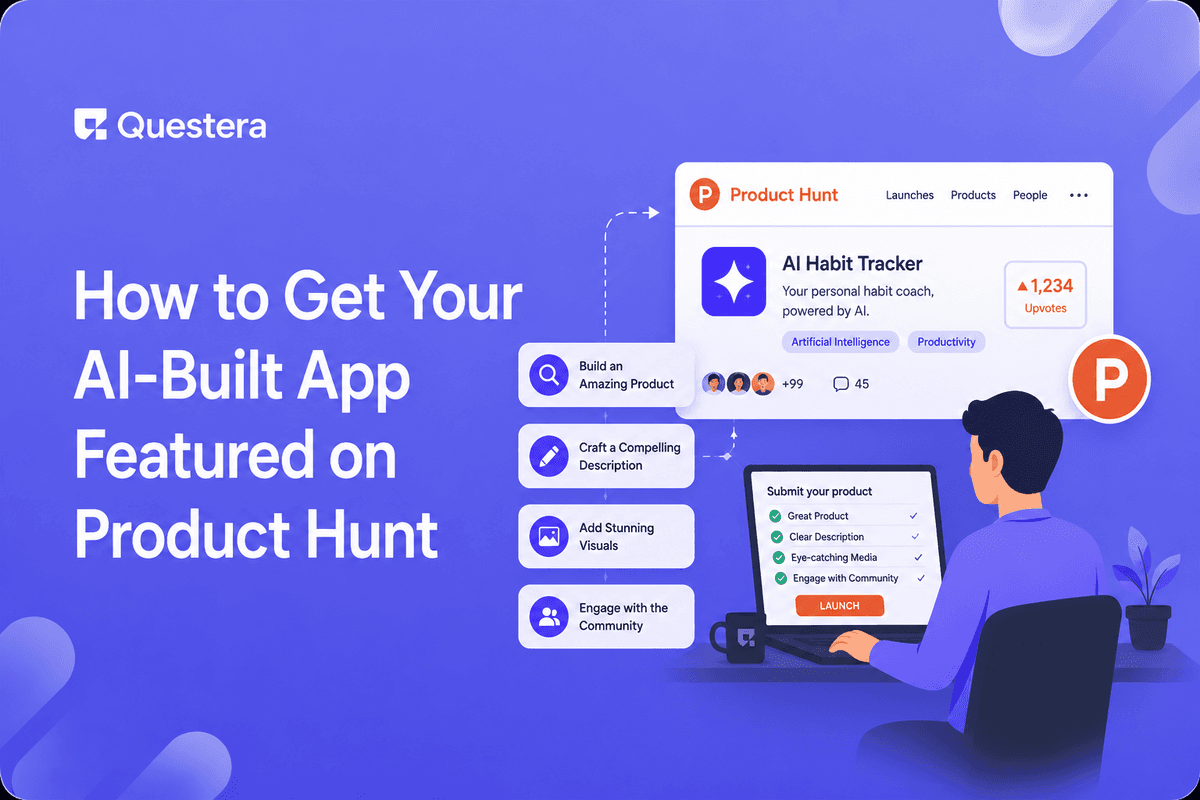
Product Hunt remains one of the strongest distribution moments for AI-built apps in 2026 — but only if the launch is planned, the audience is warmed up, and the launch-day execution is disciplined. AI apps in particular have to overcome the "just another GPT wrapper" skepticism, which means showing real product value rather than capability theater. The build is the easy part; the launch is the work.
Introduction
Product Hunt has been the indie launch ritual for over a decade. In 2026, it's still one of the strongest single distribution moments available to indie founders — a successful launch drives 1,000–10,000+ qualified visitors, hundreds of signups, and the kind of social proof that compounds into ongoing distribution.
But Product Hunt in 2026 isn't 2016 Product Hunt. The platform is saturated with AI app launches. Anyone can build an MVP in a weekend; everyone is launching something. The bar to stand out has risen meaningfully. The launches that succeed combine product clarity, audience preparation, and disciplined launch-day execution.
Why Product Hunt Still Matters in 2026
- Concentrated qualified traffic — Tech-curious, builder-friendly audience open to trying new products
- Compounding social proof — Top 5 finish becomes credibility you cite forever
- SEO benefit — Product Hunt pages rank well; you get backlink value
- Press attention — Tech journalists watch Product Hunt for stories
- Investor visibility — VCs use Product Hunt as a discovery channel for early-stage products
- Distribution moment — One concentrated moment of attention is worth weeks of fragmented effort
Why AI App Launches Face Extra Scrutiny
- 'Just another GPT wrapper' — Reviewers have seen hundreds of thin wrappers. You need to show real product value beyond the AI capability.
- AI fatigue — Many users have signed up for dozens of AI tools they never used. The bar to convert is higher.
- Trust concerns — AI products raise data privacy and accuracy questions traditional SaaS doesn't.
- Capability theater — Demos that show impressive AI outputs but no real workflow value bounce.
- Niche skepticism — 'Build anything you want' bores reviewers; 'AI for [specific user] solving [specific problem]' converts.
The pattern that works: lead with the specific user and specific problem; treat AI as an implementation detail, not the selling point.
The 4-Week Pre-Launch Plan
Week 1: Foundation
- Pick your launch day — Tuesday, Wednesday, or Thursday work best (weekends are dead; Monday is competitive)
- Avoid major holiday weeks and AI vendor launch days
- Create your Product Hunt account if you don't have one. Engage authentically for 2–4 weeks first.
- Identify your hunter — Ideally someone in your network with a track record of successful launches.
- Audit your product critically — Does it work on mobile? Are loading states polished? Fix what's rough.
Week 2: Asset Preparation
- Write the tagline — One sentence, specific user + specific value. Not 'AI-powered task manager' but 'AI task manager for distributed engineering teams using Linear.'
- Write the description — 300–500 words. Lead with the problem and user; describe the solution.
- Create the gallery — 5–7 images. Hero image, key feature screenshots, GIF showing the AI in action.
- Record a demo video — 60–90 seconds. Show real workflow, not capability theater. Hosted on YouTube or Loom.
- Build a launch landing page — yourproduct.com/launch with the same positioning as Product Hunt.
Week 3: Audience Preparation
- Build your launch email list — DM existing users, ask waitlist subscribers to commit to launch day support
- Soft launch to 50–100 users in private — Product Hunt rewards launches with traction signals
- Set up your social presence — Twitter/X thread drafts, LinkedIn post drafts, Reddit-appropriate content
- Reach out to allies — Other founders in adjacent products who might support your launch
- Prepare your hunter — Brief your hunter on the product, the target audience, the angle to lead with
Week 4: Final Polish and Timing
- Confirm launch day and time (Pacific time) — Product Hunt resets at 12:01am Pacific.
- Schedule social media announcements for launch day
- Send a 'launch tomorrow' email to your warm audience asking for early-morning support
- Final QA on the product — Fix any remaining rough edges. Day-of bugs kill launches.
Launch Day Execution: The 24-Hour Playbook
Hour 0 (12:01am Pacific): Launch Goes Live
- Hunter posts the product — You don't post yourself; your hunter does
- Send your launch email to your audience asking for upvotes and comments
- Post to social media — Twitter/X first, then LinkedIn, then niche communities
- Reply to early commenters within 5 minutes — engagement begets engagement
Hours 1–4: Mobilize
- Reach out personally to 20–50 supporters via DM (one-on-one, not broadcast)
- Post to Reddit in relevant niches — IndieHackers, r/SideProject, niche subreddits
- Post to relevant Slack and Discord communities you're an active member of
- Continue replying to every Product Hunt comment within 10 minutes
Hours 5–12: Sustain Momentum
- Check ranking every 30 minutes — adjust strategy if you're slipping
- Send a midday email update to your audience — 'We're #X right now; would love your support'
- Continue engaging on Product Hunt and social media
- Track signups from Product Hunt traffic; reach out personally to high-value early users
Hours 13–24: Push to the Finish
- Final push around 4–6pm Pacific (peak US engagement window)
- Late evening Pacific = early morning Europe; Europe-based supporters wake up to amplify
- Final comment replies until you go to bed
- Track final ranking; thank everyone who supported
What Gets AI Apps into Top 5
Pattern 1: Specific User + Specific Problem
Generic "AI for productivity" launches finish below Top 20. Specific "AI for [user] solving [problem]" launches consistently make Top 10. The narrower the framing, the better the conversion of viewers to upvoters.
Pattern 2: Demo Over Claims
Reviewers have heard every AI claim. Show, don't tell. A 60-second video showing real workflow value outperforms paragraphs of "AI-powered" marketing copy.
Pattern 3: Hunter with Credibility
Hunters with a track record of successful launches get more visibility. Cold-hunted launches struggle. Build hunter relationships authentically in the months before launch.
Pattern 4: Real Social Proof on Launch Day
Comments from real users describing real value beat "this is so cool!" from your friends. Pre-launch private testing produces the kinds of comments that move reviewers.
Pattern 5: Niche Community Amplification
Launches that mobilize specific communities (IndieHackers, niche Slacks, specialized subreddits) outperform generic launches. The niche community knows your category and votes thoughtfully.
Specific Tactics That Move the Needle
- Lead with a benefit headline, not a feature — 'Ship your SaaS in 7 days' beats 'AI-powered SaaS builder.'
- Include a GIF in your gallery — animation captures attention better than static screenshots
- Pre-launch newsletter mention — Building in public via newsletters drives launch day support
- Founder posting in comments — 'Hi, I built this — happy to answer questions' converts.
- Specific call to action in comments — 'Try the demo with no signup at [URL]' converts better than 'check us out'
- Cross-launch on similar platforms — BetaList, Hacker News (Show HN), niche launch lists.
What Kills AI App Launches
- Generic 'AI for everything' framing — Reviewers skip these
- No demo video — Most users won't sign up to evaluate; the video is your sales pitch
- Sleeping through the first 6 hours — Early traffic compounds; missing it permanently caps your ceiling
- Buying upvotes — Product Hunt detects this. Account gets banned, launch gets removed.
- Asking for upvotes in DMs — Against Product Hunt rules. Ask for 'support' or 'feedback' instead.
- Cold-finding a hunter the week before — Hunters need time to engage with your product authentically
- Launching with a buggy product — Day-of bugs lose conversions and create negative comments
- Skipping the niche community work — Generic Twitter/X reach is shallow; niche community reach is deep
Post-Launch: What to Do in the Next 30 Days
- Day 2 — Thank everyone who supported. Personal DMs to high-value supporters.
- Days 3–7 — Reach out to every signup who looks like a strong fit. Personal video calls if your pricing supports it.
- Week 2 — Publish a launch retrospective. Builder communities love these.
- Weeks 2–4 — Submit to other launch platforms (BetaList, Hacker News Show HN, niche listicles).
- Month 1 — Reach out to journalists who covered similar products. A Product Hunt finish is a credible press hook.
Realistic Expectations
- Top 5 — 5,000–15,000+ visitors, 200–500+ signups, 10–50 paying customers within 30 days
- Top 10 — 2,000–5,000 visitors, 100–250 signups, 5–25 paying customers within 30 days
- Top 20 — 800–2,000 visitors, 30–100 signups, 2–10 paying customers within 30 days
- Below Top 20 — Often less than 500 visitors and meaningfully fewer signups
Frequently Asked Questions
Should I launch on Product Hunt in 2026 at all?
Yes, if the product is real and you can commit 4 weeks to prep. The category is more competitive than 2016, but successful launches still deliver meaningful distribution.
Do AI apps still work on Product Hunt?
Yes, but the framing matters. Generic "AI for X" launches struggle. Specific "AI solving Y for user Z" launches consistently make Top 10.
What's the right tagline format?
Specific user + specific value, in one sentence. Examples: "AI ghostwriter for B2B founders posting on LinkedIn," "Build a SaaS in 7 days with bundled marketing tools."
Do I need a video?
Yes. AI app launches without demo videos finish below launches with videos in over 80% of cases. 60–90 seconds, showing real workflow, hosted on YouTube or Loom.
How do I find a hunter?
Build relationships authentically over 1–3 months. Engage on Product Hunt; comment on others' launches; reach out personally to hunters whose launches you genuinely admire.
What if I finish below Top 20?
It happens. The launch is still useful — you got distribution, learned what resonates, built an audience asset for future launches. Don't treat Top 5 as the only valid outcome.
Key Takeaways
- Product Hunt remains a strong distribution moment for AI-built apps in 2026 — but the bar to break through has risen meaningfully. Top 5 finishes require 4 weeks of preparation.
- AI apps face specific skepticism. Lead with specific user and specific problem; treat AI as implementation detail, not selling point. Demo over claims.
- The 4-week pre-launch plan covers foundation, asset preparation, audience preparation, and final polish.
- Launch-day execution is exhausting but disciplined. A Top 5 finish is genuinely worth the effort.





© 2026 Questera
Follow in Google