






The Death of Boilerplate: How AI Killed Repetitive Coding
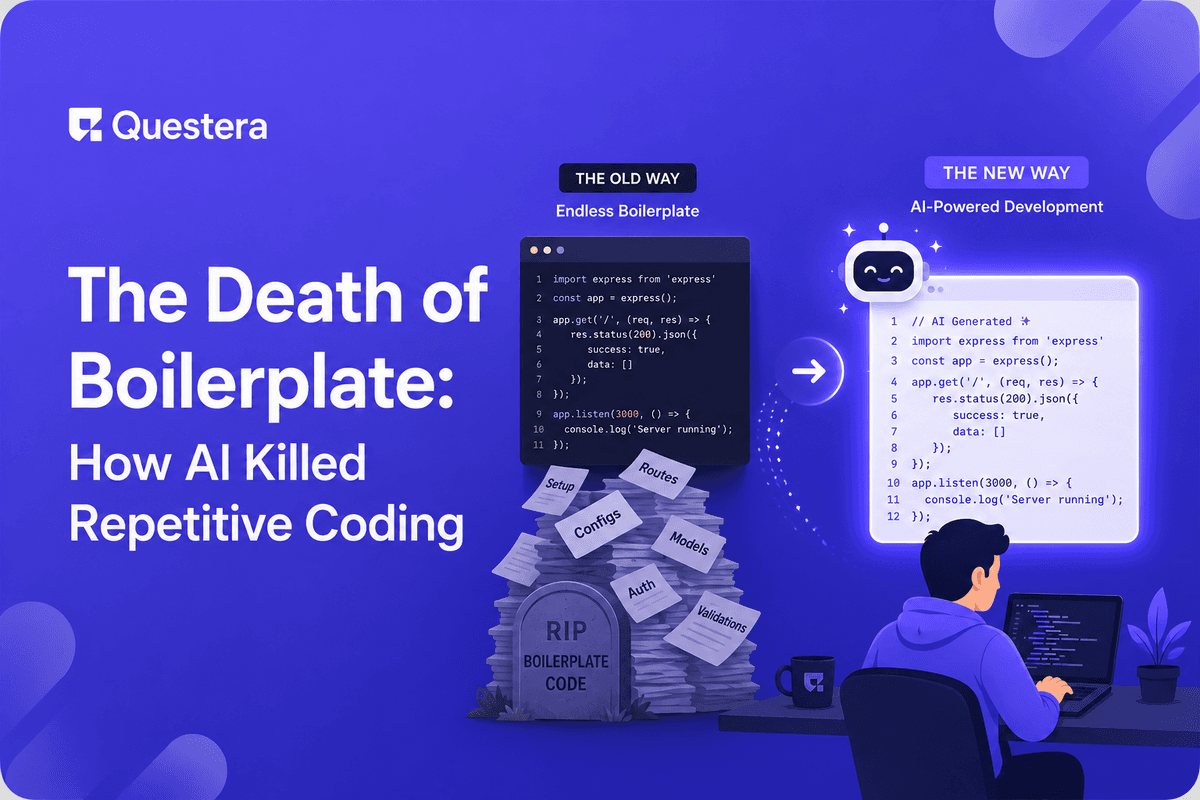
Boilerplate code dominated engineering work for decades. Auth scaffolding, CRUD APIs, form validation, error handling, test setup, API client generation, basic UI components — engineers spent 40–60% of their time writing the same patterns over and over. In 2026, AI generates virtually all of it. This shift freed engineering attention for the work that actually requires judgment: architecture, security, edge cases, performance, customer empathy. The death of boilerplate isn't about engineers losing work — it's about engineers gaining time for higher-leverage work.
In 2026, engineers who still write auth scaffolding by hand look as anachronistic as engineers who wrote their own HTTP libraries in 2015. The boilerplate-writing era ended. Engineering attention concentrated on the work that actually requires judgment. This guide covers what specific patterns died, what replaced them, and what engineers should do differently in 2026.
What 'Boilerplate' Actually Meant
Boilerplate is code that's predictable, repetitive, and necessary but doesn't carry unique business logic. The same patterns appear across thousands of projects with only minor variations.
Examples of Classic Boilerplate
- Auth scaffolding — Login, signup, password reset, email verification flows
- CRUD API endpoints — Create, Read, Update, Delete for each resource
- Form validation — Required fields, email format, password strength, etc.
- Error handling — Try-catch wrappers, error logging, user-facing error messages
- Test setup — Test fixtures, mocks, test database setup, integration test scaffolding
- API client code — TypeScript types from OpenAPI specs, fetch wrappers
- Basic UI components — Buttons, forms, modals, tables with standard patterns
- Configuration files — Webpack config, ESLint config, tsconfig, package.json setup
- Database migrations — Adding columns, indexes, foreign keys
- Deployment scripts — CI/CD pipelines, Docker files, Kubernetes manifests
Why Boilerplate Dominated Engineering Work
- Every new app needed the same foundational pieces
- Frameworks reduced but didn't eliminate boilerplate
- Generators (Rails generators, create-react-app, etc.) helped but still required manual customization
- Snippets and templates helped but required context-specific adjustment
- Engineers built up muscle memory for common patterns
- Significant time spent on patterns that varied only in details
What Killed Boilerplate
AI App Builders Generate Full Applications
- Auth scaffolding generated automatically with chosen provider
- Database schema and migrations generated from feature requirements
- Basic UI components generated to fit design vibe
- CRUD endpoints generated alongside data models
- Form validation included by default
- Error handling and loading states generated when specified
AI IDEs Autocomplete and Generate
- Cursor and similar tools generate boilerplate in context
- Type signatures generated from usage
- Test setup generated from component patterns
- Repetitive patterns extracted into snippets automatically
Component Libraries and BaaS
- shadcn/ui, Radix, Mantine, etc. provide pre-built accessible components
- AI builders integrate these libraries by default
- Custom-built buttons, modals, tables increasingly unnecessary
- Supabase provides auth, database, storage, edge functions without setup
- Engineers integrate; rarely set up from scratch
What Specific Patterns Died
Build this with a prompt on Greta.sh — describe the app, Greta writes and deploys it.Login and Signup Pages
- Hand-coded login forms with email/password validation — dead
- Custom JWT generation and validation — dead (handled by auth providers)
- Manual password reset flows — dead (auth providers handle)
- Email verification setup — dead (handled at provider level)
CRUD API Endpoints
- GET /resources, POST /resources, PUT /resources/:id, DELETE /resources/:id — generated
- Validation middleware — generated alongside endpoints
- Pagination logic — included by default
- Filter and sort parameters — handled by default
Form Components
- Hand-coded form components — dead in most cases
- Field-by-field validation logic — replaced by form libraries (react-hook-form, zod, etc.)
- Error message rendering — included by default
- Multi-step form scaffolding — generated when needed
Data Fetching Patterns
- Custom fetch wrappers — replaced by react-query, swr, or similar
- Loading state boilerplate — generated by AI in context
- Error handling boilerplate — generated by AI in context
- Cache invalidation logic — generated for common patterns
Configuration and Deployment
- Custom webpack configs — Next.js handles for most projects
- ESLint config — generated by AI to fit project conventions
- TypeScript config — generated to match project requirements
- Test runner configuration — generated by frameworks
- Custom CI/CD pipelines — Vercel, Netlify, Railway handle for most projects
- Docker files — generated by AI when needed
What Didn't Die
- Custom business logic — Domain-specific code remains hand-written or AI-augmented with significant human input
- Architecture decisions — Service boundaries, data models, integration patterns remain human
- Security-critical code — RLS policies, auth checks, sensitive data handling needs human review
- Performance-critical paths — Optimization at scale requires engineering judgment
- Edge case handling — AI generates obvious paths; humans handle non-obvious
- Test quality — Tests still need to test the right things; not just generate test scaffolding
- Operational logic — Monitoring strategy, alert rules, incident response remain human
- Integration code — Connecting custom systems still needs engineering judgment
How Engineering Time Redistributed
| Activity | Old % of Engineering Time | New % of Engineering Time |
|---|---|---|
| Boilerplate code | 40–60% | <5% |
| Custom business logic | 20–30% | 30–40% |
| Code review | 5–10% | 15–25% |
| Architecture and design | 5–10% | 10–20% |
| Customer conversations | <5% | 10–15% |
| Testing and QA | 5–15% | 10–15% |
| Operations and on-call | 5–15% | 10–15% |
The redistribution is substantial. Boilerplate dropped from 40–60% of engineering time to under 5%. The freed time went to code review (reviewing AI output), customer conversations (tightened feedback loops), and architecture (more time for design decisions). Engineers spend more time on judgment-heavy work and less on mechanical work.
What Engineers Should Do Differently in 2026
Stop Writing Boilerplate by Hand
- Use AI app builders for greenfield apps
- Use AI IDEs (Cursor) for boilerplate generation in existing codebases
- Use component libraries (shadcn/ui) instead of custom basic components
- Use BaaS (Supabase) for auth/database/storage instead of custom infrastructure
Invest in Code Review Skill
- Most engineering value now in reviewing AI output, not writing initial code
- Spotting subtle correctness, security, performance issues in AI-generated code
- Understanding what 'good' looks like across patterns
- Reviewing at the right level of abstraction
Deepen Architecture Skills
- Architecture is where AI is weakest and humans add most value
- Trade-off analysis between approaches
- System design across services and integrations
- Long-term implications of structural decisions
Develop Domain Expertise
- Industry-specific knowledge (healthcare, fintech, real estate, etc.)
- Compliance frameworks (HIPAA, SOC 2, GDPR, financial regulations)
- Specific business workflows AI doesn't know
- Combine domain expertise + AI fluency for high leverage
Spend More Time with Customers
- Build cycle compression frees time for customer work
- Engineers in direct customer conversations is increasingly common
- Customer empathy informs better code review and architecture decisions
What Kinds of Repetitive Coding Still Exist
Custom Integration Glue
- Connecting two systems with unique APIs requires hand-written code
- AI helps but custom logic is often required
- Less standardized than typical CRUD work
Domain-Specific Business Logic
- Insurance pricing algorithms, tax calculation rules, regulatory compliance logic
- Hand-written or carefully AI-augmented with significant human input
- AI doesn't know your specific business rules
Performance-Critical Code Paths
- High-throughput data pipelines, real-time systems, embedded systems
- Optimization requires engineering judgment
- AI generates correct code; humans optimize
Security-Critical Patterns
- RLS policies, auth enforcement, sensitive data handling
- AI generates plausible patterns; humans verify correctness
- Specific compliance patterns require domain knowledge
How AI App Builders Specifically Eliminated Boilerplate
AI app builders go further than AI IDEs in eliminating boilerplate. Instead of generating boilerplate within an existing codebase, they generate entire applications without any boilerplate-writing stage. Greta, Lovable, Bolt, Rocket.new all generate full stacks from prompts — auth, database, payments, UI components all bundled in initial generation. The engineer never writes the boilerplate; it's generated in context.
What This Means for Boilerplate-Adjacent Careers
Bootcamp Graduates
- Old bootcamps taught boilerplate-heavy curricula (Rails, MERN, etc.)
- Boilerplate skills depreciated significantly
- Modern bootcamps emphasize AI tooling, code review, broader foundations
Body-Shop Offshore Development
- Low-skill offshore work was largely boilerplate generation
- Compressed as AI generates boilerplate directly
- High-skill offshore engineering thrives at same level as onshore
Framework Specialists
- Engineers whose primary value was framework-specific boilerplate knowledge
- Value compressed
- Path forward: broaden foundations, develop judgment skills
Common Mistakes Engineers Make Around the Death of Boilerplate
- Still writing boilerplate by hand — Habit dies hard. Use AI tools; the time savings compound.
- Treating AI-generated boilerplate as same as hand-written — AI output needs review for correctness, security, performance. Don't ship without review.
- Underestimating code review skill — As boilerplate writing dropped, code review rose. Develop this skill explicitly.
- Specializing in framework boilerplate — Rails generators, Next.js patterns specialization less valuable. Broaden.
- Skipping architecture upskill — Architecture is where AI is weakest; where engineering value concentrates.
- Ignoring domain expertise — Domain + AI fluency = high leverage. Pure technical specialization without domain depth less valuable.
- Continuing to teach boilerplate in mentorship — Junior engineers need to learn architecture, code review, customer empathy, not boilerplate.
- Failing to invest in customer empathy — Time freed from boilerplate writing best spent with customers, not on more code.
- Reluctance to use AI tools — The output gap between AI-using and non-AI-using engineers is structural and growing.
Frequently Asked Questions
Will all boilerplate disappear eventually?
Most of it, yes. Some domain-specific glue and integration code will remain because the variation is too high for AI to generate cleanly. But the broad pattern — boilerplate as 40–60% of engineering work — is over.
Does AI generate good code or just code that looks right?
Both. Quality has improved dramatically; AI-generated code is mostly correct and reasonable. But engineering review remains necessary because AI sometimes generates plausible-looking code with subtle issues — security, performance, edge cases.
What about senior engineers who built careers writing boilerplate efficiently?
Career adapts. Their skill in code patterns transfers to reviewing AI-generated code. Speed of writing boilerplate less valuable; speed of reviewing AI output more valuable.
Is there a career path in 'prompt engineering' specifically?
Yes, but as part of broader engineering, not as standalone. Prompt design + code review + architecture + domain expertise = high-leverage engineer. Pure prompt engineering as standalone role less common.
What about boilerplate in less-common languages (Rust, Go, etc.)?
AI handles less common languages now too, though with more variation in quality. The same trend applies; boilerplate-writing time decreased across languages.
Do I still need to learn how to write boilerplate manually?
Useful for understanding what AI is generating. The skill enables effective code review of AI output. But spending career time writing it by hand is no longer productive.
Boilerplate code is dying. Auth scaffolding, CRUD APIs, form validation, test setup, basic UI components, configuration files, deployment scripts — AI generates virtually all of it in 2026. Engineering time redistributed dramatically. Boilerplate dropped from 40–60% to under 5% of engineering time. Code review, customer empathy, and architecture grew correspondingly. Engineers should adapt: stop writing boilerplate by hand; invest in code review skill; deepen architecture skills; develop domain expertise; spend more time with customers. The death of boilerplate isn't a future event — it happened. Make the transition now if you haven't.





© 2026 Questera
Follow in Google