






Common Vibe Coding Scenarios and How to Handle Them

TL;DR
- Common vibe coding scenarios are predictable, not random.
- Most issues come from unclear scope and vague prompts.
- Over-scaffolding creates unnecessary complexity.
- Feature creep is one of the biggest vibe coding problems and solutions challenges.
- Broken context across files often results from vibe coding prompt mistakes.
- Small iteration cycles improve vibe coding workflow optimization.
- Ship first, refactor later — a core vibe coding best practice.
- Premature optimization slows momentum.
- Structured debugging reduces handling vibe coding errors time.
- Clear prompting and scope discipline eliminate most avoidable issues.
Introduction:
Vibe coding sounds simple in theory. You move fast. You scaffold quickly. You let AI assist. You iterate.
But once you’ve shipped a few real products, you realize something: predictable patterns start showing up. The same friction. The same delays. The same mistakes.
These are common vibe coding scenarios.
If you don’t recognize them early, they slow you down. If you do recognize them, they become manageable.
In this guide, we’ll walk through the most frequent vibe coding problems and solutions, backed by practical experience. You’ll learn vibe coding best practices, how to approach handling vibe coding errors, and how to optimize your workflow without sacrificing speed.
Let’s get into it.
What Is a Vibe Coding Scenario?
A vibe coding scenario is a recurring situation that appears during rapid AI-assisted builds. These are not random bugs. They’re predictable structural issues that emerge when speed meets complexity.
Understanding common vibe coding scenarios helps you:
- Avoid unnecessary refactoring
- Maintain momentum
- Improve vibe coding workflow optimization
- Reduce launch delays
This article acts as a vibe coding troubleshooting guide, built from real-world vibe coding examples and repeated execution patterns.
1. The Over-Scaffolded App
The Scenario
You prompt aggressively. The AI generates a full architecture, folders, services, utilities, abstractions you didn’t even ask for. It feels impressive. Until you realize you don’t need half of it. This is one of the most common vibe coding scenarios.
The Problem
Too much structure too early creates unnecessary cognitive load.
The Solution
Delete aggressively. Keep only what supports the MVP. Among effective vibe coding problems and solutions, scope reduction is the most powerful.
Best Practice
Define your MVP boundary before prompting. This is core to vibe coding best practices.
2. Feature Creep During the Build
The Scenario
Midway through building, you think: “What if I add this small feature?” That “small feature” adds three more components and a new API route.
The Problem
Momentum stalls. This ranks high among common vibe coding scenarios.
The Solution
Freeze scope. Document future features in a backlog.
Prevention
Adopt versioned releases. This is central to handling vibe coding errors related to scope mismanagement.
3. Broken Context Across Files
The Scenario
The AI updates one file but breaks another. Logic drifts. Naming becomes inconsistent. These are subtle but frequent common vibe coding scenarios.
The Problem
Context loss. Often caused by vibe coding prompt mistakes, such as vague instructions or missing system summaries.
The Solution
Maintain a system overview file. Modularize prompts. Use structured instructions.
Build this with a prompt on Greta.sh — describe the app, Greta writes and deploys it.Pro Tip
This belongs in every serious vibe coding troubleshooting guide: control context deliberately.
4. The Endless Refactor Loop
The Scenario
You refactor. Then refactor again. Then rewrite entirely.
Perfectionism creeps in.
The Problem
Launch delay. This is one of the most dangerous vibe coding problems and solutions scenarios because it masquerades as improvement.
The Solution
Ship functional. Refactor post-validation. That’s core to modern vibe coding best practices.
5. Authentication Rabbit Hole
The Scenario
You start building auth. Suddenly you’re configuring sessions, cookies, OAuth flows, edge cases. You lose two days. It’s one of the most painful common vibe coding scenarios.
The Solution
Use prebuilt authentication templates. Don’t reinvent security.
Prevention
Add auth scaffolds to your personal template library. This improves vibe coding workflow optimization dramatically.
6. API Integration Breakdown
The Scenario
You integrate a third-party API. The AI generates calls. Something doesn’t match documentation. Errors pile up.
This is textbook for handling vibe coding errors.
The Problem
External dependency mismatch.
The Solution
Isolate the API wrapper. Test independently before integrating fully.
Debugging Tip
Among effective vibe coding debugging tips, isolating external systems is essential.
7. UI Polish Before Validation
The Scenario
You spend hours adjusting spacing and micro-interactions. Before you have users. This ranks among the most avoidable common vibe coding scenarios.
The Problem
Misplaced effort.
The Solution
Ship ugly. Improve later. This is one of the simplest but most overlooked vibe coding best practices.
8. Premature Performance Optimization
The Scenario
You optimize queries. Introduce caching. Refactor for scale.
You have three users.
The Problem
Overengineering. Among vibe coding problems and solutions, premature scaling is a silent killer.
The Solution
Measure first. Optimize only when metrics justify it. This is critical when handling vibe coding errors tied to architecture decisions.
9. Tool Overload
The Scenario
You use three AI tools, two IDE extensions, and switch contexts constantly. Output becomes inconsistent. This is a rising pattern in real-world vibe coding examples.
The Problem
Fragmented workflow.
The Solution
Standardize one primary tool. Build structured processes around it.
This improves vibe coding workflow optimization immediately.
10. Poor Prompt Structuring
The Scenario
You write vague prompts. The AI generates vague code. This is directly linked to vibe coding prompt mistakes.
The Problem
Ambiguity leads to drift.
The Solution
- Define constraints
- Specify file context
- Clarify desired behavior
This is one of the strongest vibe coding best practices.
Patterns Behind Common Vibe Coding Scenarios
When you analyze these common vibe coding scenarios, they share themes:
- Lack of scope boundaries
- Unclear intent
- Overreliance on automation
- No launch deadline
Understanding these patterns improves your ability to apply effective vibe coding problems and solutions consistently.
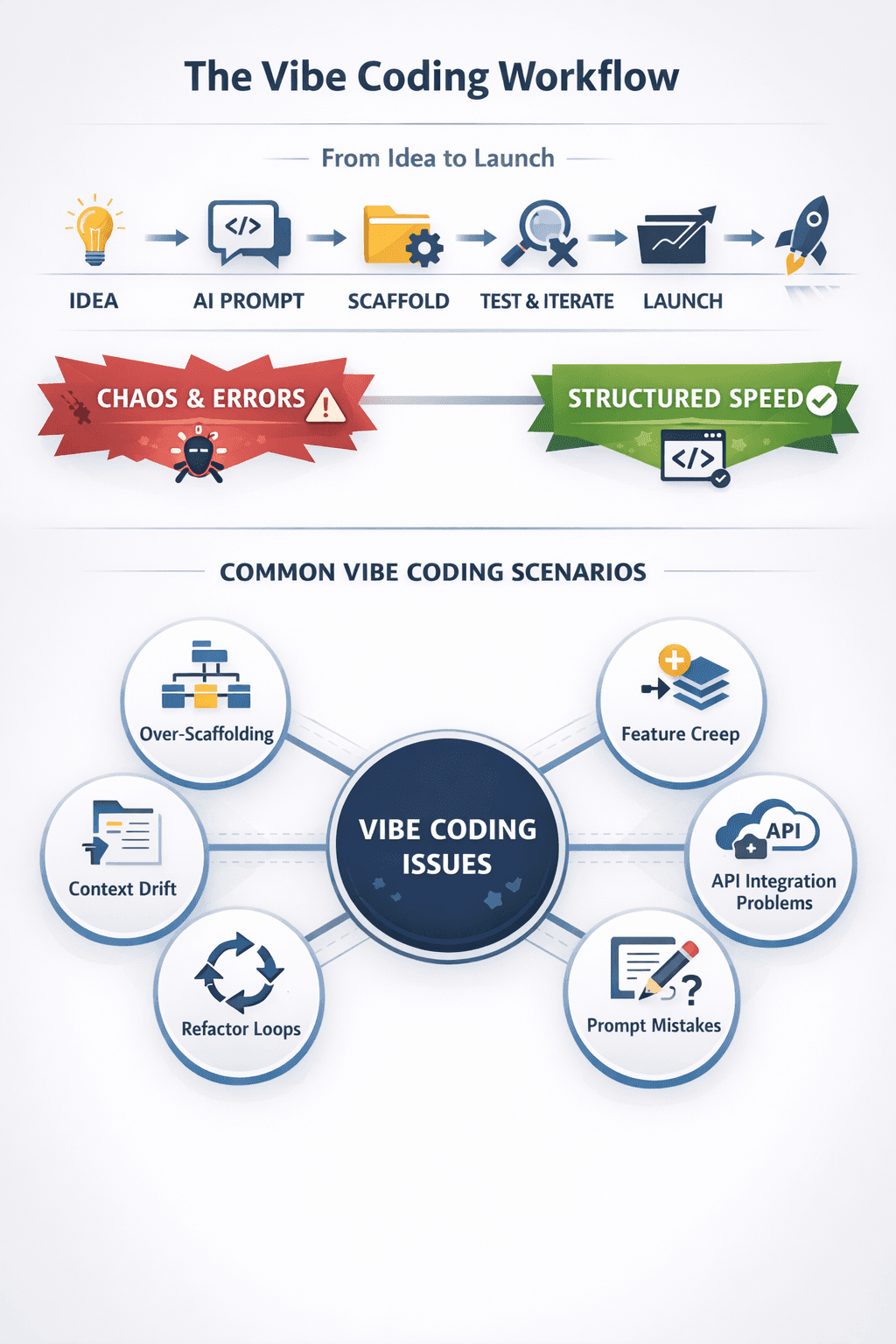
A Practical Framework for Handling Any Vibe Coding Scenario
If you’ve experienced a few common vibe coding scenarios, you’ll notice a pattern: the surface issue looks technical, but the root cause is usually structural. It’s rarely “bad code.” It’s unclear scope, poor sequencing, or rushed prompting.
Instead of reacting randomly every time something breaks, you need a consistent way to approach vibe coding problems and solutions. The goal isn’t to slow down. It’s to stay in control while moving fast.
Here’s a simple, practical way to handle recurring issues in real-world vibe coding examples.
Start With Validation, Not Expansion
A frequent mistake in common vibe coding scenarios is expanding before confirming value. You build a working feature, then immediately think about analytics, edge cases, scaling logic, and performance improvements.
That expansion feels productive, but it often isn’t.
Before adding anything new, ask a direct question: has the core feature been validated by real usage or feedback? If the answer is no, stop building sideways.
Many avoidable vibe coding problems and solutions stem from premature expansion. Validate first. Improve second.
Work in Small, Controlled Iterations
Large changes create large debugging surfaces. One of the most effective vibe coding debugging tips is simple: reduce the size of your changes.
When you update multiple files, introduce new logic, and restructure architecture in one session, handling vibe coding errors becomes chaotic.
Instead:
- Build one endpoint at a time
- Test that endpoint independently
- Confirm expected output before expanding
This improves vibe coding workflow optimization and reduces cascading failures.
Aggressively Limit Scope
Overengineering is one of the most predictable common vibe coding scenarios. AI tools tend to generate more structure than necessary, especially when prompts are vague.
If you don’t define limits, complexity creeps in automatically.
Strong vibe coding best practices include:
- Only abstract when repetition appears twice
- Avoid performance optimization without real load
- Refuse to build for hypothetical users
Bounding scope protects momentum. It keeps your project aligned with the MVP instead of a future version that doesn’t exist yet.
Ready to ship? Open Greta.sh — your idea → a working app, in one chat.Separate Execution From Refactoring
Another recurring issue in vibe coding problems and solutions is the endless refactor loop. You build something functional, then rewrite it for elegance. Then rewrite it again for clarity.
That cycle feels productive, but it delays launch.
Execution and refinement should not happen simultaneously. First, ship working code. After validation or measurable traction, schedule structured refactoring.
This sequencing dramatically improves handling vibe coding errors because you’re not constantly destabilizing your own foundation.
Be Explicit With Prompts
Many common vibe coding scenarios originate from vague instructions. If your prompt lacks constraints, the AI fills in assumptions.
These vibe coding prompt mistakes often create:
- Inconsistent naming
- Misaligned architecture
- Unexpected logic
The fix is clarity:
- Define exact scope
- Specify file context
- State what not to include
Prompt precision is one of the most underrated vibe coding best practices.
Why This Approach Works
Most common vibe coding scenarios are not caused by lack of skill. They’re caused by lack of structure.
When you:
- Validate before expanding
- Iterate in small slices
- Aggressively limit scope
- Separate execution from refinement
- Write precise prompts
You eliminate the majority of predictable friction.
That’s the core of sustainable speed. Not chaotic acceleration, but controlled execution.
Conclusion
Vibe coding isn’t chaotic by nature. It only feels chaotic when there’s no structure behind the speed.
When you apply disciplined scope control, precise prompting, and small iteration cycles, vibe coding becomes extremely powerful. You move fast without losing control. You debug intentionally instead of reactively. You replace random refactoring with deliberate execution.
Modern AI-native tools make this workflow even smoother. When your coding environment maintains context well, supports clean scaffolding, and aligns with structured execution, handling vibe coding errors becomes significantly easier. Many developers are finding that purpose-built AI platform like Greta fit naturally into this process, especially when speed and architectural clarity both matter.
FAQs
1. What are the most common vibe coding scenarios?
Over-scaffolding, feature creep, broken context, and premature optimization.
2. How do I handle vibe coding errors effectively?
Isolate the issue, reduce scope, and apply structured debugging methods.
3. What are core vibe coding best practices?
Define MVP boundaries, prompt clearly, ship early, refactor later.
4. How can I fix vibe coding errors quickly?
Use modular prompts, isolate failing components, and test independently.
5. Why do vibe coding prompt mistakes cause issues?
Ambiguity leads to inconsistent code generation.
6. What improves vibe coding workflow optimization?
Template reuse, tool standardization, and scope constraints.
7. Are vibe coding problems avoidable?
Most are predictable and preventable with structure.
8. What are good vibe coding debugging tips?
Test APIs independently and commit changes incrementally.
9. Should I refactor during MVP phase?
Only if critical. Otherwise, launch first.
10. Is vibe coding sustainable long-term?
Yes, when combined with structured engineering after validation.





© 2026 Questera
Follow in Google