






How to Build a Social Media App in 2026
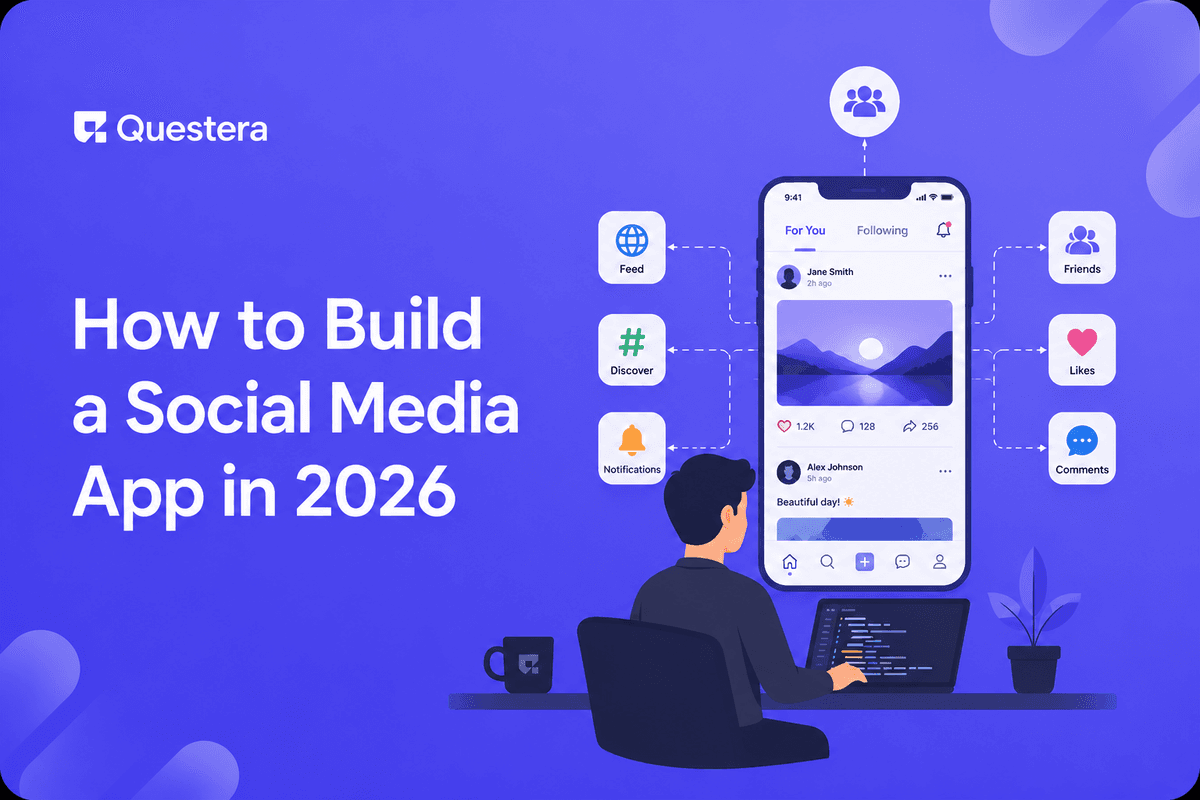
Building a social media app in 2026 is structurally possible — modern AI app builders like Greta can ship a working feed, profile system, post creation, comments, and notifications in 2–3 weeks. The catch: social media is the highest-difficulty SaaS category because the build is the smallest problem. Cold-start network effects, content moderation, abuse handling, and infrastructure costs at scale all combine to kill most attempts. The realistic version is a niche-first community app — not "Twitter for everyone" but "private community for X profession."
Introduction
Building a social media app sounds romantic until you look at the realities. The product itself isn't the hard part — modern AI app builders can ship a working feed, profile system, post creation, comments, and notifications in 2–3 weeks. The hard parts are network effects (your app is worthless without enough users), content moderation (the first abuser will arrive within days), and infrastructure costs at scale.
This guide is the honest playbook for 2026. Not "build the next Twitter" but "build a viable niche social product solo." The 2026 reality is that horizontal social media is dead for indie founders; niche community products are very much alive.
Why Building "The Next Twitter" Doesn't Work for Solo Founders
The math is unforgiving. Horizontal social platforms have three structural challenges that make them nearly impossible for indie founders:
- Network effects are zero-sum at scale — Every new horizontal social app fights established players (X, Threads, Instagram, TikTok) for the same users.
- Moderation costs grow super-linearly — At 10k users you can moderate yourself. At 100k you need tools and processes. At 1M+ you need a real team.
- Infrastructure costs at scale are brutal — Free social apps with millions of users generate enormous bandwidth, storage, and compute bills.
What Does Work: Niche-First Community Apps
The version that's working for indie founders in 2026 is the niche community app — a social product serving one specific audience with one specific kind of content. Think "Reddit for [narrow topic]" or "private Slack alternative for [profession]."
Why niche works where horizontal doesn't:
- Cold start is solvable — Recruiting the first 200–500 users in a defined niche is feasible.
- Moderation is tractable — Self-moderation works at niche scale. Community norms develop organically.
- Pricing is realistic — Niche communities will pay subscription fees ($5–$30/month) for genuinely valuable spaces.
- Infrastructure costs stay reasonable — At 5k–50k active users in a niche, costs are manageable.
- Differentiation is real — A community for woodworkers can offer features Reddit can't.
Which Niches Actually Work in 2026
Niches That Work
- Professional communities — Specific industries (recruiters, founders, healthcare workers, designers) where peer connection has career ROI.
- Hobby communities with concentrated demand — Specific hobbies where existing platforms (Reddit, Facebook Groups) fit poorly.
- Local community apps — Apartment buildings, neighborhoods, small cities. Hyperlocal apps work where horizontal apps lack focus.
- Recovery and support communities — Sobriety, mental health, chronic illness. High emotional engagement; willingness to pay for safe spaces.
- Industry-specific knowledge sharing — Verticals like legal, medical, real estate, where general-purpose Q&A platforms lack depth.
- Curated creator communities — Spaces where creators share work-in-progress with peers, not consumers.
Niches That Rarely Work
- Generic 'better Twitter' or 'better Instagram' — Horizontal competition is brutal.
- Anonymous social apps — Moderation is a nightmare; these tend to attract abuse disproportionately.
- Teen-focused social apps — Compliance burden (COPPA, age verification) plus rapid user-base shifts.
- Crypto-native social — Has been promised since 2017; no enduring product-market fit.
- Local restaurants/businesses social — Yelp, Google, and Instagram dominate.
- Pure dating apps — Requires extensive moderation and identity verification beyond what an indie founder can sustain.
What Features Your Social App v1 Actually Needs
- User accounts with profiles — Photo, bio, links, settings
- Content creation — Posts (text + optional images), comments
- Feed — Either chronological or simple category-based; no recommendation algorithm in v1
- Follow/connection graph — Users can follow each other or join sub-groups
- Notifications — In-app and optional email for important events
- Search and discovery — Find users and topics; browse new content
- Moderation tools — Report content, block users, admin dashboard
- Direct messaging — Optional but common; can be deferred to v2
- Mobile responsiveness — Most social use is mobile; treat as table stakes
What to Skip in v1
- Recommendation algorithms — Chronological or category-based feeds work for v1.
- Live streaming — Massive infrastructure cost and content complexity.
- Stories or ephemeral content — Adds complexity without clear v1 value.
- Video uploads — Video hosting and CDN costs are punishing. Allow images in v1; defer video.
- Group voice or video chat — Specialized infrastructure costs add up fast.
- Complex privacy controls (per-post audience targeting).
- Polls, events, marketplaces — Each is its own feature category.
- Ads infrastructure — Indie social apps should be subscription-funded, not ad-funded.
Which AI Platform to Use
| Platform | Best For | Why It Works for Social |
|---|---|---|
| Greta | Niche social with content/marketing layer | Bundled growth tooling, multi-backend, predictable pricing |
| Lovable | Design-led consumer-feeling social | Strong UI polish, Visual Edits mode |
| Bolt.new | React-first with Figma-driven design | WebContainers speed, Figma import |
| Replit | Custom backends or unusual infrastructure | Real Linux env for niche tech requirements |
The Realistic Build Timeline
- Days 1–2: Spec and niche selection. Lock the specific community and the specific content format.
- Days 3–5: Scaffold, data model (User, Post, Comment, Follow, Notification, Group), auth.
- Days 6–9: Core content flow — post creation, feed, profile, follow graph.
- Days 10–13: Comments, notifications, search and discovery.
- Day 14: Moderation tools — report content, admin dashboard, basic safety.
- Days 15–18: Real-time updates for feed and notifications. Mobile responsiveness polish.
- Days 19–20: Direct messaging (if scoping includes it). Transactional emails.
- Day 21: Pre-launch audit, Stripe Subscriptions integration if charging, soft launch to first 50 users.
The Moderation Reality
Most social media app failures aren't about the build. They're about moderation. Build the tools from day one and assume you'll need them in week one.
What Moderation Tools to Ship in v1
- Report content — Any user can flag a post or comment with a reason
- Block users — Hide a specific user's content and prevent contact
- Admin dashboard — See reports, suspend users, delete content
- Audit log — Track moderation actions for accountability
- Auto-moderation rules — Block content matching specific keyword lists
- Content review queue — New users' first 3 posts go to review queue before public visibility
Moderation Principles That Scale
- Set clear community guidelines on day one. Without them, every moderation call is contested.
- Be willing to ban early adopters who violate norms. Setting the tone early matters.
- Use AI moderation tools (Perspective API, OpenAI Moderation) as a first-pass filter but always allow human review.
- Don't let your inbox become the moderation queue. Build proper in-app reporting from day one.
- Budget for moderation time — even niche communities require 5–10 hours/week initially.
- Document your decisions. Public moderation logs build trust; arbitrary moderation kills communities.
Monetization for Indie Social Apps
Indie social apps that try to be free almost always fail. Subscription monetization is the path that works in 2026.
- Freemium with limits — Free tier with limited posts, follows, or storage. Pro tier ($5–$15/month) removes limits.
- Premium-only — Charge from day one, no free tier. Smaller user base but higher engagement and zero spam.
- Per-community pricing — Each subscribed community pays a host fee; users contribute optionally.
- Membership tier — Higher-priced 'inner circle' for engaged community members ($30–$100+/month).
Skip ad-based monetization for indie social apps. The CPMs are too low to support meaningful revenue at indie scale, and ads degrade the experience that makes niche communities valuable.
Infrastructure Cost Reality
- Database costs grow with users and content volume. Use efficient indexes; archive old content from hot storage.
- Image hosting and CDN costs scale linearly with users. Use compressed formats (WebP, AVIF); set reasonable upload size limits.
- Real-time infrastructure (Supabase Realtime, Pusher) charges per concurrent connection.
- Email costs scale with notification volume. Consolidate notifications; allow users to choose digest formats.
- Rough math: at 10k monthly active users, infrastructure typically runs $200–$800/month. At 100k MAU, $2k–$8k/month.
Common Mistakes to Avoid
- Building for everyone — Horizontal social is dead for indie founders. Pick a narrow niche and own it.
- Skipping moderation tools in v1 — Bad actors arrive within days. Build moderation from day one.
- Underestimating cold-start difficulty — Recruit the first 200 users manually before opening to broader signups.
- Trying to be free — Free social apps for indie founders almost always fail on unit economics.
- Building recommendation algorithms early — Chronological feeds work for niche communities.
- Ignoring mobile from day one — Most social use is mobile. A browser-only v1 fails.
- Hosting video uploads in v1 — Bandwidth costs are punishing. Allow images only; defer video.
- Not setting community guidelines on day one — Without explicit norms, moderation becomes arbitrary.
Frequently Asked Questions
Can a solo founder really build a social media app in 2026?
Yes, for niche community-focused social apps. The build takes 14–21 days using modern AI app builders. The hard part is not the build; it's cold-start, moderation, and unit economics.
Which niches are actually viable for indie social apps?
Professional communities, niche hobbies with concentrated demand, local apps, recovery and support communities, industry-specific knowledge sharing, and curated creator communities. Generic "better Twitter" or "better Instagram" niches are nearly impossible for indie founders.
How do I solve the cold-start problem?
Recruit the first 200–500 users manually before opening to general signups. Curate hard early. Don't open to general signups until you have enough content density that new users find something worth engaging with.
What about ads as a monetization model?
Skip ads for indie social. CPMs at indie scale are too low to support meaningful revenue. Subscription tiers ($5–$15/month) work much better and protect the experience.
How do I handle moderation as a solo founder?
Build tools from day one (reporting, blocking, admin dashboard, audit log). Use AI moderation as a first-pass filter. Set explicit community guidelines. Budget 5–10 hours/week of moderation time initially.
Will my AI-built social app scale?
For 1k–50k active users, yes. Beyond that, you'll need engineering review to scale database queries, add caching, and optimize hot paths. Both Greta and Replit export real code that engineers can extend rather than rebuild.
How is this different from building any other SaaS?
Social apps have specific challenges that other SaaS don't — network effects, moderation complexity, and infrastructure scaling. For comparison with standard SaaS builds, see our guide to building a SaaS MVP without code.
Key Takeaways
- Building a social media app in 2026 is structurally possible for indie founders — but only for niche community-focused apps, not horizontal 'next Twitter' plays.
- The build is the smallest part of the problem. Cold-start network effects, content moderation, and infrastructure costs are where most attempts fail.
- The right v1 scope is focused: profiles, content creation, feed, follow graph, notifications, search, moderation tools, mobile responsiveness.
- Subscription monetization is the only model that consistently works for indie social. Free + ad-supported is a graveyard for solo founders.





© 2026 Questera
Follow in Google