






How to Use Vibe Coding to Build Custom SEO Tools
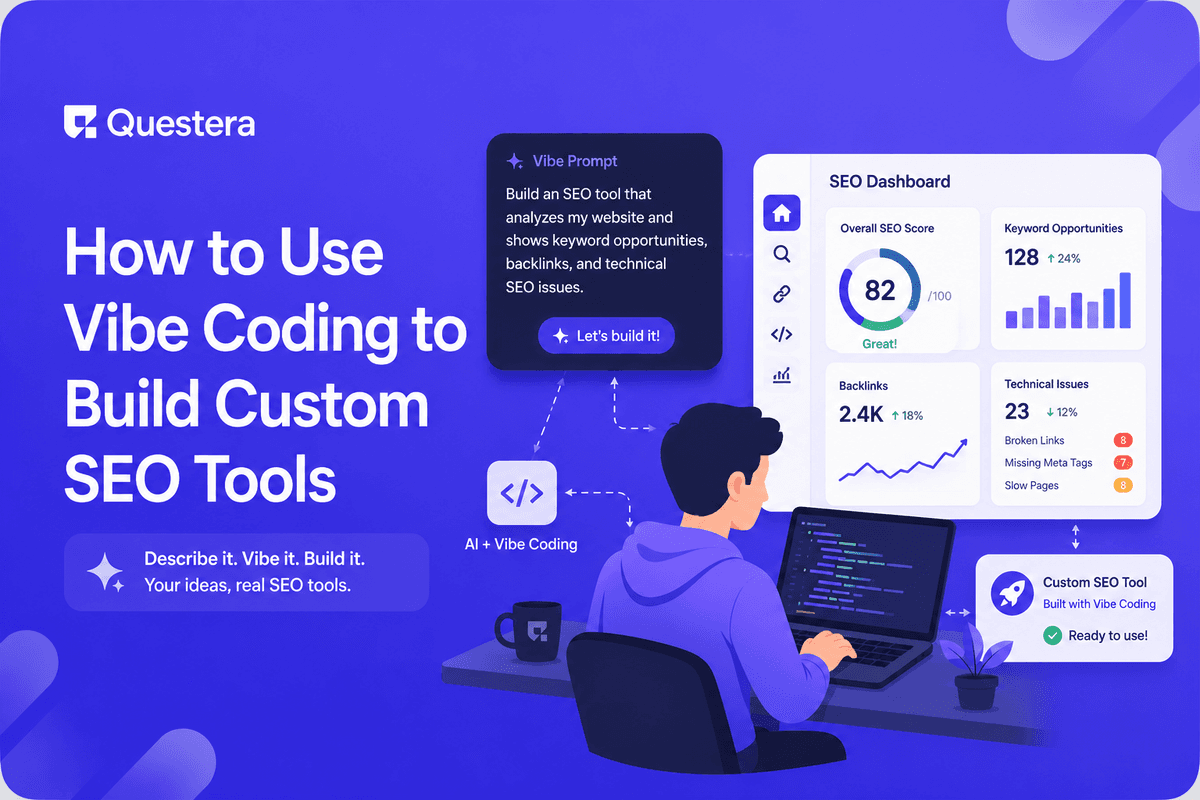
SEO tools (Ahrefs, SEMrush, Moz) charge $99–$999/month for features most SaaS founders use 10% of. With vibe coding in 2026, you can build your own custom SEO toolkit in 1–3 days — keyword rank tracker, SERP feature scraper, backlink monitor, content gap analyzer, internal link auditor. You own the tool, customize it to your workflow, and pay $5–$30/month in API costs instead of $200+. This guide covers what to build, the data sources (Google Search Console, SerpAPI, OpenPageRank, free web scraping), the prompt approach, and which tools are worth building vs buying.
SEO tools dominate marketing budgets at most SaaS companies. Ahrefs at $99–$999/month, SEMrush at $139–$499/month, Moz at $99–$599/month. Together they often add up to $500–$2,000/month of tooling for marketing teams that use maybe 10% of any single platform's features. Vibe coding changed the math. In 2026, you can build a custom SEO toolkit in 1–3 days using AI app builders — each tool tailored to your specific workflow, data sources you actually use, and reports formatted the way you want them.
Why Custom SEO Tools Make Sense in 2026
- Commercial tools charge for breadth you don't use — You pay for 100 features; you use 10
- Your workflow is specific — Generic dashboards don't match how you actually work
- Data export is often restricted — Many tools limit export or charge for API access
- Free data sources cover most needs — Google Search Console, SerpAPI, OpenPageRank, web scraping
- AI app builders make the build trivial — 1–3 days vs months of custom development
- Operational costs are minimal — API fees + hosting under $30/month for most setups
- You own the data and the tool — No platform risk, no vendor lock-in
What to Build (and What to Keep Buying)
Worth Building Yourself
- Keyword rank tracker for your specific keyword list
- SERP feature monitor (featured snippets, AI overviews, People Also Ask)
- Backlink monitor (new/lost links, anchor text changes)
- Content gap analyzer comparing you vs 2–3 competitors
- Internal link auditor for your own site
- Striking-distance keyword finder (page 2 → page 1 opportunities)
- Branded mention monitor (mentions without links)
- Competitor content publishing tracker
Keep Paying For
- Full backlink databases (Ahrefs, SEMrush have crawl infrastructure you can't replicate)
- Domain authority estimates at scale (commercial DA/DR scores)
- Historical SERP data (years of historical rankings)
- Full-site technical SEO audits at scale (Screaming Frog still wins)
- Brand monitoring at scale across the entire web
- Enterprise-grade rank tracking for thousands of keywords across many locations
The Data Sources You'll Actually Use
Google Search Console (Free)
- Your own site's queries, clicks, impressions, CTR, position
- Export via API or CSV (16-month rolling window)
- The single most valuable free SEO data source
- Striking-distance keyword analysis built from GSC exports
SerpAPI or ScrapingBee (Paid but Cheap)
- SERP scraping for any keyword in any location
- SerpAPI: ~$50/month for 5,000 searches; $250/month for 30,000
- ScrapingBee: cheaper but less SEO-specific
- Use for rank tracking, SERP feature monitoring, competitor analysis
Other Sources
- OpenPageRank (free tier) — Page rank approximation for any domain; 1,000 requests/day free
- Common Crawl (free) — Open web crawl data for backlink discovery and content analysis
- Direct web scraping (free) — Competitor sitemaps, robots.txt, schema markup detection
- AI for content analysis — OpenAI, Claude, Gemini APIs at $5–$20/month for typical SEO workflows
Tool 1: Keyword Rank Tracker
What It Does
- Tracks rankings for your keyword list across locations
- Daily or weekly checks
- Visualizes ranking changes over time
- Alerts on significant movements (up or down)
- Distinguishes between desktop and mobile rankings
Build Prompt for AI App Builder
Example prompt structure: 'Build a SaaS rank tracker app. User adds keywords with target location (city, country) and device (desktop/mobile). Daily cron job queries SerpAPI for each keyword and stores the ranking. Dashboard shows current rank, 7-day change, 30-day change. Line chart of ranking history per keyword. Email alert if any keyword drops 5+ positions. Stack: Next.js + Supabase + SerpAPI integration + Vercel cron jobs.'
Cost Structure
- 100 keywords daily = 3,000 SerpAPI requests/month = ~$30 SerpAPI plan
- Supabase free tier handles most teams
- Vercel hobby plan free for non-commercial
- Total: $30/month vs commercial rank tracker at $100–$300/month
Tool 2: SERP Feature Monitor
What It Does
- For each tracked keyword, captures which SERP features appear
- AI Overviews, Featured Snippets, People Also Ask, Image Pack, Video Pack, Knowledge Panel, Local Pack
- Whether you appear in those features or not
- Changes over time (AI Overview added/removed, etc.)
Why this matters in 2026: AI Overviews now appear on ~30% of informational queries. Featured Snippets continue to drive significant CTR. Monitoring SERP features is more valuable than monitoring blue-link rankings alone. Commercial tools charge premium tiers for this; custom builds make it accessible.
Tool 3: Backlink Monitor
What It Does
- Monitors your backlink profile for new and lost links
- Anchor text distribution
- Source domain quality (using OpenPageRank or domain age)
- Alerts for new high-value links
- Alerts for lost important links
Trade-Off Honesty
Commercial backlink tools (Ahrefs, Majestic) have crawl infrastructure scanning billions of pages continuously. Your custom tool won't match their coverage. The trade-off: your tool monitors your known backlink profile cheaply; you supplement with periodic Ahrefs reports for discovery. Many indie founders accept this trade-off — comprehensive monitoring of known links + periodic deep audits = 80% of value at 20% of cost.
Want to try one of these? Start on Greta.sh — no setup, no boilerplate — just a prompt.Tool 4: Content Gap Analyzer
What It Does
- Compares your content against 2–3 competitors
- Identifies topics they cover that you don't
- Identifies keywords they rank for that you don't
- Suggests content priorities based on competitor overlap
Build Approach
- Scrape competitor sitemaps for URL inventory
- Fetch each URL; extract title, H1, meta description, body content
- Use AI (Claude/OpenAI API) to classify content by topic and intent
- Compare your sitemap-derived inventory to competitor inventories
- Output: topics competitors cover that you don't, with priority scoring
Tool 5: Striking-Distance Keyword Finder
What It Does
- Identifies keywords currently ranking page 2 (positions 11–20)
- Prioritizes by impressions × proximity to page 1
- Highlights quick wins for content optimization
- Tracks movements over time
Data source: Google Search Console (your own data). Export the past 90 days; filter to positions 11–20 with more than 100 impressions. Score by impressions × (21 minus current position). Free entirely — uses your own GSC data.
Tool 6: Internal Link Auditor
- Crawls your own site
- Maps internal link graph
- Identifies orphan pages (no internal links pointing to them)
- Identifies under-linked high-value pages
- Suggests internal linking opportunities based on content topic overlap
The General Build Pattern
| Day | Task |
|---|---|
| Day 1 | Pick the tool. Wire up data source (GSC, SerpAPI, sitemap scraping). |
| Day 2 | Build dashboard. AI app builder generates UI from prompt. Iterate on layout. |
| Day 3 | Add scheduling (cron jobs for daily/weekly checks). Test alerts and reports. |
Total time per tool: 1–3 days depending on complexity. Total time for full toolkit (6 tools): 1–3 weeks.
Operational Considerations
- API rate limits — Most SEO data APIs have rate limits; respect them
- Error handling — APIs fail; build retry logic and graceful degradation
- Data storage costs — Daily snapshots of 100+ keywords adds up over months; archive old data
- Alerting fatigue — Configure alerts conservatively; only notify on significant changes
- Maintenance — APIs change; tools need occasional updates
- Backup data sources — Have fallback if primary API fails (e.g., scraping as backup to SerpAPI)
When to Keep Paying for Commercial Tools
- You manage 10+ client sites — Agency workflows benefit from commercial tool depth
- You need comprehensive backlink discovery — Ahrefs/SEMrush coverage is real
- You need historical SERP data — Years of historical rankings
- You need enterprise-grade reporting for stakeholders — White-label reports, branded dashboards
- You don't have AI app builder fluency — Building takes time you may not have
- You're in a regulated industry needing audit trails — Commercial tools provide compliance documentation
Hybrid Stack
The realistic answer for most teams: Custom build for rank tracker, SERP monitor, striking-distance finder, internal link auditor (daily/weekly workflows). Plus one commercial tool subscription — Ahrefs OR SEMrush at the lowest tier — for backlink discovery and deep audits. Total cost: $30/month custom + $99/month commercial = $129 vs $300+ for multiple commercial tools. Coverage: 90% of typical SaaS founder SEO workflow needs.
Common Mistakes Building Custom SEO Tools
- Trying to replicate Ahrefs entirely — Don't. Their backlink crawl is multi-million-dollar infrastructure. Build the tools you actually use; supplement with commercial for discovery.
- Skipping rate limit handling — APIs will throttle you. Build exponential backoff and graceful degradation from day one.
- Over-engineering the dashboard — A simple table is often more useful than fancy charts. Start ugly; refine if needed.
- Not archiving historical data — Daily snapshots add up. Archive monthly snapshots; delete daily after 90 days.
- Hard-coding API keys — Use environment variables. Don't commit secrets to GitHub.
- Ignoring email/Slack alerts — The tool's value compounds when it tells you things you'd miss. Build the alert layer.
- Treating it as one-time — Tools need occasional updates as APIs evolve. Budget 1 hour/month maintenance per tool.
- Building for everyone — These tools serve YOU. Don't generalize them for a broader audience unless you're selling them as a product.
- Skipping Google Search Console — Your own GSC data is the most valuable free SEO data. Wire it up first.
- Comparing to commercial tools feature-by-feature — Your custom tool wins on workflow fit, not feature count.
Frequently Asked Questions
How long does it really take to build a custom SEO tool?
1–3 days per tool with vibe coding. Keyword tracker: 1 day. Content gap analyzer: 2–3 days (more complex data processing). Internal link auditor: 2 days. Total toolkit (5–6 tools): 1–3 weeks of part-time work.
What about data accuracy vs commercial tools?
Commercial tools have more comprehensive crawl infrastructure for backlinks. For your own site's data (GSC), accuracy is identical. For SERP data (SerpAPI), accuracy matches commercial tools that use similar data sources. Trade-off is coverage breadth (commercial wins) vs workflow fit (custom wins).
Will SerpAPI ToS allow this?
SerpAPI's terms allow building custom SEO tools for internal use. Read the current terms; some restrictions apply to redistribution of data. For personal/team use, this is well within acceptable use.
Can I sell these tools as a SaaS product?
Yes — the tools you build can become the foundation of a SaaS product. Many SEO SaaS products started as internal tools founders built for themselves. Validate with users before productizing.
What if AI app builders make mistakes in the generated code?
Review the generated code, especially around API integration, rate limiting, error handling. Use Cursor or similar to refine. The 'harden phase' applies — don't ship raw AI output to production.
Custom SEO tools are 1–3 days to build per tool with vibe coding in 2026. Operational costs $5–$30/month vs $200+/month for commercial alternatives. Worth building: rank tracker, SERP feature monitor, backlink monitor, content gap analyzer, striking-distance keyword finder, internal link auditor. Keep buying: full backlink databases, historical SERP data, enterprise reporting. The hybrid stack wins on cost and workflow fit. Vibe coding makes it accessible to anyone with basic SaaS-building patience.





© 2026 Questera
Follow in Google