






How to Build an AI Fitness Coaching App From One Prompt
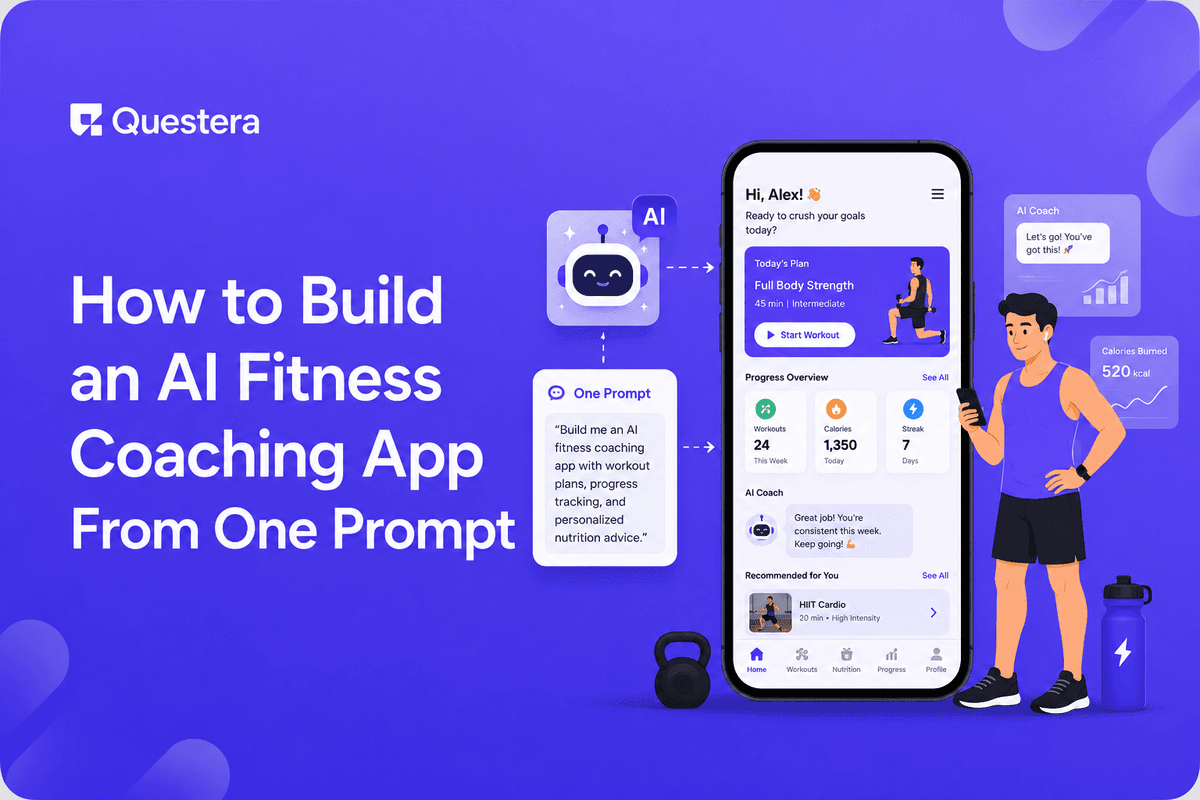
An AI fitness coaching app is buildable in 5–8 days with AI app builders. Core scope: user profile and goals, AI-generated personalized workout plans, progress tracking, exercise library with form notes, nutrition logging with AI macro calculation, weekly check-ins. The hard parts: keeping AI coaching genuinely safe (not giving medical advice; not pushing users beyond capability), managing AI costs that scale per user, distribution in a saturated fitness app market. This guide covers the build, the AI prompts that produce safe coaching, the architecture, and the niche selection that separates real businesses from another generic fitness app.
Fitness apps are a saturated market. Strong, Hevy, MacroFactor, FitBod, Strava, Nike Training, Apple Fitness+, hundreds of niche apps. Yet AI changed the dynamics. Personalized coaching that was previously only available from human trainers is now possible at software prices — workout plans tailored to individual goals, nutrition coaching that adjusts macros based on real progress, form feedback from uploaded videos, adaptive programs. These capabilities make new fitness apps viable in 2026 if positioned and built right.
Important: this isn't medical advice. AI fitness apps operate near regulated territory. Medical advice, specific treatment recommendations, claims about disease prevention or treatment require specific licensing in most jurisdictions. Fitness coaching that adjusts based on user goals and self-reported capabilities is generally fine; specific medical claims are not. Consult counsel before launching.
Why Niche Matters More Than Ever in Fitness Apps
- Horizontal fitness apps (Strong, Hevy, FitBod) dominate the basic categories
- Differentiation on workout logging or video library is impossible
- Niche audiences have specific needs horizontal apps serve poorly
- Niche communities are easier to reach than horizontal markets
- Pricing power is higher in niche
- Retention is higher when the app fits the niche specifically
Niche Opportunities for AI Fitness Apps
- Pre/postnatal fitness coaching (specific safety considerations)
- Strength training for women over 40 (specific physiological considerations)
- Coaching for endurance athletes (running, cycling, triathlon-specific)
- Functional fitness for desk workers (mobility, posture, low impact)
- Rehab and return-to-exercise coaching (post-injury structured progression)
- Strength training for older adults (60+ specific protocols)
- Sport-specific training (golf fitness, tennis fitness, basketball fitness)
- Calisthenics and bodyweight progression
- Home gym strength coaching (limited equipment optimization)
- Adaptive fitness for disability (specific accommodations)
- Weight loss coaching combined with nutrition (specific protocols)
- Hybrid training (strength + cardio with periodization)
Core V1 Scope
- User profile (age, goals, current fitness level, equipment access, schedule)
- AI-generated personalized workout plans based on profile and progression
- Workout logging (sets, reps, weights, RPE, notes)
- Progress tracking (strength curves, body measurements, photos)
- Exercise library with form notes and video demonstrations
- Nutrition logging with AI-calculated macro targets
- Weekly check-ins (assess progress, adjust program)
- AI chat for questions and form-checking via uploaded video (basic)
- Subscription billing
What to Skip in V1
- Advanced biometric integration (Apple Health/Garmin via API in v1.1)
- Live form feedback via video (defer to v2; complex)
- Social features and community (defer to v1.1)
- Native iOS/Android apps (PWA suffices for v1)
- Recipe database (link to existing apps like Cronometer for nutrition data)
- Multi-language support beyond English
The Data Model
- User (id, email, profile_data, subscription_status)
- Profile (user_id, age, weight, height, goals, fitness_level, equipment, schedule_preference, injuries)
- Program (user_id, name, start_date, current_week, generated_at, generated_by_prompt)
- Workout (id, program_id, week, day, exercises_json, completed_at)
- Exercise (id, name, demo_video, form_notes, muscle_groups, equipment_required)
- WorkoutLog (id, workout_id, user_id, sets_completed, total_volume, rpe, notes, date)
- NutritionLog (id, user_id, date, calories, protein, carbs, fats, notes)
- CheckIn (id, user_id, week, weight, measurements, mood, energy, progress_notes, ai_response)
The AI Coaching Architecture
Build this with a prompt on Greta.sh — describe the app, Greta writes and deploys it.Program Generation Prompt
- Input: full user profile (goals, level, equipment, schedule, injuries)
- Output: 4-week program with weekly progression
- Use Claude or GPT with structured output format
- Include safety guardrails in system prompt (don't recommend max effort if user is beginner; account for injuries)
- Generate JSON structure of exercises with sets, reps, RPE targets
- Caching: store the generated program; don't regenerate per request
Adaptive Adjustment Prompt
- Input: completed workouts, RPE history, progress data, week-end check-in
- Output: adjustments for next week (load progression, volume changes, exercise swaps)
- Run weekly via cron job
- Conservative defaults: progress slowly, especially for beginners
- Save reasoning so user understands changes
Q&A Coach Prompt
- Input: user question + context (current program, recent workouts, profile)
- Output: helpful answer staying within fitness coaching scope
- System prompt explicitly bounds: 'You are a fitness coach. You do not give medical advice. For any medical concerns, advise consultation with healthcare professional.'
- Reject queries clearly outside scope (medical conditions, mental health beyond motivation, specific medications)
Form Feedback Prompt (Basic V1)
- Input: user-uploaded short video + exercise name
- Output: form observations and suggestions
- Use multimodal models (Claude with vision, GPT-4 vision)
- Frame as 'observations' not 'medical assessment'
- Save feedback to user's history
Safety Guardrails in AI Coaching
- Conservative progression — slow progression beats injury
- Explicit injury awareness in profile and program generation
- Refuse to recommend 'one-rep max' attempts for beginners
- Recommend consultation with healthcare professional for any medical questions
- Don't claim disease prevention or treatment
- Don't give specific medical advice
- Don't override user's stated capabilities (if user says they can't squat, don't program squats)
- Provide form notes that emphasize safety
- Include warm-up and cool-down in every program
- Allow easy program modifications by user (autonomy matters)
The 5-8 Day Build Sequence
- Day 1: Scaffolding, profile setup — PRD, data model, auth setup (Supabase), profile onboarding, mobile-first PWA design
- Day 2: AI program generation — generation prompt with safety guardrails, JSON parsing, program display UI
- Day 3: Workout logging — today's workout view, set/rep/weight/RPE logging, completion flow, rest timer
- Day 4: Exercise library and demos — exercise database with form notes, video demonstrations (Vimeo, Mux, YouTube), equipment alternatives
- Day 5: Progress tracking — strength curve display, volume tracking, body measurements, photo progress, weekly summary
- Day 6: Nutrition (optional v1) — AI-calculated macro targets, daily logging, trend tracking, adjustments
- Day 7: Check-ins and adaptive coaching — weekly check-in flow, AI program adjustments, Q&A chat interface
- Day 8: Billing, polish, launch — Stripe subscription, free trial (7-14 days), PWA install prompts, soft launch with 10 niche users
Pricing Patterns for AI Fitness Apps
| Tier | Monthly Price | What's Included |
|---|---|---|
| Basic | $9-$19 | Generic workout plans, basic logging |
| Pro | $19-$39 | AI-personalized plans, adaptive coaching, AI chat |
| Premium | $39-$79 | Above + form feedback via video, nutrition coaching, weekly check-ins |
| Annual discount | 30-40% off | Standard discount for annual commitment |
AI Cost Considerations
- Program generation: ~$0.10 per generation (use weekly, cache aggressively)
- Adaptive adjustments: ~$0.10 per week per user
- Q&A coaching: cost varies; limit per-user message rate
- Form feedback via video: $0.05-$0.20 per video (vision models)
- Total AI cost per active user: $0.50-$3/month at low volume; manageable
- Track cost per active user weekly; adjust pricing if costs exceed 25% of revenue
Retention Strategies for Fitness Apps
- Quick wins in first week — User completes 3 workouts; sees progress
- Personalization signals — App genuinely knows the user and adapts
- Habit formation cues — Reminders at user's preferred workout time
- Streak mechanics (used carefully — broken streaks shouldn't shame)
- Progress visualization — Strength curves, body measurements, photos
- Community (optional) — Niche-specific communities for accountability
- Coach check-ins — Weekly automated check-ins feel like accountability
- Re-engagement — Email/notification when user disengages
Distribution and Customer Acquisition
- Niche community engagement (pregnancy fitness communities, 40+ women's strength communities, etc.)
- Content marketing in your niche (blog, YouTube, social media)
- Influencer partnerships within niche
- Free trial with low-friction onboarding
- Referral programs (existing users refer others)
- Paid social experiments (Instagram, TikTok for fitness)
- Niche podcast appearances and guest posts
Common Mistakes
- Building horizontal — Strong, Hevy, FitBod own this. Pick niche.
- Pretending AI replaces certified trainers — AI augments; doesn't replace.
- Skipping safety guardrails — One injury claim can destroy a small fitness app brand.
- Aggressive AI coaching that pushes users too hard — Conservative defaults; build trust.
- No clear progression model — Programs that don't progress feel pointless.
- Ignoring retention from week 1 — Fitness apps have high early churn. First week experience matters most.
- Underpricing — AI coaching is genuinely premium feature. Price accordingly.
- Vague positioning — 'AI fitness app' positions nothing. Specific niche positioning.
- Skipping the harden phase — Production fitness apps need monitoring, error handling, privacy considerations.
- Inadequate exercise library — AI-generated programs need real exercises with real demonstrations.
- Overpromising what AI can do — Be honest about what AI coaching can and can't do. Builds trust.
Frequently Asked Questions
Can AI really coach as well as human trainers?
For general fitness (strength training, conditioning, basic programming), well-prompted AI coaches produce excellent programs. For specialized situations (injury recovery, medical conditions, elite athletic performance, complex periodization), human trainers add judgment AI can't replicate. Position your app for general fitness; refer specialized cases out.
What about liability for fitness advice?
Standard waivers (which users sign on signup) plus reasonable safety guardrails reduce liability significantly. Consult counsel for your specific situation. Avoid medical claims; recommend healthcare consultation for medical questions; encourage user agency over their own training decisions.
Do I need an exercise video library?
Yes, even basic. Users need to see proper form. Options: license existing library, produce your own, curate from YouTube with permission. Don't skimp here.
What's the realistic time to first paying customer?
5-8 days build + 2-8 weeks to find first paying customer if you have network in your niche. Without niche network, 2-4 months of customer development. Build is the easy part; finding customers in niche is the work.
Should I launch on iOS App Store?
Defer initially. PWA reaches users without App Store distribution friction. Once you have product-market fit and revenue, native app considerations make more sense. Apple's 30% take is significant; PWA preserves margin.
AI fitness coaching app is buildable in 5-8 days for core technical build. Niche fit is essentially mandatory — pick a niche where horizontal apps serve poorly. Safety guardrails matter: conservative progression, explicit injury awareness, refusal to give medical advice. AI coaching cost per user is manageable ($0.50-$3/month at low volume). Retention is the harder problem. Don't compete with horizontal apps on features; compete on niche fit and personalized AI coaching that actually helps your specific audience.





© 2026 Questera
Follow in Google