






Agentic Coding Explained: When Your App Builder Plans, Codes & Tests Itself
Through 2023 and 2024, AI app builders mostly did one-shot generation. You prompted; the model produced code; you reviewed and iterated. The model was a powerful autocomplete with broader context — useful, but fundamentally reactive. The human did the planning, broke down tasks, judged when code was done.
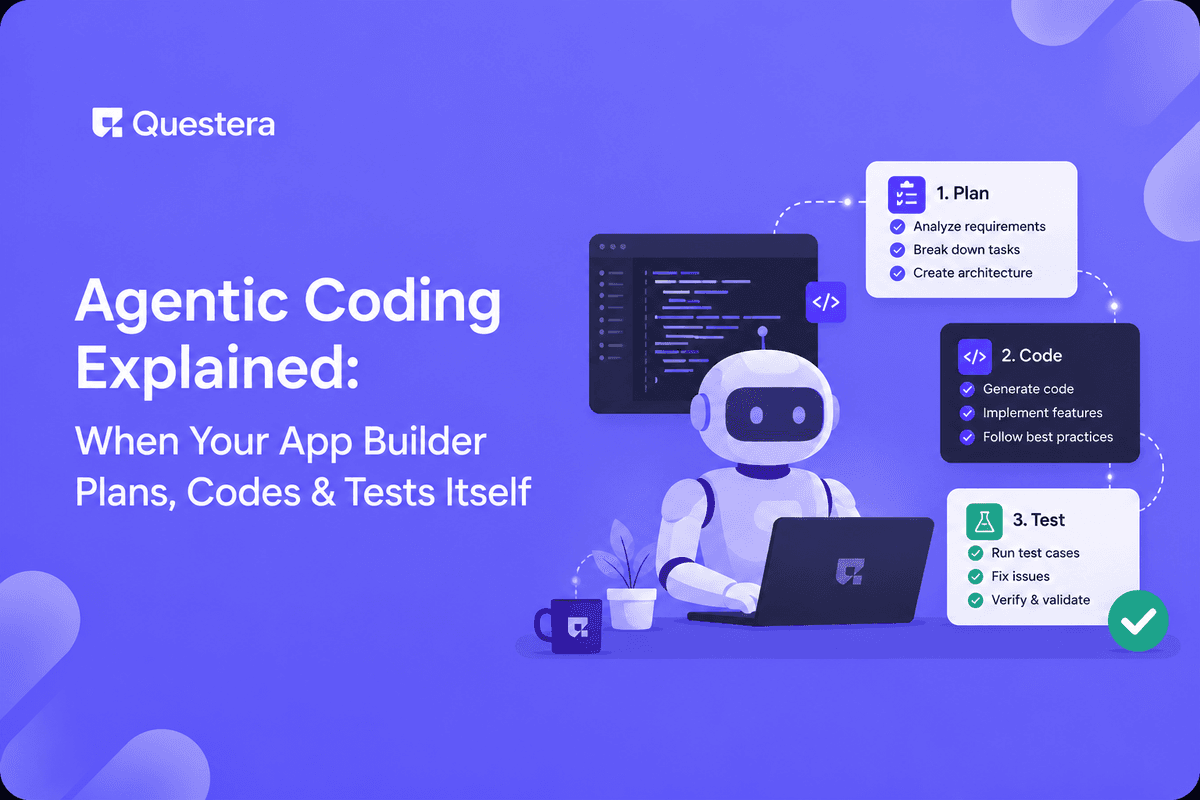
2025 brought agentic coding into the mainstream. Instead of one-shot generation, the AI app builder plans the task, writes code, runs tests, observes results, fixes failures, and continues iterating until the task is done. The agent makes decisions during the loop — when to refactor, when to test, when to retry, when to ask for clarification. The human supervises rather than micromanages. By 2026, agentic coding is standard. Greta runs agentic loops for complex tasks. Cursor Agent autonomously implements features. Claude Code handles multi-step terminal tasks. This guide covers what agentic coding actually is, what it does well, what it still struggles with, the realistic workflow, and how it changes the role of the human developer.
What Agentic Coding Actually Is
Agentic coding is a loop where an AI agent (typically a language model with tool use) executes multi-step tasks autonomously. The agent has access to tools — read files, write files, run commands, run tests, search the codebase, query documentation. Given a task, the agent breaks it down, executes steps, observes results, and adapts.
The Core Loop
- Receive task from user ('add subscription cancellation flow')
- Plan: break task into steps (read existing code, design flow, implement UI, wire to Stripe, test)
- Execute step: write/modify code, run command, run test
- Observe: read output, parse test results, identify issues
- Decide: continue to next step, retry with different approach, ask user for clarification
- Loop until task is complete or stuck
- Report results to user with summary of what was done
What Makes It 'Agentic'
- Multi-step autonomy — agent decides intermediate steps, not just final code
- Tool use — reads files, runs commands, queries docs
- Self-correction — observes failures and adapts
- Goal-oriented — works toward completion, not just one-shot output
- Bounded by tools and reasoning, not just text generation
Examples of Agentic Coding Tasks
Building a New Feature End-to-End
- Task: 'Add user invitation to teams feature'
- Agent reads existing User and Team models
- Designs Invitation model and flow
- Implements API endpoints and UI components
- Wires email sending; adds tests
- Runs tests; fixes failures
- Reports completion with summary
Debugging an Issue
- Task: 'Payments are failing for European customers'
- Agent reads payment code; examines recent error logs
- Identifies likely cause (currency code mismatch)
- Implements fix; adds test case for European payment scenario
- Verifies test passes; reports findings
Migrating Between Approaches
- Task: 'Migrate from useEffect to React Query for data fetching'
- Agent identifies all useEffect data fetching
- Refactors each to React Query; updates dependent code
- Runs tests to verify nothing broke; iterates on failures
Performance Optimization
- Task: 'Dashboard is loading slowly'
- Agent profiles loading time
- Identifies N+1 query as cause
- Implements eager loading fix; verifies improvement
- Reports before/after metrics
What Agentic Coding Does Well
- Multi-file changes with consistent application
- Tasks where iteration on test results is valuable
- Refactoring across the codebase with verification
- Debugging where the agent can read logs and try fixes
- Feature work that requires touching many files
- Migration tasks (e.g., upgrading library, switching pattern)
- Adding tests to existing code
- Performance investigations with profiling
- Documentation generation that needs to be accurate to code
What Agentic Coding Still Struggles With
- Tasks requiring deep business domain knowledge
- Novel architecture decisions (better to consult human judgment)
- Highly specialized algorithms (cryptography, performance-critical paths)
- Tasks crossing organizational boundaries (when policy or tradeoffs matter)
- Long-running tasks where context exceeds reasonable session
- Decisions about what NOT to build
- Code review for subtle correctness issues
- Security review for non-obvious vulnerabilities
- Knowing when to stop and ask vs continue iterating
The Realistic Agentic Workflow
Step 1: Frame the Task Well
- Clear goal stated upfront
- Constraints mentioned ('don't break existing tests')
- Success criteria explicit ('feature works for invited users')
- Acceptance signals ('tests pass; manual test of flow works')
- Better task framing = better agentic results
Step 2: Let the Agent Work
- Agent plans and executes
- Watch progress; don't micromanage
- Trust the loop within reasonable bounds
- Stop if it goes off track; redirect with new context
Step 3: Review the Result
- Read the agent's summary of what was done
- Run the feature manually
- Check tests passed
- Review code for quality (not just correctness)
- Don't blindly accept; supervision still matters
Step 4: Iterate or Ship
- Issues found → frame next iteration
- All good → ship
- Don't keep the loop running indefinitely; clear endings matter
Cost and Time Considerations
- Agentic loops use more model tokens than one-shot generation
- Cost per task higher than single prompt
- Time per task longer than single prompt (multiple steps)
- But total productivity higher — fewer back-and-forth cycles with human
- Net: pay more per task; do more tasks per hour
- ROI is usually positive for non-trivial tasks; one-shot still fine for trivial
When Agentic vs One-Shot Makes Sense
Use Agentic For
- Feature work touching multiple files
- Refactoring across the codebase
- Debugging where iteration matters
- Migration tasks
- Adding tests to existing code
- Anything requiring read-modify-verify loop
Use One-Shot For
- Simple component generation
- Boilerplate scaffolding
- Documentation snippets
- Quick prototypes
- Code review (model reads; suggests; you decide)
- Anything short and self-contained
Tools That Do Agentic Coding Well
- Greta — Agentic loops for full SaaS app generation and feature work
- Cursor Agent — IDE-native agentic coding
- Claude Code — Terminal-native agent
- Aider — Open-source CLI agent
- Windsurf Agent — Codeium's agentic IDE
- GitHub Copilot Agent — emerging in 2025-2026
- Each has different strengths and ergonomics
The Human's Evolving Role
- From writing every line → to specifying tasks well
- From implementing → to reviewing and judging
- From debugging step-by-step → to debugging strategically
- From keeping context in head → to providing context clearly
- From technical work → toward product and business judgment
- Engineering judgment still matters; the application of it changes
Common Mistakes
- Treating agentic coding as fully autonomous — Supervision matters. Review results.
- Vague task framing — Agent plans based on what you said. Vague tasks produce vague results.
- Letting agent run indefinitely — Set bounded scope; intervene when off track.
- Skipping the review — Agent's summary needs human verification.
- Using agentic for trivial tasks — Wastes time and tokens. One-shot is fine for simple work.
- Blindly accepting agent output — Same risks as accepting AI-generated code generally.
- Skipping tests — Agent runs tests in the loop; if tests aren't there, agent has no signal to fix.
- Forgetting about cost — Agentic loops use more tokens. Monitor usage.
- Treating it as silver bullet — It accelerates many tasks but doesn't replace engineering judgment.
- Skipping context — Agents work better with relevant context. Provide it.
Frequently Asked Questions
Is agentic coding the same as AI agents?
Agentic coding is the application of agent patterns to coding tasks. 'AI agents' is the broader category (agents for many tasks). Agentic coding specifically refers to multi-step autonomous code work.
Can agentic coding replace developers?
No, not fully. It accelerates many tasks and reduces the human role from implementing every line to supervising and judging. Engineering judgment, product decisions, architecture, and complex problem-solving still require humans. The role shifts; doesn't disappear.
How much should I trust agentic output?
Same as any AI-generated code — verify before shipping. Review the agent's summary. Run the feature manually. Check tests. Don't blindly accept; don't excessively distrust. Match supervision to task stakes.
What if the agent goes off track?
Stop it. Provide new context. Restart with clearer task framing. Don't let runaway loops continue indefinitely. Cost and time both compound when the loop is unproductive.
Does agentic coding need MCP?
Not strictly. Many agentic systems use direct tool integration without MCP. But MCP is becoming the standard way to expose tools to agents; tools built on MCP work across multiple agents.
How long do agentic tasks typically take?
Varies wildly. Simple multi-step tasks: minutes. Complex feature implementations: 15-60 minutes. Debugging investigations: variable. Long-running tasks may need to be broken down further.
Agentic coding is when AI app builders move from one-shot generation to multi-step autonomous loops — plan, code, test, observe, fix, continue. Mainstream in 2026. Does well: multi-file changes, refactoring, debugging with iteration, migration tasks, adding tests. Struggles with: novel architecture, deep domain knowledge, decisions about what NOT to build. Workflow: frame task well, let agent work, review result, iterate or ship. If you're using AI app builders in 2026 and haven't worked with agentic capabilities, try them this week. Pick a moderate task, frame it clearly, let the agent work, review the result. The future of development is collaborative — human judgment paired with agentic execution.





© 2026 Questera
Follow in Google