






9 Ways AI Tools Reduce Technical Debt

TL;DR
- AI tools help reduce technical debt by detecting issues early
- AI tools for technical debt improve code quality and consistency
- Automation enables continuous technical debt reduction
- AI reduces maintenance effort and engineering overhead
- Teams gain higher velocity and long-term system stability
Introduction: Why Reducing Technical Debt Is a Leadership Imperative
Software technical debt is no longer a purely engineering concern; it is a business risk. As systems scale, unresolved debt directly impacts delivery velocity, platform stability, security posture, and ultimately customer experience. For SaaS companies and enterprises alike, the inability to reduce technical debt systematically often leads to slower innovation and rising operational costs.
Traditional approaches to technical debt management, manual reviews, periodic refactoring initiatives, and backlog grooming are increasingly insufficient. They rely heavily on human judgment, are difficult to scale, and often occur too late to prevent compounding effects.
This is where modern AI tools for technical debt are reshaping best practices. By applying machine learning and pattern recognition across codebases, development workflows, and historical data, AI enables continuous, data-driven technical debt reduction rather than reactive cleanup.
This article outlines nine concrete ways AI tools help reduce technical debt, with a focus on enterprise and SaaS environments where scale, reliability, and long-term maintainability are critical.
Got an idea? Build it now!
Just start with a simple Prompt
Get Started Today


Understanding Software Technical Debt and Why It Grows
Before we talk solutions, let’s ground ourselves.
Software technical debt refers to the long-term cost of short-term decisions. You ship faster today, but you pay later in bugs, slow development, and fragile systems.
Common Causes of Technical Debt
- Rushed MVPs
- Poor documentation
- Copy-paste coding
- Legacy dependencies
- Lack of testing
- Knowledge silos
These causes of technical debt are not signs of bad developers; they’re signs of real-world pressure. The challenge is finding scalable ways to manage and reverse them.
That’s exactly where AI in software maintenance changes the game.
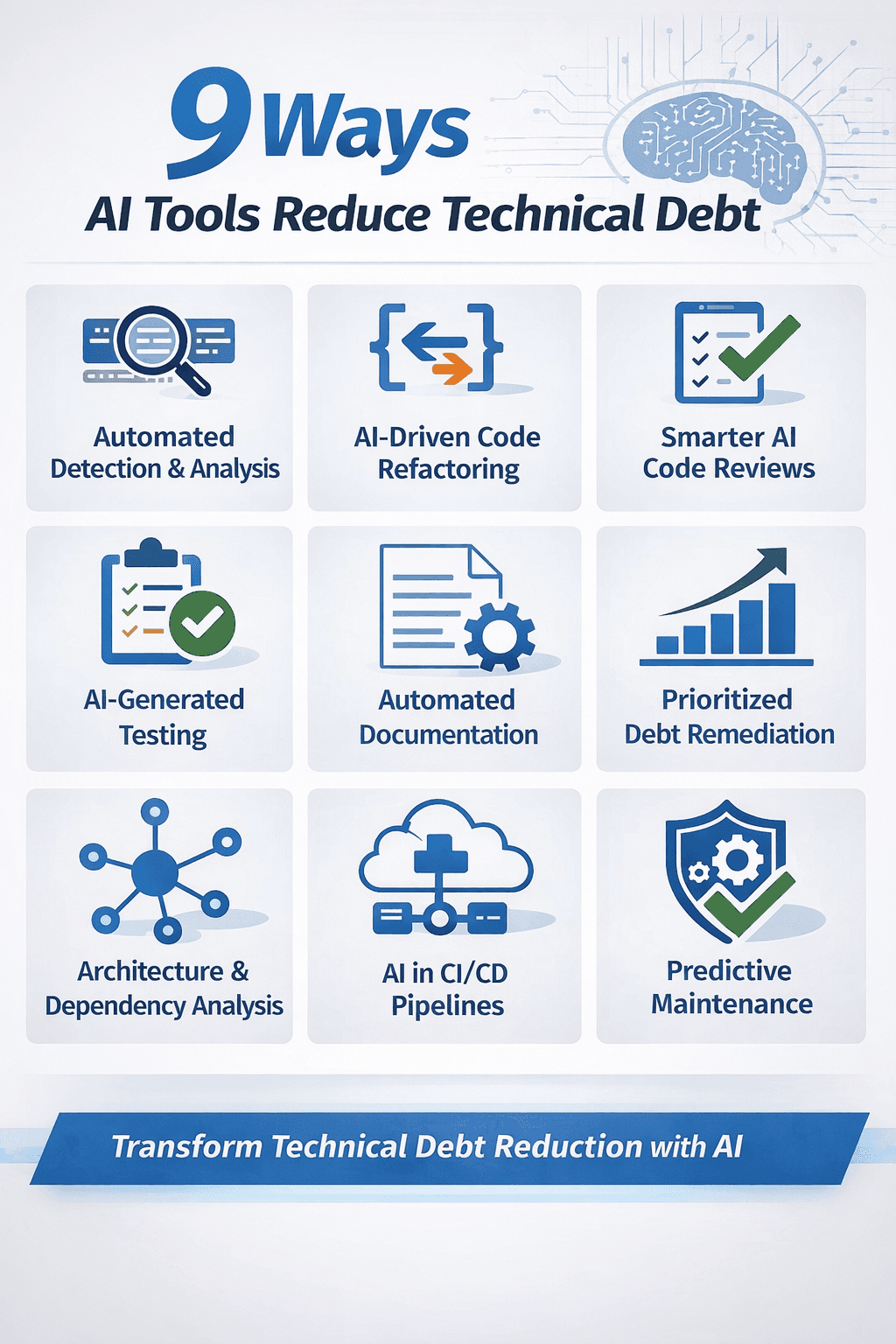
1. How AI Tools for Technical Debt Detect Problems Early
One of the hardest parts of technical debt management is visibility. You can’t fix what you can’t see.
AI Tools for Technical Debt Provide Continuous Code Analysis
AI-powered systems can scan entire codebases, far faster and more consistently than humans. They identify:
- Code smells
- Complexity spikes
- Duplicate logic
- Risky dependencies
Instead of discovering issues months later, teams can reduce technical debt at the moment it starts forming.
This proactive approach is a major leap forward in technical debt reduction.
2. Reduce Technical Debt With AI-Powered Code Reviews
Manual code reviews are valuable, but also inconsistent. Review quality depends on time, focus, and experience.
AI Powered Code Quality Tools Add Consistency
AI-assisted reviews act like an always-on senior engineer:
- Flagging anti-patterns
- Enforcing standards
- Catching risky shortcuts
By pairing humans with AI tools for technical debt, teams dramatically improve review quality while reducing reviewer fatigue.
That’s a win-win for long-term technical debt reduction.
3. Technical Debt Reduction Through Cleaner Code Generation
Bad code at the start becomes expensive code later.
AI Helps Reduce Technical Debt at the Source
Modern AI coding assistants don’t just autocomplete,they suggest:
- Cleaner patterns
- Better abstractions
- Safer defaults
By generating higher-quality first drafts, teams can reduce technical debt before it ever reaches production. This is one of the most underrated benefits of AI in software maintenance.
4. AI-Driven Refactoring Makes Legacy Code Safer
Refactoring is scary. Touching old code often feels like pulling a thread from a sweater,everything might unravel.
Technical Debt Reduction With AI-Guided Refactoring
AI tools analyze structure, dependencies, and usage patterns to suggest safer refactors:
- Breaking down large functions
- Reducing coupling
- Improving readability
This lowers the risk barrier and makes it easier to reduce technical debt incrementally instead of postponing it indefinitely.
5. AI Tools for Technical Debt Improve Test Coverage
Missing or outdated tests are a hidden form of debt.
How AI Helps Reduce Technical Debt in Testing
AI-powered testing tools can:
- Generate test cases automatically
- Identify untested paths
- Predict failure-prone areas
Better test coverage means fewer regressions, less firefighting, and stronger technical debt reduction over time.
Think of tests as insurance,and AI helps you stop underinsuring.
6. Reduce Technical Debt by Automating Documentation
Poor documentation doesn’t break builds,but it slows everything else down.
AI in Software Maintenance Improves Knowledge Sharing
AI can generate:
- Function-level explanations
- API documentation
- Architectural summaries
This reduces onboarding friction and prevents knowledge loss, two silent drivers of software technical debt.
Documentation automation is one of the simplest ways to reduce technical debt without touching production code.
7. Technical Debt Reduction Through Smarter Prioritization
Not all debt is equal. Fixing the wrong things wastes time.
AI Tools for Technical Debt Help You Fix What Matters
AI can rank issues based on:
- Usage frequency
- Business impact
- Risk exposure
This allows teams to focus on changes that deliver real value, instead of cosmetic cleanup. Strategic prioritization is the backbone of effective technical debt management.
8. Reduce Technical Debt With Architectural Insight From AI
Some debt isn’t in lines of code; it’s in structure.
How AI Powered Code Quality Tools Spot Structural Debt
AI can analyze:
- Dependency graphs
- Coupling patterns
- Module boundaries
By highlighting architectural weaknesses early, teams can reduce technical debt before it becomes systemic and expensive to fix.
This is where technical debt reduction shifts from reactive to strategic.
9. Continuous Monitoring Helps Reduce Technical Debt Over Time
One-off audits don’t work. Debt creeps back in.
AI Tools for Technical Debt Enable Continuous Prevention
By integrating AI into CI/CD pipelines, teams get:
- Real-time feedback
- Automatic quality gates
- Ongoing visibility
This transforms technical debt reduction into a continuous habit rather than a painful cleanup sprint.
Technical Debt Reduction in Practice: Real-World Impact From Research and Industry
Recent research and enterprise adoption confirm that AI-driven technical debt reduction delivers measurable value. Rather than theoretical benefits, AI tools for technical debt now demonstrate clear improvements in maintainability, productivity, and system stability. For organizations managing growing software technical debt, this evidence positions AI as a practical, scalable solution.
How AI Tools for Technical Debt Reduce Structural Complexity
Empirical studies show that AI-powered refactoring directly addresses core causes of technical debt, including excessive complexity and tight coupling. A 2025 analysis of Graph Neural Network–based refactoring reported reductions of up to 35% in complexity and 33% in coupling across large codebases. These structural improvements enable teams to reduce technical debt at the architectural level, rather than relying on incremental fixes.
AI Tools for Technical Debt Deliver Measurable Business Outcomes
Organizations adopting AI tools for technical debt consistently report productivity gains and cost efficiencies. Industry data indicates improvements of up to 50% in developer productivity and roughly 33% reductions in project costs, along with more stable releases. These results highlight the role of technical debt management as a driver of operational performance in SaaS and enterprise environments.
AI in Software Maintenance Improves Engineering Focus
By automating refactoring, testing, and code reviews, AI in software maintenance reduces the effort required to manage accumulated software technical debt. Engineering teams spend less time on reactive maintenance and more time on product development and architectural improvements, making technical debt reduction compatible with rapid delivery.
How Greta Helps Reduce Technical Debt at the MVP and Growth Stages
Greta is an example of how modern AI platforms can support technical debt reduction from the earliest stages of development. By generating structured, full-stack application logic from high-level intent, Greta helps teams avoid many early causes of technical debt, such as rushed architecture, inconsistent patterns, and undocumented logic.
For startups and SaaS teams, this approach reduces the maintenance burden typically introduced during MVP development. Instead of accumulating fragile shortcuts, teams can reduce technical debt by starting with cleaner abstractions and more consistent structure, making long-term technical debt management easier as the product scales.
This aligns closely with the broader role of AI in software maintenance, where prevention is more effective than remediation.
Sustained Technical Debt Reduction Reduces Long-Term Risk
Organizations that embed AI into their workflows experience lasting benefits, including lower defect rates and improved scalability. Continuous monitoring through AI powered code quality tools helps prevent recurring technical debt examples and ensures debt management remains proactive rather than episodic.
Conclusion
Technical debt isn’t a failure; it’s a reality of building software in the real world. What *is* optional is letting it spiral out of control.
With modern AI tools for technical debt, teams can finally reduce technical debt in a proactive, continuous, and scalable way. From cleaner code generation to smarter prioritization and safer refactoring, AI reshapes how technical debt reduction actually works in practice.
The future of AI in software maintenance isn’t about replacing engineers. It’s about giving them superpowers, so they can build faster today without paying for it tomorrow.
Got an idea? Build it now!
Just start with a simple Prompt
Get Started Today
FAQs
1. What is technical debt in software development?
Software technical debt is the long-term cost of shortcuts taken during development that slow future progress.
2. Can AI eliminate technical debt?
No, but AI tools for technical debt can dramatically reduce and prevent it when used consistently.
3. How early should teams start technical debt reduction?
As early as possible. Prevention is far easier than cleanup.
4. Are AI powered code quality tools safe for production systems?
Yes, when used with human oversight and proper testing.
5. What’s the biggest benefit of AI in technical debt management?
Visibility. AI helps teams see problems early and act before debt becomes expensive.
Ready to be a
10x Marketer?
See it in action



© 2026 Questera
Follow in Google