






7 AI Coding Trends to Watch This Year in 2026
This year marks a turning point for software development. AI is no longer just a convenience for writing snippets faster; it is reshaping how developers think, plan, and build software from the ground up. The AI coding trends this year reveal a deeper shift: coding is becoming more collaborative, strategic, and intelligent.
Instead of focusing only on syntax and speed, developers are now working with AI systems that understand context, architecture, and intent. These AI development trends are redefining productivity, reducing repetitive work, and allowing developers to focus on higher-level problem-solving.
As we move toward 2026, the future of AI coding is being shaped by smarter tools, new workflows, and a redefinition of what it means to be an AI developer. This blog explores the top AI coding trends you need to understand right now, and how tools like Greta are helping developers stay ahead.
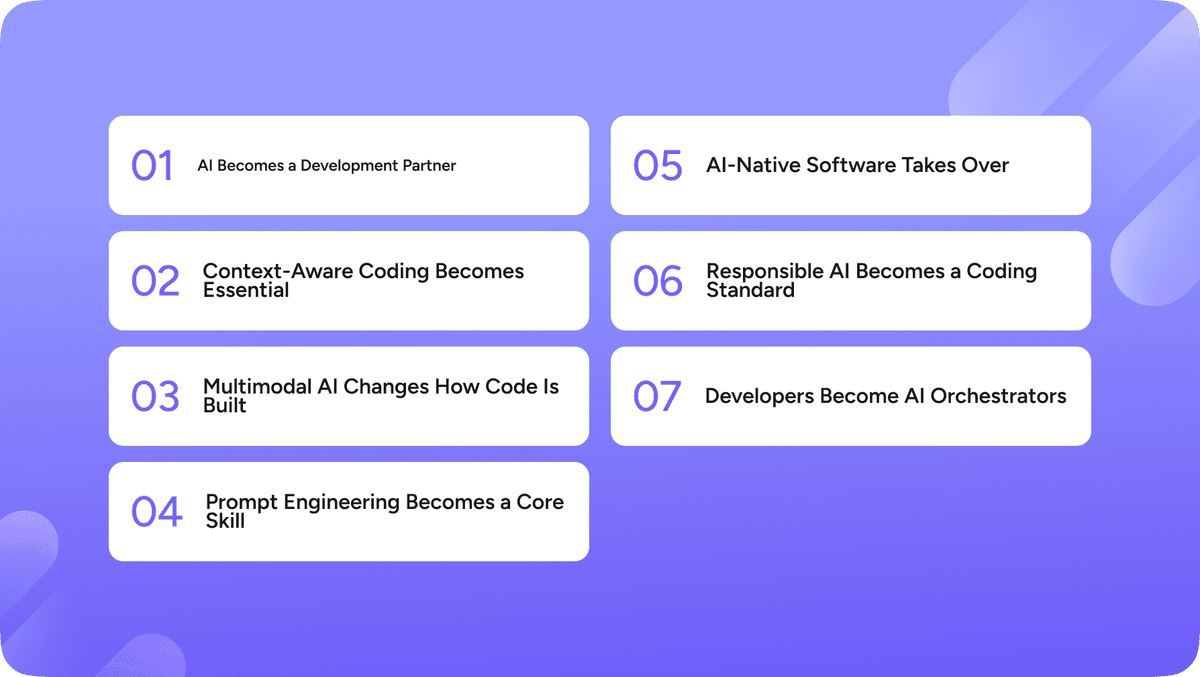
Trend 1: AI Becomes a Development Partner
From Assistance to Collaboration
One of the most important AI coding trends in 2026 is the shift from AI as a passive assistant to AI as an active development partner. Instead of only responding to commands, AI now anticipates needs, suggests improvements, and helps with decision-making. About 84% of developers use or plan to use AI tools in their development workflow, up from 76% last year, and 51% use them daily—showing AI has become mainstream in coding practices.
- Recommend better architectures
- Identify performance risks early
- Suggest cleaner, scalable solutions
This marks a major leap in AI programming trends.
Why Developers Care
Developers save time not just writing code, but thinking through problems. Greta, for example, works as a tool that helps developers reason through solutions instead of blindly generating code. This is a major shift in AI developer trends toward smarter collaboration.
Trend 2: Context-Aware Coding Becomes Essential
Understanding the Bigger Picture
Modern AI software trends are focused on context. AI systems are now capable of understanding entire codebases, project history, and development patterns, not just isolated lines of code.
- Follow existing coding conventions
- Prevent breaking changes
- Align new code with existing logic
This is becoming a baseline expectation in the AI coding industry trends.
Build this with a prompt on Greta.sh — describe the app, Greta writes and deploys it.Greta as a Context-Aware Tool
Greta is designed to retain project-level understanding, which means developers don’t have to repeat themselves. This reflects where AI coding trends this year are headed: persistent, intelligent systems that grow with your project. In 2026 forecasts, 97% of developers say their organizations allow AI coding tools, and 92% use AI in at least part of their workflow.
Trend 3: Multimodal AI Changes How Code Is Built
Coding Beyond Text
Another major shift in trends in AI programming is multimodal AI. Developers can now interact with AI using diagrams, descriptions, screenshots, and logs, not just written prompts.
- Convert ideas directly into code
- Bridge the gap between design and development
- Reduce misunderstandings between teams
Why This Matters
Multimodal tools are accelerating development and reshaping AI development trends by making coding more intuitive and collaborative. The latest AI coding trends show that the future is not just typed, it’s visual and conversational.
Trend 4: Prompt Engineering Becomes a Core Skill
Prompts as Programming Logic
Prompt engineering is no longer a side skill. It is quickly becoming one of the most important AI programming trends. Developers are now treating prompts like reusable, structured assets.
- Control AI behavior
- Improve consistency
- Reduce errors
How Tools Are Adapting
Greta helps developers refine and reuse prompts effectively, turning them into long-term productivity tools. This reflects the growing maturity of AI coding trends 2026, where prompts are part of the architecture, not experiments. Across surveys, 82% of developers use AI coding tools either daily or weekly, reflecting that AI isn’t just experimental—it’s routine.
Trend 5: AI-Native Software Takes Over
Designing Software for AI from Day One
One of the most forward-looking AI coding industry trends is AI-native development. Instead of adding AI to existing software, teams are designing systems where AI is a core component from the start.
- Adapt dynamically
- Learn from usage
- Improve continuously
This represents a major evolution in AI software trends.
Want to try one of these? Start on Greta.sh — no setup, no boilerplate — just a prompt.Greta’s Role in AI-Native Development
Greta supports AI-native workflows by helping developers design systems where AI actively participates in decision-making. This aligns with the long-term future of AI coding.
Trend 6: Responsible AI Becomes a Coding Standard
Ethics Moves into the Codebase
Responsible AI is no longer just a policy topic, it’s now part of everyday development. One of the most serious AI coding trends this year is the integration of governance, transparency, and accountability into AI-generated code.
- Understand AI decisions
- Reduce bias
- Ensure explainability
This is shaping modern AI developer trends, especially in enterprise environments.
Tools Are Catching Up
Platforms like Greta are beginning to support responsible AI practices, helping developers make informed and ethical decisions during development.
Trend 7: Developers Become AI Orchestrators
A New Role for Developers
The final trend shaping AI programming trends is the changing role of the developer. Developers are no longer just writing code, they are orchestrating systems where AI plays an active role.
- Guiding AI outputs
- Validating decisions
- Designing workflows
This shift defines the most advanced top AI coding trends today.
Greta and the New Developer Mindset
Greta empowers developers to operate at this higher level, managing complexity while staying in control. This reflects where AI coding trends 2026 are headed: smarter humans working with smarter machines.
Ready to ship? Open Greta.sh — your idea → a working app, in one chat.What These AI Coding Trends Mean for the Future
The AI coding trends this year clearly show that software development is becoming more strategic and less mechanical. AI is not replacing developers, it is elevating them.
- Embrace AI-native design
- Invest in context-aware tools
- Treat AI collaboration as a core skill
The future of AI coding belongs to developers who learn how to think alongside AI, not compete with it.
Final Thoughts on AI Coding Trends 2026
These latest AI coding trends are not temporary shifts. They represent a long-term transformation in how software is built, maintained, and evolved.
By understanding these AI development trends and using intelligent tools like Greta, developers and teams can stay ahead of the curve, build better software, and remain competitive in a rapidly changing industry.
The future of coding is already here, and it’s powered by intelligent collaboration.
FAQs
1. What are the top AI coding trends this year?
The top AI coding trends this year include AI development partners, context-aware coding, multimodal AI, prompt-driven development, and AI-native software design.
2. How will AI coding trends 2026 affect developers?
AI coding trends 2026 will shift developers toward orchestration, decision-making, and system design rather than manual coding.
3. What skills matter most in AI programming trends?
Prompt engineering, AI literacy, system thinking, and validation of AI-generated code.
4. How do AI development trends improve software quality?
They reduce errors, improve consistency, and speed up testing and optimization.
5. Why is Greta useful in modern AI coding?
Greta helps developers maintain context, refine AI outputs, and make smarter coding decisions.





© 2026 Questera
Follow in Google